
Reviewed · TOURS IN SIEM REAP
2 Days Discover Angkor Wat Complex and Cambodia’s Villages Tours
Angkor Wat is only the beginning here. Over two early starts, you move from Cambodia’s grandest temple complex to the overgrown ruins of Beng Mealea, then out along country roads to stilt houses and fishing life at Kompong Phluk. It gives you a useful mix of famous sights and quieter corners.
I like the private format, which lets your group set a comfortable pace, and I like the range of places packed into two days. Guides such as Praim and Khim are praised for clear English, strong temple knowledge, thoughtful timing, and even helping with photos.
The main catch is cost control. The $235 price covers the vehicle, guide, water, and towels, but temple and lake fees add $69 per person. The 5:00 am start and long walking periods also call for decent energy.
Key points to know before booking
- Two very different days: Day one covers the major Angkor monuments, while day two combines remote Beng Mealea with village and lake visits.
- Private group of up to 10: You travel only with your own party in an air-conditioned SUV or minivan.
- Guide quality matters: Praim and Khim are named guides associated with strong English, useful explanations, flexibility, and photo help.
- Extra fees add up: Angkor admission is $37 per person, Beng Mealea is $10, and Kompong Phluk with the private boat is $22.
- A 5:00 am start: The schedule is built around an early departure, so plan your sleep and breakfast carefully.
- Cold water and towels included: These are small but welcome comforts in Cambodia’s heat.
Why this two-day route works
Many Angkor outings stop after the headline temples. This one keeps going. You get the famous stone faces and jungle roots, but also a less restored temple, rural roads, a stilt village, and Tonle Sap, Cambodia’s great seasonal lake.
That variety is the tour’s strongest feature. Day one is about royal power, religious art, and the scale of the Khmer Empire. Day two shifts toward quieter ruins and present-day life around water. I like that contrast because it keeps Angkor from feeling like a single long sequence of temple courtyards.
The private setup is useful for a route with several stops. Your group can spend more time at a place that catches your interest or move on when you have had enough. You do not have to match the pace of strangers. The vehicle is air-conditioned, and cold drinking water and cold towels are included, which matter after walking through exposed temple grounds.
Still, this is a full program. The listed stop times total several hours of sightseeing each day, not counting driving, meals, or ticket arrangements. You should expect warm weather, uneven surfaces, stairs at some temples, and plenty of walking. The operator asks for moderate physical fitness, a fair warning rather than a minor footnote.
A few more things to do in Siem Reap worth a look
- Siem Reap: Angkor Wat 2-Day Tour with Sunrise and Sunset
★ 4.9 · 4,429 reviews - Angkor 2-Day Sunset & Sunrise Small-Group Tour
★ 5.0 · 2,567 reviews - 2 Days Exclusive Temple Highlights with Sunset and Sunrise Tour
★ 5.0 · 1,157 reviews
Day one at Angkor Wat, Ta Prohm, and Angkor Thom
The first day begins at 5:00 am. That is an early alarm, but it gives the day a strong start and leaves room for the major Angkor sites before the schedule moves on.
Angkor Wat in two hours
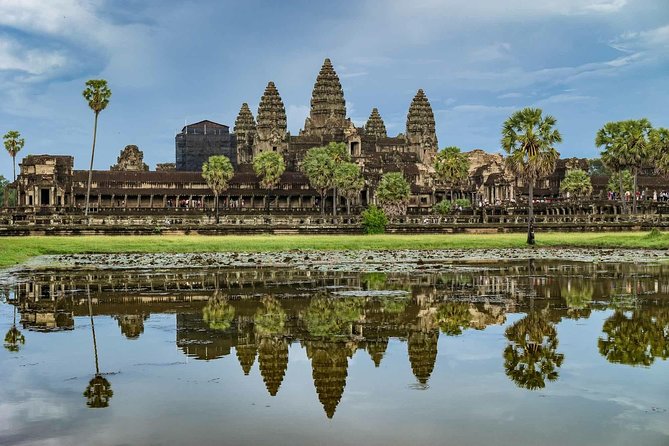
Angkor Wat is the anchor of the first day. Built as a Hindu temple dedicated to Vishnu, it covers a huge site of 162.6 hectares and is one of the world’s largest religious monuments.
Two hours gives you time to grasp the scale and examine the temple’s design, though it is not enough for every corner. Your guide can help turn a vast collection of galleries, towers, and carvings into a story about the Khmer kings and the temple’s religious purpose.
The entrance ticket is not included. Angkor admission costs $37 per person. Keep that in mind when comparing the headline tour price with your real budget.
Ta Prohm and its tree roots
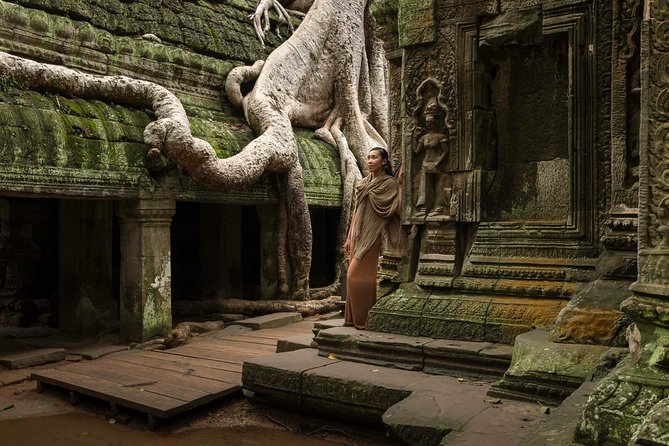
The next major stop is Ta Prohm, scheduled for about one hour. It is famous for the giant trees and thick roots growing through the stonework. The temple also appeared in the film Tomb Raider, which has made it one of Angkor’s most recognizable sights.
Ta Prohm has a different mood from Angkor Wat. Instead of broad scale and formal order, you get broken walls, vegetation, and the sense of a monument being slowly reclaimed by nature. Your guide’s explanations are especially useful here, since the striking tree roots can easily become the whole story if you do not also look at the temple’s layout and carved details.
The time is enough for a focused visit, but not a leisurely one. If you enjoy photography, the private format helps because you can tell your guide when you need a few extra minutes.
Same base, a different kind of day out:
- Angkor Wat Sunrise or Sunset Tour with Guide from Siem Reap
★ 5.0 · 12,109 reviews - Siem Reap: Angkor Wat: Small-Group Sunrise or Sunset Tour
★ 5.0 · 9,444 reviews - From Siem Reap: Kampong Phluk Floating Village Tour by Boat
★ 4.9 · 6,979 reviews - Sunset tour of Kampong Phluk stilts home village on the Tonle Sap
★ 5.0 · 4,865 reviews
Ta Keo, the high temple
Ta Keo receives about 30 minutes. This mountain temple was built by Jayavarman V and rises on a five-stepped pyramid, with five sanctuaries at the top of a structure about 22 meters high.
It is a compact stop, but it adds a different architectural form to the day. Ta Keo feels more like a huge stone pyramid than a low, spreading complex. If climbing or steep steps are difficult for you, take this visit at your own pace and do not treat the short schedule as a reason to rush.
Angkor Thom and the Terrace of the Elephants
Angkor Thom was an ancient Khmer city built around 1181 under King Jayavarman VII. Its square enclosure was surrounded by walls about 8 meters high and extended more than 12 kilometers around the city.
The 30-minute visit introduces the scale of the old urban center. It is worth listening closely here, because the walls and gateways make more sense when your guide explains that this was a city, not simply another isolated temple.
The nearby Terrace of the Elephants also has a 30-minute stop. King Jayavarman VII used the terrace as a viewing platform for royal ceremonies and victories. The carved elephants give the terrace its name, but the broader point is its role as a public and political space.
These shorter stops work best as part of the larger Angkor Thom story. Do not expect a long, detailed exploration of every carving. Instead, use them to understand how temples, walls, terraces, and royal display fitted together.
Bayon and its famous faces
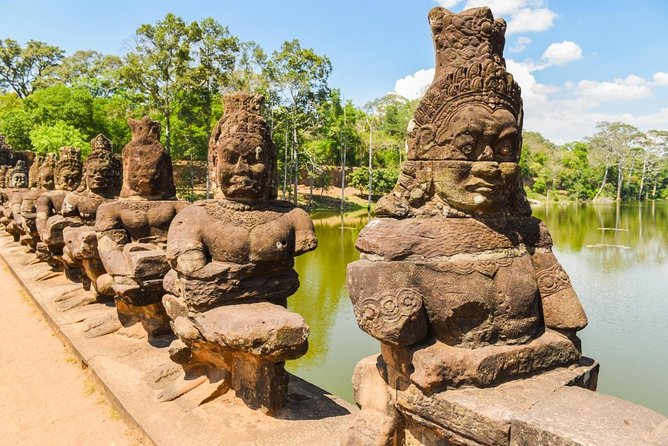
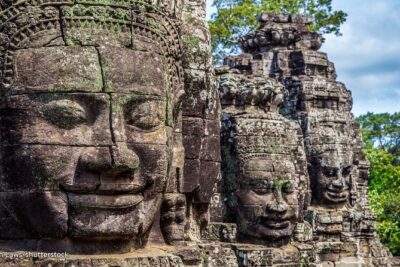
The final major temple on day one is Bayon, with about one hour scheduled. It is known for its stone faces, often described as smiling faces or the faces of Buddha.
Bayon can be visually confusing at first. Towers, corridors, and faces overlap in a crowded arrangement. This is where the guide’s skill makes a real difference. Praim is praised for explaining places in clear English and for answering questions without overloading the visit with detail. Khim is also praised for strong explanations of the temples and their past.
The first day is temple-heavy, but not repetitive. Angkor Wat gives you monumental scale, Ta Prohm gives you jungle-covered ruins, Ta Keo offers a pyramid temple, Angkor Thom shows the old city, and Bayon closes with its remarkable faces.
Day two at Beng Mealea and the Tonle Sap villages
Day two changes pace and setting. You leave the central Angkor circuit for Beng Mealea, then continue toward Kompong Phluk and Tonle Sap.
Beng Mealea, two hours among unrestored ruins
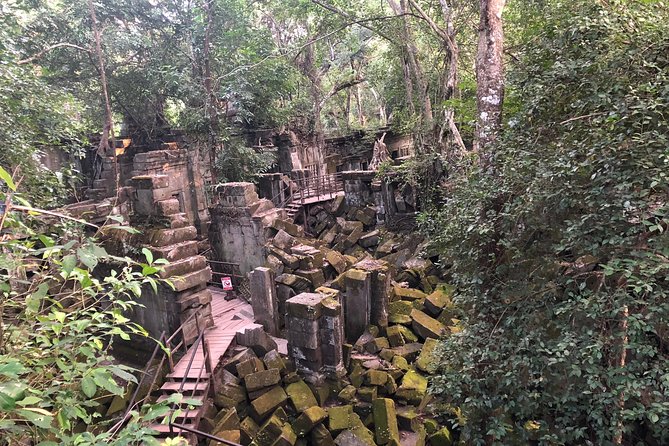
Beng Mealea receives about two hours, making it the longest single temple stop of the second day. The name means Lotus Pond. It was built as a Hindu temple, though some carvings show Buddhist subjects.
The temple is made largely of sandstone and remains largely unrestored, with trees and heavy brush growing among the ruins. That lack of repair is the main reason to visit. You see a monument in a more broken, tangled condition than the polished headline sites.
Beng Mealea also demands care underfoot. The rough state of the site means you should expect uneven ground and a less straightforward route through the ruins. The two-hour period gives you time to look around without treating the temple as a quick photo stop, but the physical demands are real.
The entrance fee is separate at $10 per person. This is one of the clearest examples of the tour’s added cost, so include it in your calculations before booking.
Kompong Phluk and life on stilts
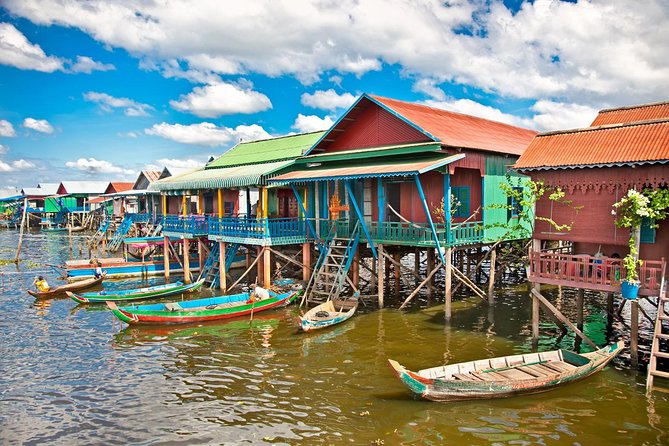
Kompong Phluk is a commune and village in Siem Reap Province built on stilts beside Tonle Sap. Its name means Harbor of the Tusks, and the local community depends largely on fishing.
This stop brings the tour closer to everyday Cambodian life. Instead of royal temples, you see a community shaped by water levels, boats, and fishing. The stilt construction is not just a visual curiosity. It reflects the practical demands of living beside a lake that changes with the seasons.
You are scheduled to spend about two hours here. The visit includes an admission fee and private boat ride, priced at $22 per person. That boat cost is not covered in the $235 group price.
Conditions at the village can vary with the season, particularly because Tonle Sap is seasonally inundated. The tour description does not promise one fixed village view year-round, so go with an interest in how the water shapes local life rather than expecting a single postcard scene.
Tonle Sap, the great freshwater lake
The final lake stop lasts about one hour. Tonle Sap is the largest freshwater lake in Southeast Asia, connected to the 120-kilometer Tonle Sap River.
This is a useful finish because it places the village visit in a larger setting. Kompong Phluk is not an isolated attraction. It is part of a broad water system that supports fishing communities and changes in size with the seasons.
The lake portion is less about monuments and more about observation. You have time to take in the water, the boats, and the connection between the village and its environment. If your main interest is temple architecture, this may feel like a slower ending. If you want Cambodia beyond the temple zone, it adds real value.
What the $235 group price really covers
The base price is $235 per group of up to 10 people. That can be good value for a full private two-day program, especially for a larger party. Split among 10 people, the tour portion is modest. For a couple or solo traveler, the per-person share is much higher.
The included services are practical:
- Air-conditioned SUV or minivan
- English-speaking guide
- Cold drinking water
- Cold towels
- Private participation for your own group
The required extras total $69 per person:
- $37 for Angkor Wat and the other Angkor temples
- $10 for Beng Mealea
- $22 for Kompong Phluk admission and private boat
Meals, beverages, and personal expenses are also separate. You should therefore compare the full expected spend, not only the advertised group price. The advantage is that the main costs are clear before you go.
For a group that values a private vehicle, guide, and flexible pace, the price can make sense. For a small party seeking the cheapest possible temple visit, a shared tour may cost less, but it will not offer the same private format.
The guide can shape the whole experience
The most important human part of this tour is the guide. Praim is praised for professional planning, clear English, useful explanations, and a friendly approach to questions. He is also known for taking good photos when asked, a handy benefit if you are traveling without someone who can capture the group.
Khim is praised for detailed explanations of the temples and their history. Having the same guide for both days can help the experience feel connected, rather than like two unrelated outings.
The exact guide assignment is not guaranteed in the details provided, so treat Praim and Khim as examples rather than a promise. When you book, it is sensible to confirm who will lead your dates if that matters to you.
Timing, comfort, and practical limits
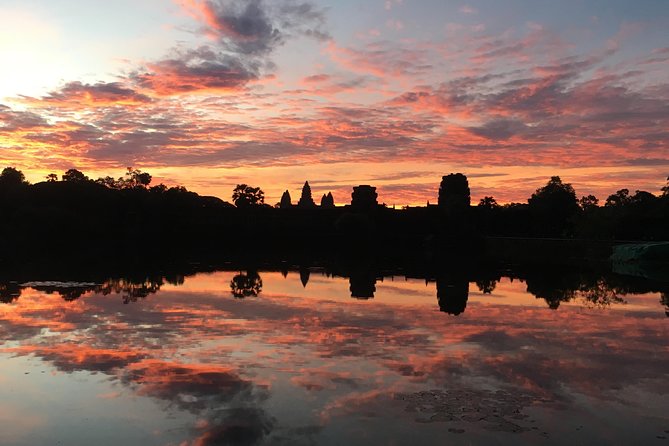
The 5:00 am start is the first major practical issue. You need to be ready early, and the two-day schedule leaves little room for a slow morning. The upside is a full day for the major sites and a strong chance to see the temples before the worst heat of the day.
The air-conditioned vehicle is a real comfort on drives between sites. Cold water and towels help too, but they do not replace lunch, which you must arrange and pay for yourself.
You should be comfortable with moderate physical activity. Ta Keo’s pyramid form, uneven ruins at Beng Mealea, and long temple walks may not suit anyone who needs easy, level access. The tour details do not provide specific accessibility information, so ask before booking if mobility is a concern.
Free cancellation is available up to 24 hours before the local start time. Cancellations or changes made less than 24 hours ahead do not qualify for a refund.
Who should book this experience?
I would choose this tour if you want the major Angkor temples but also want Cambodia’s countryside and lake communities in the same trip. It suits couples, families, and groups of friends who value a private vehicle and do not want to spend two days only at the best-known ruins.
It is also a good fit if you like asking questions. The strongest guide feedback centers on clear explanations, history, flexibility, and help with photos. Those details matter more on a temple route than a simple driver-only service.
I would think twice if you want a slow, relaxed schedule, dislike early mornings, or need every expense folded into one price. The second day is especially full, and the added fees make the final cost notably higher than $235 for each person in a small group.
Should you book the Angkor and villages tour?
Book it if you want a broad two-day picture of Siem Reap: Angkor Wat and Bayon, Ta Prohm’s roots, Angkor Thom’s royal setting, Beng Mealea’s rough ruins, and life around Tonle Sap. The private structure, air-conditioned transport, and strong guide options make the long route easier to manage.
Before paying, add the $69 per-person admission total, budget for food, and make peace with the 5:00 am start. If those points work for you, this is a well-shaped choice for seeing both Cambodia’s ancient monuments and its living water culture.
FAQ
How long is the tour?
The experience lasts approximately two days.
What time does the tour start?
The start time is 5:00 am.
How many people can join the private tour?
The price covers one private group of up to 10 people.
What transport is provided?
You travel in an air-conditioned SUV or an air-conditioned minivan.
Is an English-speaking guide included?
Yes. An English-speaking tour guide is included.
Are temple entrance fees included?
No. Angkor admission costs $37 per person, and Beng Mealea costs $10 per person.
How much does the Kompong Phluk boat and admission cost?
Admission and the private boat ride to Kompong Phluk and Tonle Sap cost $22 per person.
Can I cancel for a full refund?
Yes, if you cancel at least 24 hours before the experience start time. Cancellations made less than 24 hours ahead are not refunded.
Just added in Siem Reap
- 1-Day Angkor Wat Private Tour with Spanish Tour Guide.★ 5.0 · 9 reviews
- Angkor Wat: Small-Group Tour with Balloon Ride and Lunch★ 4.6 · 13 reviews
- Sky Venture Microlight Siem Reap★ 4.9 · 18 reviews
- Angkor Wat plus Balloon Ride with Khmer Lunch★ 5.0 · 46 reviews
- Siem Reap: 3-Hour Ancient Trails Motorbike Tour★ 4.8 · 71 reviews
- Angkor Wat Private Tour in a Tuk Tuk★ 5.0 · 69 reviews
- Angkor Silk Farm & Lotus Silk Farm: Siem Reap Discovery Tour★ 4.8 · 68 reviews
- Angkor Wat Sunrise Tour By E-Bike Experience With Breakfast Included★ 5.0 · 76 reviews
Tours in Siem Reap, compared.
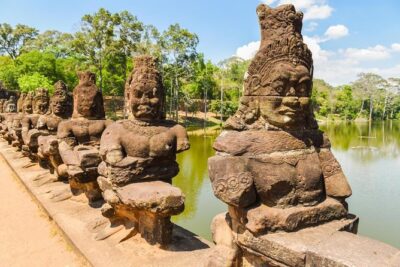
Angkor Wat Sunrise or Sunset Tour with Guide from Siem Reap
Read our review →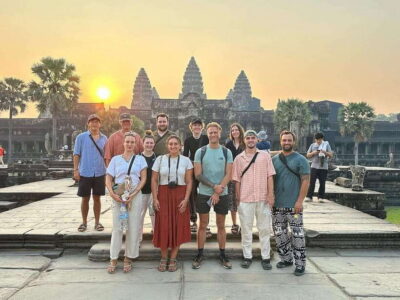
Angkor Wat: Small-Group Sunrise or Sunset Tour
Read our review →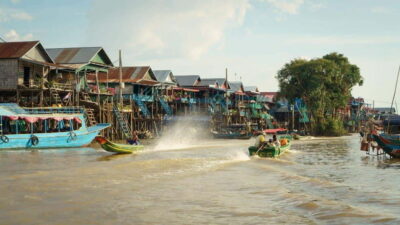
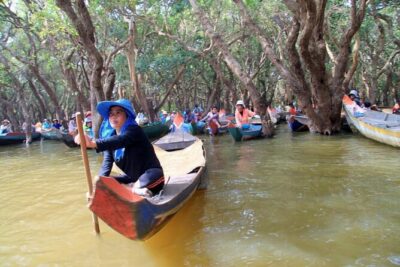
Sunset tour of Kampong Phluk stilts home village on the Tonle Sap
Read our review →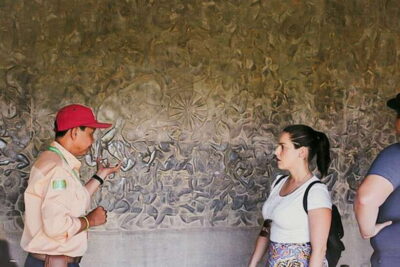
Angkor Wat 2-Day Tour with Sunrise and Sunset
Read our review →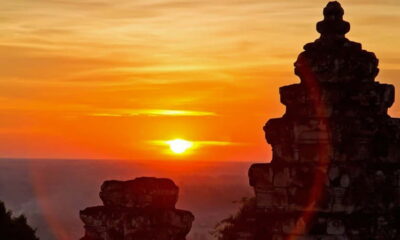
Angkor Wat Sunrise tour with Small – Group and Guide tours
Read our review →
Angkor Wat Highlights and Sunrise Guided Tour from Siem Reap
Read our review →Browse the lists this tour appears in