Reviewed · TOURS IN SIEM REAP
Private Angkor Wat and Lost Temple Jungle Tour
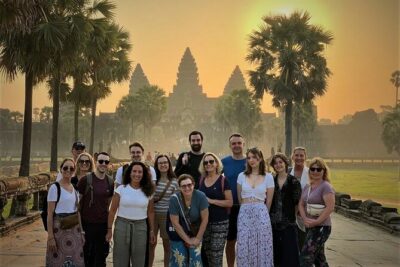
Angkor Wat is only the beginning here. This six-and-a-half-hour private tour strings together the famous temples with quieter stops, including Thommanon and Banteay Kdei. I like the hotel pickup and tuk-tuk transport, and I like having an English-speaking guide to explain the kings, gods, and Buddhist carvings instead of simply pointing at old stones.
The two things I like most are the efficient route and the human touch from guides such as Bon Sith and Mr. Somra, both praised for clear explanations. The main catch is cost: the $40 tour does not include the required $37 one-day Angkor Pass or lunch, so your basic day total is at least $77 per person.
Key points to know
- Six major temple stops: Angkor Wat, Angkor Thom’s South Gate, Bayon, Thommanon, Ta Prohm, and Banteay Kdei.
- Private format: Your group participates alone, with hotel pickup and return in Siem Reap.
- Tuk-tuk transport: The listed package includes a tuk-tuk, English-speaking guide, and bottled water.
- Best-known sights included: You get Angkor Wat, the Tomb Raider temple, and Bayon’s famous faces in one outing.
- Extra cost to budget: The one-day Angkor Pass is $37 per person, and lunch is not included.
- Flexible cancellation: Cancel at least 24 hours before the start time for a full refund.
Why this temple route works in one day
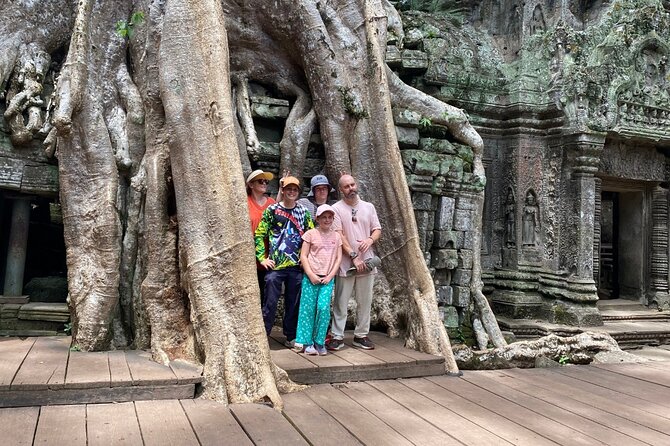
The smart feature of this tour is its mix. You see Angkor Wat, the park’s superstar, but you also visit temples that add scale and variety to the day. Bayon gives you carved faces and royal symbolism. Ta Prohm gives you tree roots and broken galleries. Banteay Kdei offers another Buddhist temple in a related style without simply repeating the same view.
That matters because Angkor can blur together if you visit too many similar ruins in a row. This route shifts between grand courtyards, gates, towers, carvings, and jungle-covered stone. A guide also gives the monuments a human frame by explaining the rulers who ordered them built, especially Suryavarman II and Jayavarman VII.
The private setup is useful if you want to pause for photos, ask questions, or move at your own pace within the scheduled stops. It is also a practical choice for a first visit, since Angkor is spread across a large area and the route takes care of the basic transport.
You should still keep your expectations realistic. Six and a half hours is enough for the main highlights, but it is not enough for every temple in the archaeological park. This is a highlights day, not a slow study of every corridor and inscription.
A few more things to do in Siem Reap worth a look
- Full-Day Angkor Wat Sunrise Private Tour with Guide from Siem Reap
★ 5.0 · 2,920 reviews - Siem Reap: Angkor Wat Private Tuk-Tuk Tour
★ 4.9 · 2,222 reviews - Angkor Wat Private Day Tour from Siem Reap
★ 5.0 · 834 reviews
Angkor Wat: two hours with Cambodia’s biggest name
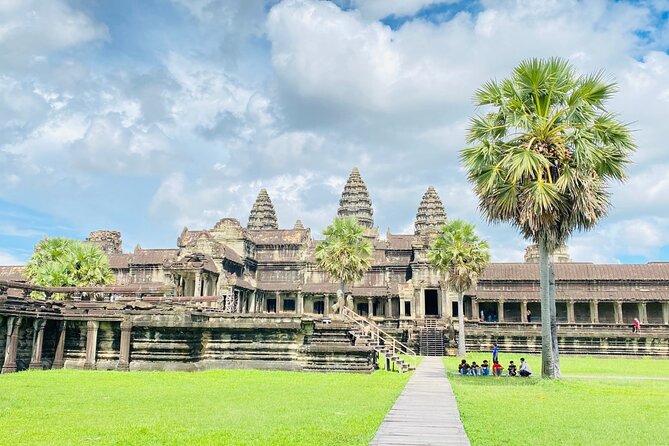
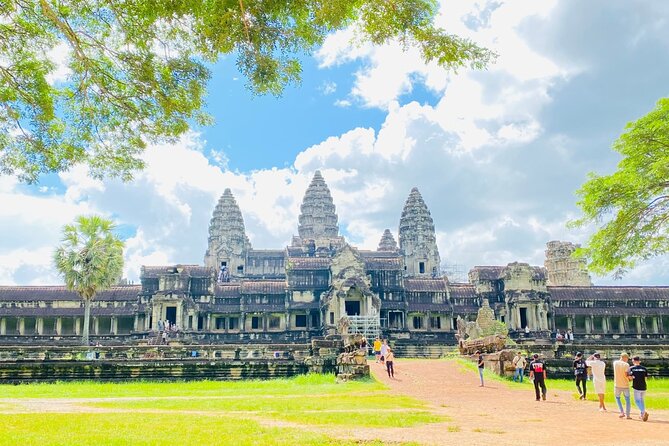
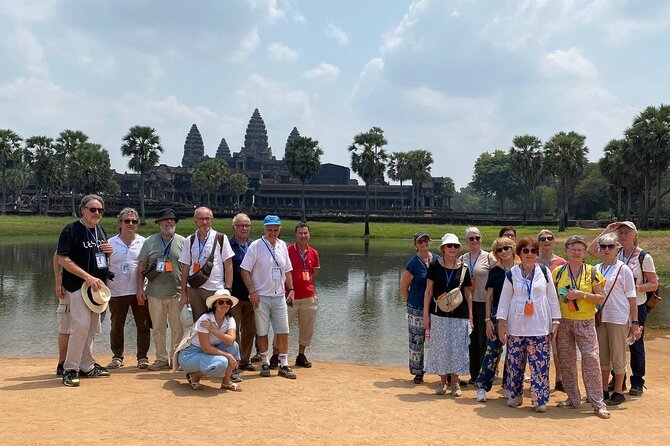
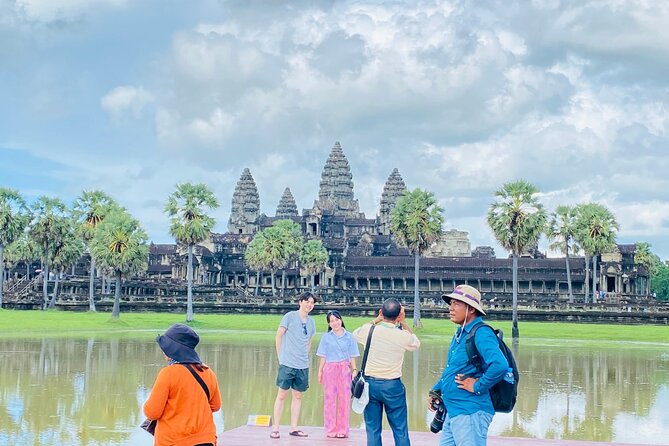
Your longest stop is Angkor Wat, and that is the right choice. Built in the 12th century by King Suryavarman II, it began as a Hindu temple dedicated to Vishnu and later became a Buddhist site. Its scale is the first thing you notice: long galleries, towers, courtyards, and a formal plan designed to impress.
Allow the guide to explain how the temple reflects Khmer ideas about kingship and the universe. Without that context, you may see only a huge stone complex. With it, the towers, galleries, and carved scenes begin to make sense as parts of a carefully planned religious and royal center.
Two hours gives you time to look beyond the famous front view. Pay attention to the reliefs and the way the temple opens through successive spaces. The monument rewards patience, though the amount of walking and standing can make this an intense first stop.
The Angkor Pass is not included. The required one-day ticket costs $37 per person, which is nearly the cost of the tour itself. Add the $40 tour price and your basic admission and transport cost reaches $77 per person before lunch. That is not a bargain-basement day, but it is fair if you value a private guide and door-to-door transport.
Angkor Thom’s South Gate: a short but useful introduction
The South Gate of Angkor Thom gets about 30 minutes. It is a brief stop, yet it helps you understand the scale of the city that contains Bayon. The gate is one of the most recognizable entrances in the park, and its approach gives you an early look at the stone faces and monumental design associated with Angkor Thom.
Do not treat this only as a photo stop. Ask your guide what the gate was meant to communicate and how it relates to the larger city. The guide’s explanations are especially useful here because the structure itself can be easy to rush past.
The drawback is simple: 30 minutes is short. You will not get a long, quiet examination of the gate. Still, the stop breaks up the drive and prepares you for Bayon, which sits at the center of Angkor Thom.
Bayon Temple: one and a half hours among stone faces
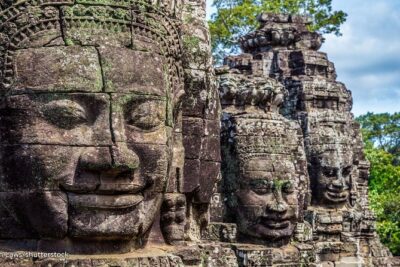
Bayon is the second major anchor of the day. Built in the late 12th or early 13th century as the state temple of King Jayavarman VII, it is associated with Buddhism and is known for its many carved faces.
The temple feels different from Angkor Wat. Angkor Wat is orderly and grand from a distance. Bayon is more enclosed and visually busy, with towers, passages, and faces appearing from different angles. One moment you are studying a carving, and the next a face seems to look across the stonework toward you.
The one-and-a-half-hour visit gives your guide room to discuss Jayavarman VII and the religious shift represented by the temple. This is where a good guide earns the fee. Guides such as Mr. Somra have been praised for explaining both culture and history clearly, while Bon Sith has received similar praise for informative commentary.
Bayon can be confusing without help. Its layers are not always obvious, and the crowded arrangement makes it easy to miss what you are seeing. Keep your attention on the details as well as the famous faces. The temple is more than a single photo point.
Same base, a different kind of day out:
- Angkor Wat Sunrise or Sunset Tour with Guide from Siem Reap
★ 5.0 · 12,109 reviews - Siem Reap: Angkor Wat: Small-Group Sunrise or Sunset Tour
★ 5.0 · 9,444 reviews - From Siem Reap: Kampong Phluk Floating Village Tour by Boat
★ 4.9 · 6,979 reviews - Sunset tour of Kampong Phluk stilts home village on the Tonle Sap
★ 5.0 · 4,865 reviews
Thommanon: a smaller temple with a change of pace
Thommanon receives 30 minutes. It is a Hindu temple built during the reign of Suryavarman II, east of Angkor Thom and north of Chau Say Tevoda. Compared with Angkor Wat and Bayon, it is compact and easier to take in at a glance.
That smaller scale is useful during a full temple day. You get a change of pace and a chance to see a different expression of Khmer temple design without spending another two hours on a vast complex. Your guide can point out how the structure connects to the wider building traditions of the period.
The limitation is that 30 minutes will feel brief if you enjoy architectural details. This is a supporting stop, not the reason to book the tour. Its value comes from giving the main route more variety.
Ta Prohm: roots, ruins, and the Tomb Raider connection
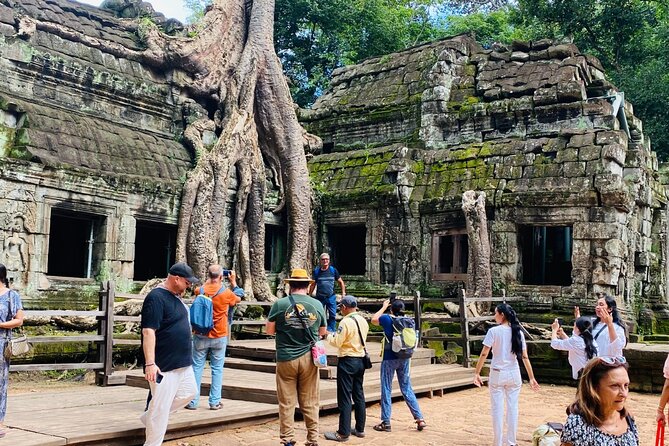
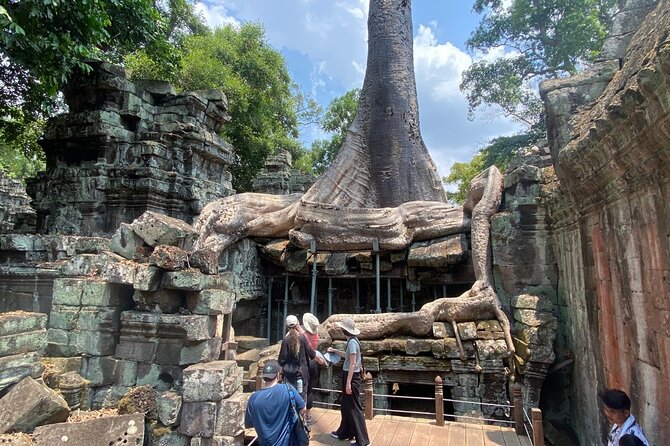
Ta Prohm is the most theatrical stop after Angkor Wat. It is widely known as the Tomb Raider temple because it appeared in the Angelina Jolie film, but its real appeal is not just its screen connection. The temple’s stone galleries and towers have been overtaken by large tree roots, creating the famous image of nature growing across the ruins.
You receive about an hour here. That is enough to see the main character of the place and take in the way trees and masonry occupy the same space. The roots are not a decoration added for visitors. They are part of what makes Ta Prohm feel so different from the more open and formal Angkor Wat.
I would give your guide time to explain the temple rather than racing straight to the best-known tree. The Tomb Raider label attracts attention, but Ta Prohm also helps you see how a major religious complex changes when maintenance, weather, vegetation, and time reshape it.
The possible drawback is that the famous areas can feel more hurried than the quieter temples. An hour is workable, but photographers and anyone fascinated by the details may wish they had longer. Still, this is one of the stops that makes the route memorable.
Banteay Kdei: a quieter final chapter
Banteay Kdei follows Ta Prohm and receives another hour. This Buddhist temple lies southeast of Ta Prohm and east of Angkor Thom. Its design is linked to the Bayon style and shares qualities with Ta Prohm and Preah Khan.
The sequence makes sense. After the famous jungle temple, Banteay Kdei lets you continue looking at Buddhist architecture without repeating the exact same experience. Its relationship to Bayon and Ta Prohm gives your guide a chance to compare temples built or developed under similar royal and religious ideas.
This stop may be especially welcome if you want more than the standard three-photo checklist of Angkor Wat, Bayon, and Ta Prohm. It is also a good place to ask follow-up questions while the day’s earlier explanations are still fresh.
You should not expect the same instant recognition as Angkor Wat or Ta Prohm. That is part of the appeal, but it also means visitors focused only on famous names may find the stop less dramatic. For me, the extra temple adds needed breathing room to the route.
Tuk-tuk transport, timing, and the private format
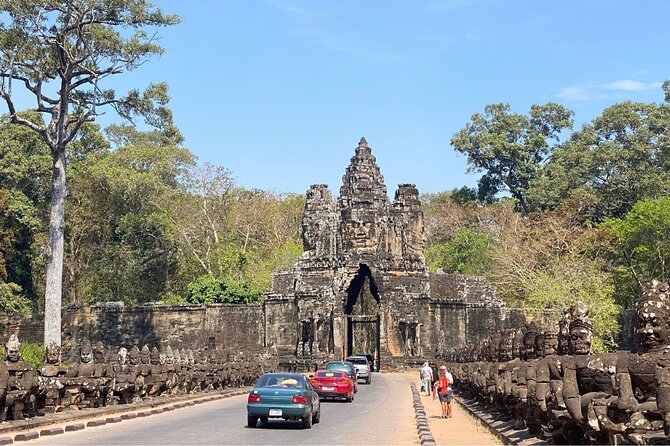
Transportation is by tuk-tuk, with hotel pickup and drop-off in Siem Reap. Bottled water is included, which is a small but useful touch during a six-and-a-half-hour outing. The tour is described as private, so only your group participates.
The private format can make a real difference at Angkor. You are not tied to the questions, photo stops, or pace of a large bus group. If you want the guide to explain a carving or compare Bayon with Banteay Kdei, you can ask without holding up a coach full of people.
The supplied tour details also describe possible choices between a private tuk-tuk, an air-conditioned car, and a small-group minivan, while the included transportation specifically lists a tuk-tuk. Confirm the vehicle option when booking if comfort or air conditioning matters to you.
Pickup is offered from hotels across Siem Reap, and the return transfer is included. That removes the need to arrange separate transport to the park. The Angkor Pass remains your responsibility, and lunch is also on your own.
Most people can participate, and the tour is near public transportation, though the information does not provide a detailed accessibility assessment. If you have mobility needs, ask the provider before booking so the vehicle and temple route fit your situation.
The guide can shape the whole day
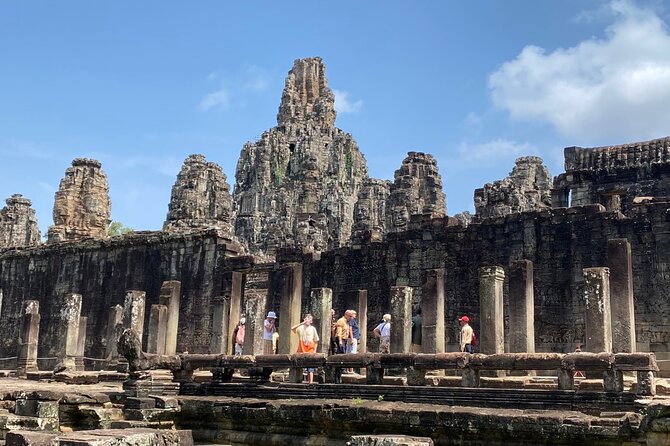
The strongest element of the experience is the guide. Temple ruins are far more useful when someone explains who built them, why their religious purpose changed, and how the temples relate to each other.
Bon Sith is noted for clear and informative explanations, while Mr. Somra is praised for combining cultural detail with a genuine manner. Other comments highlight fluent English and a friendly, punctual driver. Those details matter because the driver handles the long stretches between sites while the guide gives meaning to the stops.
Do not be shy about asking questions. You can ask about Suryavarman II at Angkor Wat, Jayavarman VII at Bayon, or the Buddhist design shared by Bayon, Ta Prohm, and Banteay Kdei. The more you connect the temples, the less the day feels like a parade of unrelated ruins.
The guide will not remove every challenge. The route still involves several temple visits in one day, and some people will find the pace tiring. But clear explanations make the time and effort count for more.
Is $40 a good value?
At $40 per person, the tour price is reasonable for a private half-day-plus outing with a guide, tuk-tuk, hotel transfers, and water. It becomes a less obvious bargain once you add the $37 Angkor Pass and lunch. Your minimum known cost is $77 per person before food.
That total can still represent good value if you are visiting Angkor for the first time and want the key temples handled in one route. Booking separate transport and finding a guide independently may take more planning, while this package brings the main pieces together.
The value is weaker if you already know the temples well, want to spend a full day at one or two sites, or prefer to explore without commentary. In those cases, a shorter private transfer or a self-planned visit could suit you better.
The experience carries a 5 out of 5 rating from 12 recorded reviews and a 100 percent recommendation figure. Treat that as a useful signal, not a guarantee of your exact guide or vehicle. The clearest pattern is the praise for guide explanations, friendly driving, and a well-organized route.
Who should book this Angkor tour?
I would choose this tour if you have one main day in Siem Reap and want the essential Angkor temples without arranging each detail yourself. It suits couples, friends, and families who value a private vehicle and direct access to an English-speaking guide.
It also suits you if Ta Prohm’s roots and Bayon’s faces are high on your list, but you still want smaller temples such as Thommanon and Banteay Kdei. The route gives you famous sights plus enough variation to keep the day from feeling repetitive.
I would think twice if you dislike early or tightly scheduled sightseeing, though the exact start time is not provided. I would also ask about the vehicle before booking if you strongly prefer an air-conditioned car over a tuk-tuk.
Free cancellation applies when you cancel at least 24 hours before the local start time. Cancellations or changes made within 24 hours are not refunded or accepted.
Should you book it?
Book it if you want a private, guide-led introduction to Angkor with the major sights packed into one efficient day. The mix of Angkor Wat, Bayon, Ta Prohm, and two smaller temples is the main strength, and guides such as Bon Sith and Mr. Somra add the historical and cultural detail that ruins alone cannot provide.
Skip it if you want a slow temple study, a full-day route, or a package with admission and lunch included. Before paying, budget the separate $37 pass, confirm whether you will use a tuk-tuk or car, and decide if six and a half hours gives you enough time. For a first visit with limited time in Siem Reap, this is a sensible and well-focused choice.
FAQ
How long does the tour last?
The tour lasts approximately 6 hours and 30 minutes.
Is hotel pickup included?
Yes. Hotel pickup and drop-off in Siem Reap are included.
Is this a private tour?
Yes. The activity is described as private, with only your group participating.
What transportation is included?
Transportation by tuk-tuk is included. The tour information also describes possible private car and small-group minivan options, so confirm the vehicle when booking.
Is an English-speaking guide included?
Yes. An English-speaking tour guide is included.
Which temples are visited?
The route includes Angkor Wat, Angkor Thom’s South Gate, Bayon, Thommanon, Ta Prohm, and Banteay Kdei.
Is the Angkor Pass included?
No. The one-day Angkor Pass costs $37 per person and must be paid separately.
Is lunch included?
No. Lunch is not included in the tour price.
Can I cancel for a full refund?
Yes, if you cancel at least 24 hours before the experience’s start time. Cancellations within 24 hours are not refunded.
Just added in Siem Reap
- Twilight Tastes of Siem Reap Include Dinner★ 5.0 · 13 reviews
- Ultimate Sunrise to Angkor Wat, Angkor Thom and Bayon Temple★ 5.0 · 3 reviews
- Trekking Tour at Phnom Kulen National Park from Siem Reap★ 5.0 · 3 reviews
- Full-Day Private Tour of Angkor Wat with Pick Up★ 5.0 · 12 reviews
- Siem Reap City Tour with War Museum and Killing Field★ 5.0 · 27 reviews
- Waterfall & River of 1000 Siva Linga- Kulen Mountain Private Tour★ 5.0 · 3 reviews
- Private Day Trip to Angkor Temples with Expert Guide★ 5.0 · 4 reviews
- Angkor Wat Experience Temple Pass and Siem Reap Food Tour★ 5.0 · 13 reviews
Tours in Siem Reap, compared.
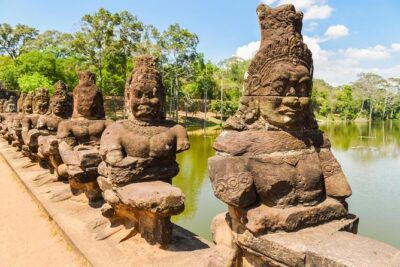
Angkor Wat Sunrise or Sunset Tour with Guide from Siem Reap
Read our review →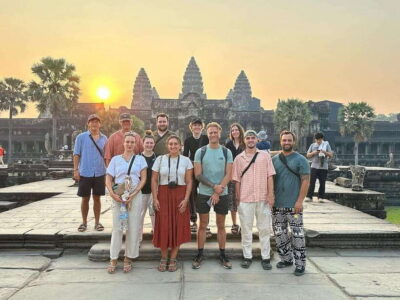
Angkor Wat: Small-Group Sunrise or Sunset Tour
Read our review →
Sunset tour of Kampong Phluk stilts home village on the Tonle Sap
Read our review →
Angkor Wat 2-Day Tour with Sunrise and Sunset
Read our review →
Angkor Wat Sunrise tour with Small – Group and Guide tours
Read our review →