
Reviewed · KAMPOT PEPPER FARM TOURS
Kampot: Cultural Bike Experience – Local Life & Countryside
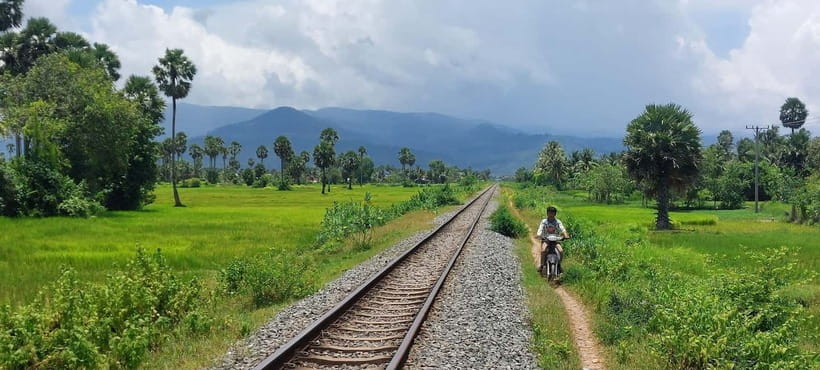
The best part of this Kampot bike tour is the way it takes you beyond the town’s usual sights. You ride quiet country roads, stop at three Buddhist monasteries, visit farming communities, and get a look at daily Cambodian life rather than just another temple photo.
I like the easy, flat route and the meal with a local family in a traditional wooden house. Guide Jason brings strong knowledge of Cambodian history, culture, and the economy, while Vin adds a warm local connection. The main drawback is the length: six and a half hours of cycling, walking, eating, and listening may feel like a lot in hot weather.
Key points to know before booking
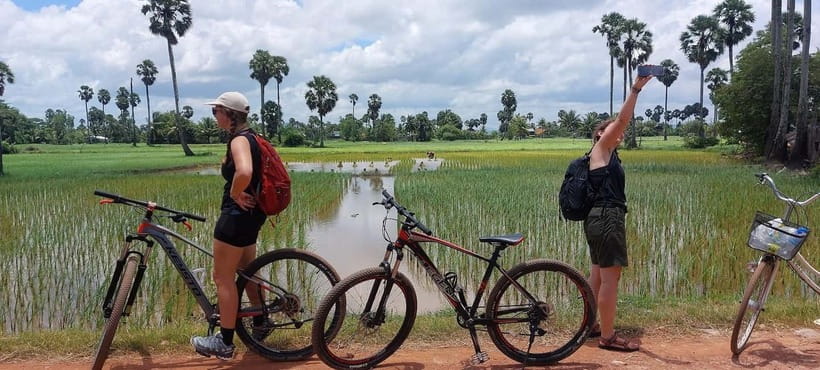
- A gentle 15-kilometer ride: The route is flat, with little traffic and frequent stops.
- Three monastery visits: You walk through Wat Chum Kriel, Wat Ang Prey Serey Meanchey, and Wat Prey Tom.
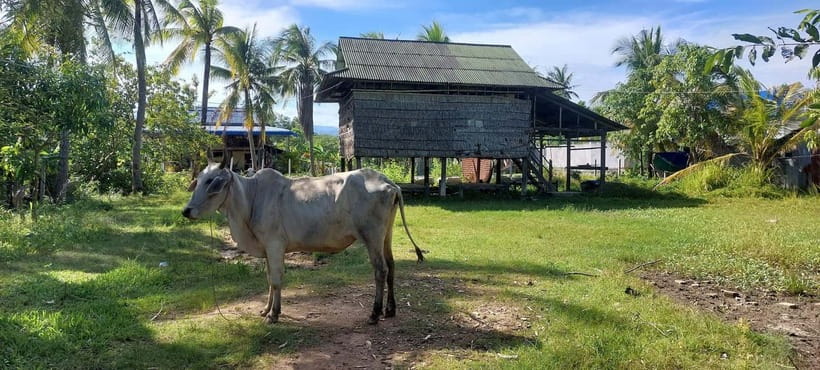
- A real local meal: Lunch is cooked by a Cambodian family and served at their traditional wooden home.
- Farming is part of the story: You visit a palm sugar farm and learn how rice is grown.
- More than a bike ride: Jason explains Cambodian history, Buddhism, local legends, and village life.
- Best for confident cyclists age 12 and older: You need to ride a bicycle and manage walking tours on foot.
Why this Kampot tour feels different
Kampot is often treated as a base for pepper farms, river views, and trips toward Bokor. This experience takes a quieter route. The focus is not on checking off one famous attraction. It is on seeing how villages, farms, temples, and families fit together.
You cycle about 15 kilometers in total, but this is not a race or a long-distance cycling challenge. The ride is broken into sections of roughly 30 to 45 minutes before you stop for a walk, a talk, a view, or a temple visit. The roads are flat and have very little traffic, which makes the day suitable for anyone comfortable on a bicycle but not eager for a hard workout.
The cultural side is just as important as the cycling. You learn about how Buddhism is practiced, hear about Cambodia’s past and local legends, and visit communities connected with rice farming, palm sugar production, and fishing. The tour also includes a look at Muslim village life, giving you a wider view of Kampot Province than a temple-only outing would provide.
Jason is the English-speaking guide. His explanations cover history, culture, and the local economy, and the available feedback gives particular praise to the depth of his information. Vin is also part of the experience, adding a local Cambodian presence to the day. That combination matters. Jason can give you the wider context, while local hosts and village visits keep the experience connected to present-day life.
More pepper country trips from Kampot:
- Kampot: Pepper Farm Tours, Salt, Lake & Phnom Chhngok Temple
★ 4.8 · 432 reviews - Kampot: Full-day Countryside Tour with Pepper Farm and Kep
★ 4.9 · 245 reviews - Kampot: Bokor Mountain Classic or Sunset Tour
★ 4.7 · 147 reviews
Starting near the Old Market
The meeting point is The Kampot Pepper Shop, near Kampot’s Old Market. This is a practical starting place if you are staying in town, and it gives you a chance to get settled before leaving the built-up area.
You begin with a short bike ride of about 15 minutes. The route then opens into scenic countryside, with another 30-minute stretch followed by a shorter ride of about 25 minutes. These opening sections are useful because the scenery changes gradually. You move from town toward local roads, farms, and village communities instead of being dropped straight at a single attraction.
Do not expect a polished sightseeing route with signs at every stop. The appeal is the ordinary setting: roads, homes, fields, and places of worship used by local residents. You will get more from the trip if you pay attention to how the communities are arranged and ask questions along the way.
Wat Chum Kriel and the first monastery visit
The first major stop is Wat Chum Kriel, where you have about an hour for a break, guided visit, and sightseeing. This is your first chance to slow down and start looking at Cambodian religious life through more than architecture.
A monastery visit can be easy to misunderstand if you only see it as a decorative temple stop. Here, the guide helps explain how Buddhism is practiced and how village monasteries function within the community. You can expect a walking tour and time to look around rather than a rushed photo stop.
The one-hour pause also gives your legs a break early in the day. That is useful because the tour combines cycling with walking, and the heat can make even an easy route feel longer. Wear clothes suitable for visiting Buddhist religious sites, and choose footwear that works for both cycling and walking.
Cycling through Tuek Chhou’s countryside
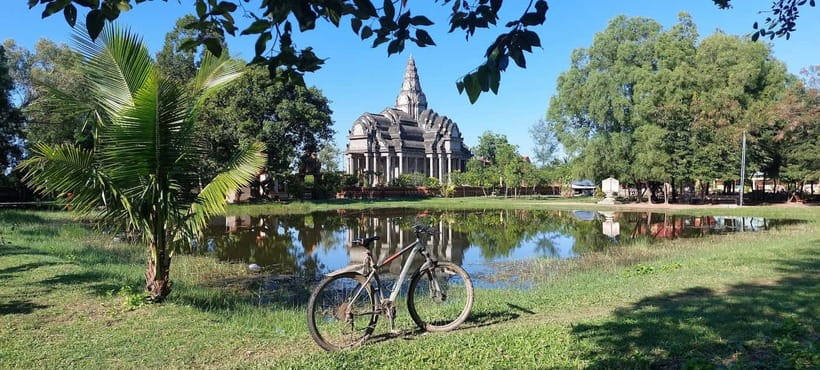
After Wat Chum Kriel, the tour continues toward Tuek Chhou. This section includes a photo stop, scenic views, and another bike ride lasting about an hour in the schedule. The route remains flat, and the slow pace is designed to let you look around.
This is where the tour’s countryside focus becomes clear. You may see rice fields, village roads, farms, and homes away from the main tourist areas. The experience is less about a single dramatic viewpoint and more about the steady change in scenery as you pedal between communities.
The cycling is described as gentle, but you still need to be comfortable riding for several short periods. There is no indication that the route is suitable for someone who cannot ride, and the activity specifically excludes people who cannot cycle, wheelchair users, and people with mobility impairments. Children under 12 are also not accepted.
More rides through the countryside near Kampot:
- Siem Reap Countryside Bike Tour / E-Bike or Tuk Tuk
★ 5.0 · 935 reviews - Angkor Sunrise Bike Tour / E-Bike or Tuk Tuk
★ 5.0 · 615 reviews - Phnom Penh Silk Island Bike Tour/ E-Bike or Tuk Tuk
★ 5.0 · 495 reviews - Siem Reap: Bike the Angkor Temples – Full-Day 30km Tour
★ 5.0 · 463 reviews
Wat Ang Prey Serey Meanchey and lunch with a local family
The next stop is Wat Ang Prey Serey Meanchey. You have around an hour for a guided visit, photos, and free time, followed by another hour for lunch at the same location.
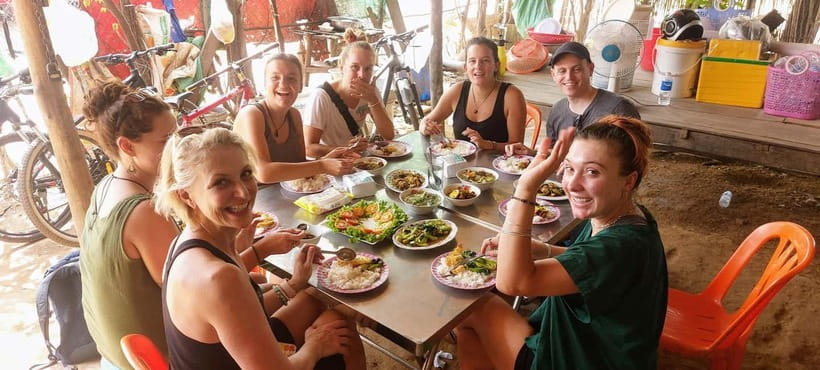
This gives you the day’s most important cultural exchange. The meal is prepared by a local family and served at a traditional wooden house. It is not simply lunch included for convenience. It is a chance to see how a Cambodian home can become part of the welcome, and how food helps connect the visitor with the people behind the places.
The meal is included along with drinks, so you do not need to budget separately for lunch during the tour. The menu is not specified, so anyone with dietary restrictions should ask before booking rather than assume that substitutions are available.
The setting also gives you time to rest properly. By this point, you have cycled through the countryside and taken part in a monastery walk. A seated meal in a family home breaks up the afternoon and keeps the tour from turning into one long string of temple visits.
The family meal is the part I would value most if you want contact with Cambodian life in a respectful, organized way. It avoids the distance you can feel when simply riding past homes and fields. At the same time, remember that this is still a scheduled tour, not an unplanned visit. You are seeing local life through a host family and a guide, which gives the experience structure.
Rice farming, palm sugar, and the work behind the scenery
The tour includes a visit to a family-run palm sugar farm and time in a rice farming community. These stops help explain the work that supports rural households.
Palm sugar is more than a souvenir or a sweet flavor on a menu. A family-run farm shows you how a local product fits into the rural economy. The supplied details do not specify the exact production steps or how much hands-on participation is offered, so you should expect explanation and observation rather than assume a full workshop.
The rice farming community adds another useful layer. Rice fields can look simple from a bike, but cultivation involves timing, labor, water, and local knowledge. Learning about the process gives you a better understanding of why these fields matter to village life and Cambodia’s food system.
The tour also introduces local fishing communities, including Muslim villages. That broadens the cultural picture. Cambodia is not one single set of customs, and Kampot Province includes different religious and working communities. Seeing that variety is one of the stronger reasons to choose this tour over a basic countryside ride.
Wat Prey Tom closes the temple visits
After lunch, you return toward Kampot with about 45 minutes of cycling and scenic driving through the countryside. The final major stop is Wat Prey Tom, with roughly an hour for a guided visit, sightseeing, and views.
By this point, the three monasteries give you a useful basis for comparison. You can think about differences in setting and use, not just collect similar photographs. Jason’s explanations are especially helpful here because the religious sites make more sense when connected to Cambodian traditions and local history.
The final monastery stop also breaks up the return journey. You then cycle for about 30 minutes before arriving back at The Kampot Pepper Shop. The day finishes where it began, near the Old Market.
The route description includes both bike-tour and scenic-drive wording during parts of the schedule. The main description presents the experience as a bicycle tour covering about 15 kilometers, with slow cycling between stops. If the exact transport arrangement matters to you, ask the provider for clarification before booking.
What the $35 price gets you
At $35 per person, this is a strong-value full-day outing if you want more than transportation and sightseeing. The price includes the bicycle, drinks, lunch, and an English-speaking guide for 6.5 hours.
You are paying for several kinds of access at once: countryside roads, three monastery visits, farming communities, local explanations, and a meal in a family home. Booking each part separately would be difficult, especially the community visits and home-cooked meal.
The value is strongest for visitors who want context. If you only want a short scenic bike ride, this tour may feel long and information-heavy. If you want to understand how religion, farming, food, and family life connect in the area, the price is modest for the amount of time involved.
The tour offers free cancellation up to 24 hours before departure and allows you to reserve now and pay later. Starting times depend on availability, so check the schedule before building the rest of your day around it.
Who should book this experience
You should consider this tour if you:
- Want to see rural Kampot beyond the main tourist stops
- Enjoy learning about history and culture while sightseeing
- Can ride a bicycle comfortably on flat roads
- Like slow travel with regular stops
- Prefer a local meal and village visits to a polished attraction
- Have six and a half hours available
- Are comfortable visiting Buddhist monasteries and walking through rural communities
This is less suitable if you dislike structured tours, long days, or educational commentary. It is also not designed for children under 12, wheelchair users, people with mobility impairments, or anyone who cannot ride a bicycle.
You should also plan for warm conditions. The route is easy in terms of hills, but cycling and walking for much of a day still take energy. Bring practical clothing, sun protection, and footwear that works at temples and on village roads.
The strongest reason to choose it
The best feature is the balance between movement and conversation. You are not sitting in a vehicle looking through a window, but you are also not pedaling nonstop. You ride slowly, stop often, walk through monasteries, and have time to listen.
The strongest praise has focused on the quality of the information, the easy cycling, the kindness of Vin and the people encountered, and the meal. Those points fit the design of the tour. It is built for understanding, not adrenaline.
Jason’s wide-ranging explanations are a major part of the value. If you enjoy asking how Cambodia’s past connects with its current economy, religion, and village life, you are likely to get much more from this than from a simple sightseeing ride.
Should you book the Kampot Cultural Bike Experience?
Book it if you want a gentle but full day that shows you modern Cambodia away from the usual tourist circuit. The flat 15-kilometer route makes the cycling manageable, while the monasteries, rice fields, palm sugar farm, Muslim communities, and family meal give the day real variety.
Skip it if you want a quick activity, a challenging ride, or a tour centered on one major attraction. Six and a half hours is a serious commitment, even with a relaxed pace.
For most active visitors staying in Kampot, I would choose this as a way to understand the province rather than simply pass through it. The combination of Jason’s explanations, local hosts, and a home-cooked lunch gives the experience more substance than its low price suggests.
FAQ
Where does the tour start and finish?
It starts and finishes at The Kampot Pepper Shop near the Old Market in Kampot.
How long does the experience last?
The experience lasts 6.5 hours.
How far do you cycle?
The tour covers about 15 kilometers by bicycle.
Is the cycling difficult?
The route is entirely flat, has no hills, and uses country roads with very little traffic. Cycling is done slowly with breaks and walking tours between sections.
Which monasteries do you visit?
You visit Wat Chum Kriel, Wat Ang Prey Serey Meanchey, and Wat Prey Tom.
Is lunch included?
Yes. Lunch, drinks, and bicycle rental are included in the price.
What kind of meal is provided?
You eat a home-cooked Cambodian meal with a local family at a traditional wooden house. The exact menu is not specified.
What language is the tour conducted in?
The live tour guide speaks English.
Who should not book this tour?
The tour is not suitable for children under 12, people with mobility impairments, wheelchair users, people who cannot ride a bicycle, or people over 95 years old.
Just added in Kampot
- Trip with Local tuk tuk to Country side & Pepper farm…★ 5.0 · 13 reviews
- Kayaking tour around green cathedral★ 4.8 · 38 reviews
- Khmer Food Culture Cooking Class in Kampot★ 5.0 · 7 reviews
- Kampot: Sunset Walking Tour★ 4.1 · 9 reviews
- Kep: Discover kampot pepper farm/lake & Salt fields…more★ 5.0 · 5 reviews
- Kep town: Local tuk tuk to Countryside & Pepper farm★ 4.6 · 8 reviews
- Kampot Pepper Farm Tour: Salt Fields, La Plantation & Cave★ 4.8 · 18 reviews
- Kampot-Phnom Penh include Pepper farm Tour, Salt field, Lake★ 4.8 · 5 reviews
Kampot Pepper Farm Tours, compared.
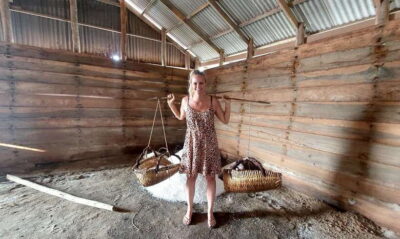
Pepper Farm Tours, Salt, Lake & Phnom Chhngok Temple
Read our review →
Full-day Countryside Tour with Pepper Farm and Kep
Read our review →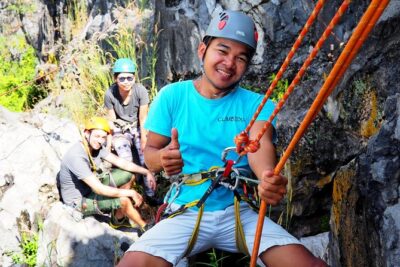
Discovery Tour: Caving, Climbing, Via Ferrata and Abseiling in Kampot
Read our review →
Tuk Tuk Trip to Pepper Farm, Kep, Crab Market & More
Read our review →
Kampot Tour Pepper Plantation, Salt Field, Cave, Secret Lake
Read our review →
Kampot Countryside include Pepper farm, Salt field & Lake
Read our review →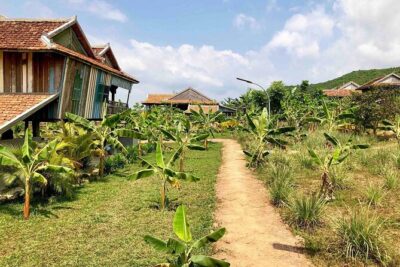
La Plantation tour (discovering Kampot Pepper) + Lunch
Read our review →Browse the lists this tour appears in