
Reviewed · ANGKOR TEMPLE TOURS
One Day Private Guide Tour of Angkor Thom, Bayon, Ta Phrom & Angkor Wat
Angkor Wat may get the postcards, but the day’s most memorable sight could be Bayon, where more than 200 carved faces gaze down from a forest of stone towers. This private tour also takes you through Angkor Thom’s royal center, the tree-wrapped ruins of Ta Prohm, and Angkor Wat itself.
I like the private vehicle and guide, which let you set the pace more easily than a large group. I also like the smart split between a morning visit and a later Angkor Wat visit, giving you a break during the hottest hours. The main drawback is the long day on foot, with lunch at your own expense and no guaranteed sunset spectacle in every season or weather condition.
Key points at a glance
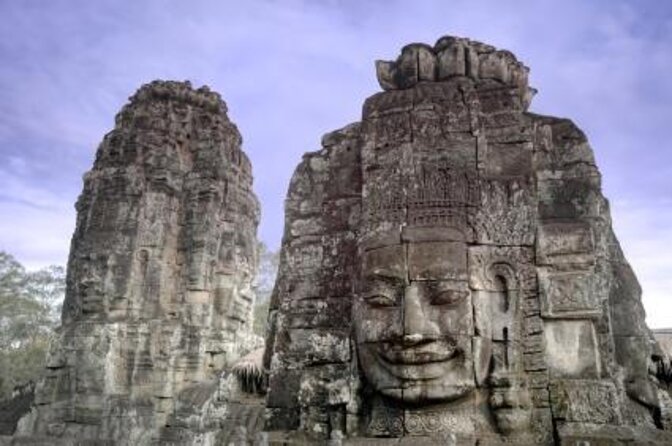
- Bayon’s 54 towers and more than 200 faces provide the tour’s most unusual temple sight.
- Angkor Thom includes several lesser-known monuments, including Baphuon, Phimeanakas, and the two royal terraces.
- Ta Prohm gets two hours, enough time to see more than the famous tree-covered corridors.
- Angkor Wat is saved for three hours later in the day, after a break for lunch.
- The private format means only your group participates, with a modern air-conditioned vehicle and licensed English-speaking guide.
- The $37 single-day Angkor pass is included, along with two bottles of water per person.
Why the private format matters at Angkor
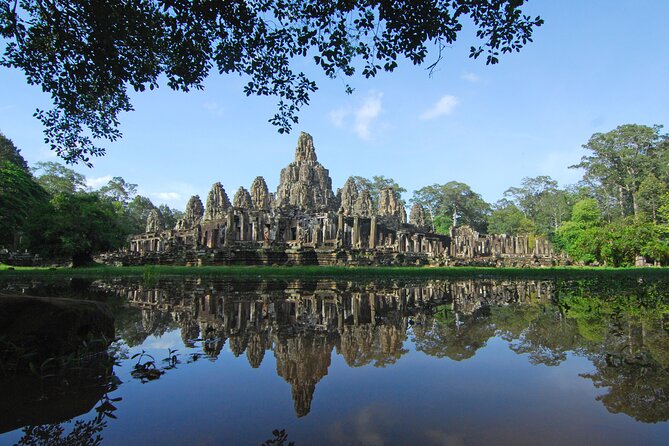
Angkor is not one temple. It is a huge archaeological park filled with monuments spread across a broad area. A private guide and driver make this full-day plan less tiring because you can move between sites in an air-conditioned vehicle instead of spending the entire day walking.
The vehicle is also useful in Cambodia’s heat. You will still walk on uneven stone, climb temple steps, and cross open courtyards, but the rides between sites give your legs and shirt a chance to recover.
Only your group takes part in the tour. That gives you a better chance to ask questions, pause at a carving, or spend less time at a stop that does not interest you. It also helps with photography. One guide praised by name in the supplied feedback is Sim, described as strong on temple history, local life, and practical photo advice. Guide assignments can vary, so you should ask when booking if a particular guide is important to you.
The guide is a major part of the experience. Without context, Angkor can become a tiring succession of stone walls and stairways. A good guide can explain why a temple was built, how its design reflects religious ideas, and how the site worked as part of a royal city.
More temples within reach of Siem Reap:
- Siem Reap Tour: Angkor Wat Sunrise, Bayon, Ta Prohm, Banteay Srei
★ 5.0 · 931 reviews - Siem Reap: Bike the Angkor Temples – Full-Day 30km Tour
★ 5.0 · 463 reviews - Preah Vihear: Full-Day Preah Vihear and Koh Ker Temple Tour
★ 4.9 · 263 reviews
Starting at Angkor Thom’s South Gate
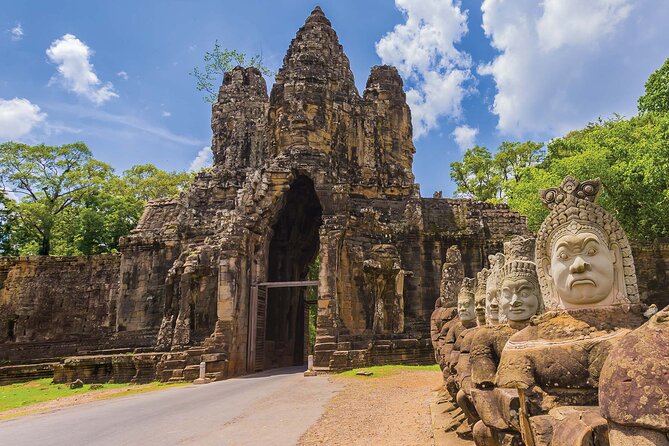
The day begins at 8:00 a.m. with the South Gate of Angkor Thom. Allow about 45 minutes here. The entrance is more than a simple gateway. A long bridge crosses the moat, lined with monumental figures connected to the Hindu story of the Churning of the Ocean of Milk.
On one side, gods pull the serpent. On the other, demons pull in the opposite direction. The figures are large, solemn, and easy to appreciate from the vehicle and bridge approach.
This is a useful first stop because it introduces the scale of Angkor Thom. In the late 12th century, this walled city served as the center of the Khmer Empire and was built as a major royal capital. The walls and gates give you a sense that Angkor was not just a collection of isolated shrines. It was a planned city with religious, political, and ceremonial spaces.
Your guide can also place Angkor in the wider Khmer world. At its height, the empire controlled areas of present-day Cambodia, Laos, Thailand, and Vietnam. That wider setting helps explain why the monuments are so large and why their carvings combine Hindu and Buddhist ideas across different reigns.
Bayon and its watchful stone faces
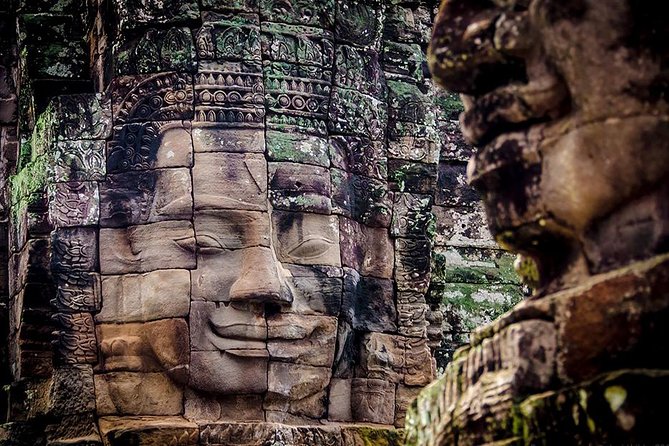
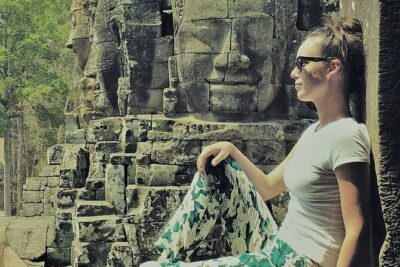
Bayon receives about an hour, and it deserves that time. Located near the center of Angkor Thom, the temple is famous for its towers carved with giant faces associated with Avalokitesvara, a Buddhist figure linked with compassion.
The faces are what make Bayon so different from Angkor Wat. At Angkor Wat, you first notice grand symmetry and long galleries. At Bayon, the experience is closer and more puzzling. Towers press around you, corridors turn sharply, and faces appear from different angles as you walk.
The temple was built under King Jayavarman VII, whose reign produced much of Angkor Thom. Your guide can help you read the carvings and understand the difference between the temple’s outer reliefs and its inner sanctuary areas.
Bayon can feel crowded and confusing, even on a well-planned visit. That is where a private guide helps. You can ask to pause for a clear view of a face, and your guide can suggest places for photographs instead of leaving you to search through the corridors alone.
Wear shoes with a firm grip. The stone can be uneven, and you will likely spend much of this stop turning, climbing, and looking upward.
Baphuon, a restored temple mountain
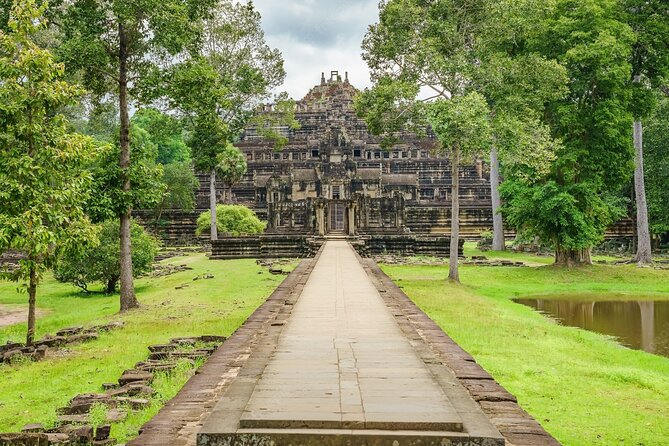
Baphuon takes about 30 minutes. It lies northwest of Bayon and was built in the mid-11th century as a state temple for King Udayadityavarman II. Its design is a three-level temple mountain, a form meant to suggest the sacred mountain at the center of the universe.
Baphuon adds an earlier layer to the morning. Bayon belongs to the period of Jayavarman VII and reflects a strong Buddhist setting. Baphuon was built earlier and has a different visual character. Seeing both helps you notice that Angkor changed over time rather than being created in one burst of construction.
The temple has undergone major restoration, and access or walking conditions may vary. Thirty minutes is enough for a useful look, but not a long, unhurried exploration. If you are especially interested in architectural details, tell your guide early in the day. The private format gives you some room to adjust, though the schedule is full.
A few more things to do in Siem Reap worth a look
- 1-Day Amazing Angkor Wat Tour with Sunset & All Interesting Major Temples
★ 5.0 · 308 reviews - Angkor Wat one Day Private Tour for All Highlight Angkor Temples
★ 5.0 · 199 reviews - 1-Day private Angkor Temple Tour from Siem Reap
★ 4.9 · 178 reviews - 1-Day Angkor Wat Sunrise & All Interesting Temples Private Tour
★ 5.0 · 174 reviews
The royal terraces and the center of power
The Terrace of the Elephants receives about 30 minutes. It formed part of Angkor Thom’s royal square and served as a platform from which King Jayavarman VII could watch returning armies and public ceremonies.
The long wall is decorated with elephants and other figures. It is less about entering a temple than understanding how the city presented royal authority. From the terrace, you can picture the open ceremonial space in front of it, filled with officials, soldiers, and public events.
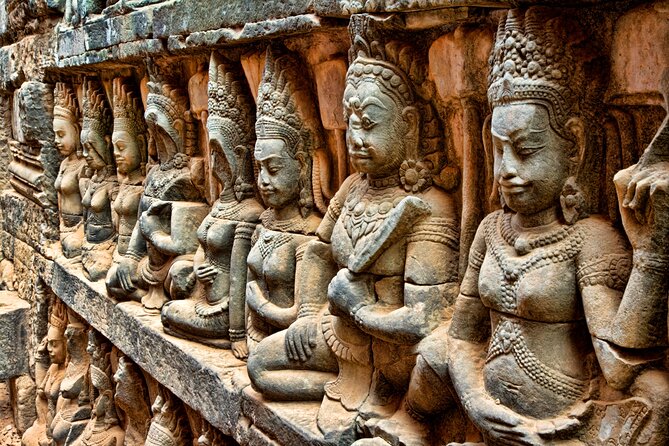
The nearby Terrace of the Leper King takes another 30 minutes. Built in the Bayon style under Jayavarman VII, it has carved figures and enclosed passages that reward close attention. The modern name comes from a later legend and should not be taken as a simple description of the monument’s original purpose.
These terraces are easy to rush past because they do not look like enclosed sanctuaries. I would not skip them. They show the public side of Angkor Thom, where the king’s power was displayed before the city’s people.
Phimeanakas and the royal enclosure
Phimeanakas receives about 30 minutes. This Hindu temple was built in the Khleang style toward the end of the 10th century, during the reign of Rajendravarman, and completed under Suryavarman I.
It is another temple mountain, but its place inside the royal enclosure matters as much as its shape. This was part of the king’s palace complex, not simply a stand-alone monument for visitors.
Do not expect the same intact drama as Angkor Wat or the face towers of Bayon. Phimeanakas is valuable for the historical sequence it adds to the morning. With your guide’s help, you can see how the royal compound developed and how different rulers left their mark on the capital.
By now, the schedule has already included several sites. The pace is steady rather than leisurely. You will get a broad understanding of Angkor Thom, but anyone wanting detailed study of every carving may need a second day.
Ta Prohm, where stone and trees share the frame
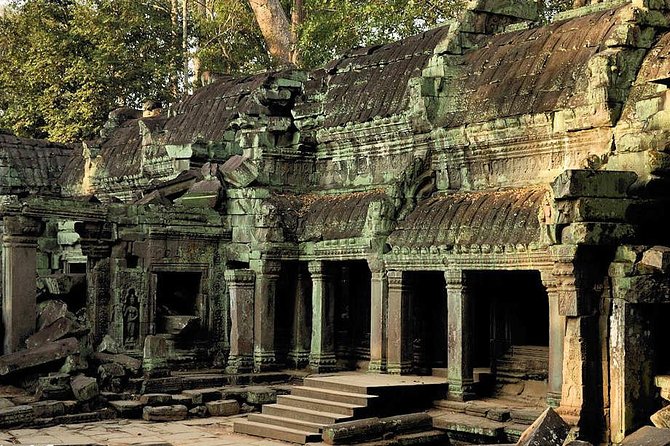
Ta Prohm gets two hours, the longest stop before Angkor Wat. That is the right call. This monastery was built by Jayavarman VII and dedicated to his mother. Its dark gray sandstone, narrow courtyards, fallen blocks, and tree-covered walls create a mood unlike the more open royal monuments.
The trees are the famous part, but do not treat Ta Prohm as a single photo stop. The best experience comes from noticing the changing scale. One passage feels tight and shadowed. Another opens into a courtyard. Carved lintels and doorways appear between collapsed sections and roots.
A guide can help separate original features from restoration work and point out details you might otherwise miss. The site’s fame also means the most photographed corners can be busy. A private visit does not guarantee an empty temple, but your guide may know when to shift to another courtyard or wait for a better angle.
The ground here can be rough, and the two-hour visit may be tiring in the heat. Use the water provided, and take the chance to slow down. Ta Prohm rewards patience more than speed.
Lunch and the afternoon visit to Angkor Wat
Lunch is not included, so plan to pay for your own meal during the break. Drinks with meals are also excluded. The tour does provide two bottles of mineral water per person during sightseeing and transfers, but that is not a substitute for planning your lunch and other drinks.
After the break, you spend about three hours at Angkor Wat. Saving the largest temple for later gives the day a useful rhythm. You have already seen the old city, a face tower temple, a restored temple mountain, royal terraces, and a jungle monastery. Angkor Wat then brings those ideas together on a grander scale.
Built as the funeral temple of King Suryavarman II, Angkor Wat was dedicated to the Hindu god Vishnu. Its long galleries, towers, moats, and carefully balanced layout create a different feeling from Bayon and Ta Prohm.
Three hours lets you go beyond the main entrance. You can cross the causeway, walk through the galleries, examine the reliefs, and approach the central towers if access is open. Exact access rules can change, so listen to your guide and dress respectfully for the temple setting.
The late afternoon timing can produce softer light and a less punishing temperature than the middle of the day. The tour description calls for sunset hours, but weather and site conditions control what you actually see. Think of sunset as a possible benefit, not a promise of a perfect sky.
What the $146.67 price includes
At $146.67 per person, this is not the cheapest way to see Angkor. The value depends on how much you care about private attention and a structured day.
The price includes private transport in a modern air-conditioned vehicle, a licensed English-speaking guide, the listed sightseeing, taxes, service charges, and two bottles of mineral water per person. Most important, it includes the $37 single-day admission ticket to Angkor Archaeological Park.
You are paying for more than transport. The guide can connect the sites, adjust explanations to your interests, and help with timing. A private vehicle also saves energy across a large park. For a small group that would otherwise hire separate transport and arrange the temple pass, the package can be reasonable.
The price does not include lunch, drinks during meals, or personal, travel, and health insurance. Group discounts are offered, but the exact reduced price is not stated. If you are traveling with several people, compare the group rate before booking.
Who will get the most from this day
This tour suits you if you want the major Angkor sights in one full day and prefer having the day organized. It is especially useful for a first visit, when the park’s size and many temple names can feel confusing.
It also works well for visitors who want to ask questions. The private format gives you more freedom than a large shared bus, though the number of scheduled stops means you should not expect unlimited time at every monument.
You should think twice if you dislike long sightseeing days, hot weather, uneven ground, or a fixed morning start. Nine hours is a lot, and the temple sequence includes repeated walking, steps, and exposed courtyards.
The plan is also less suitable if you want slow, detailed photography at every site. For that, two or more days would give you breathing room. This tour is designed for range and context, with enough time at Ta Prohm and Angkor Wat to make those stops worthwhile.
Should you book this Angkor tour?
Book it if you want a strong first-day introduction, private transport, an English-speaking guide, and all four headline experiences: Angkor Thom, Bayon, Ta Prohm, and Angkor Wat. The best parts are the guide-led context, the practical split between morning and afternoon, and the chance to see smaller Angkor Thom monuments that many rushed visits omit.
Before booking, confirm the pickup details and ask whether Sim is available if his style of temple explanation and photo guidance appeals to you. Bring comfortable shoes, sun protection, and money for lunch and drinks. At $146.67 per person, the tour offers solid value for a small group that wants convenience and a clear story rather than a do-it-yourself day.
FAQ
What time does the tour begin?
The tour begins at 8:00 a.m.
How long does the experience last?
The tour lasts approximately nine hours.
Is this a private tour?
Yes. Only your group participates in the activity.
Is transportation included?
Yes. Private transportation in a modern air-conditioned vehicle is included.
Is an English-speaking guide included?
Yes. The tour includes a professional licensed English-speaking guide.
Is the Angkor temple admission ticket included?
Yes. The single-day Angkor Archaeological Park ticket, listed at $37, is included.
Which temples and monuments are visited?
The tour visits Angkor Thom South Gate, Bayon, Baphuon, the Terrace of the Elephants, the Terrace of the Leper King, Phimeanakas, Ta Prohm, and Angkor Wat.
Is lunch included?
No. Lunch is at your own expense.
Are drinks included?
Two bottles of mineral water per person are provided during sightseeing and transfers. Drinks during meals are not included.
Can I cancel for a full refund?
Yes, if you cancel at least 24 hours before the experience start time. Cancellations made less than 24 hours in advance are not refunded, and changes within that period are not accepted.
Just added in Siem Reap
- Twilight Tastes of Siem Reap Include Dinner★ 5.0 · 13 reviews
- Ultimate Sunrise to Angkor Wat, Angkor Thom and Bayon Temple★ 5.0 · 3 reviews
- Trekking Tour at Phnom Kulen National Park from Siem Reap★ 5.0 · 3 reviews
- Full-Day Private Tour of Angkor Wat with Pick Up★ 5.0 · 12 reviews
- Private Day Trip to Angkor Temples with Expert Guide★ 5.0 · 4 reviews
- Siem Reap City Tour with War Museum and Killing Field★ 5.0 · 27 reviews
- Waterfall & River of 1000 Siva Linga- Kulen Mountain Private Tour★ 5.0 · 3 reviews
- Unveiling 2 Days Private Angkor Wat/Beyond In Sunrise/Sunset Tour★ 5.0 · 48 reviews
Angkor Temple Tours, compared.
Siem Reap Tour: Angkor Wat Sunrise, Bayon, Ta Prohm, Banteay Srei
Read our review →
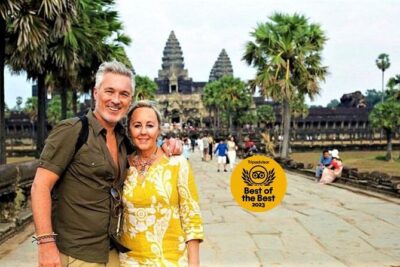
Angkor Wat one Day Private Tour for All Highlight Angkor Temples
Read our review →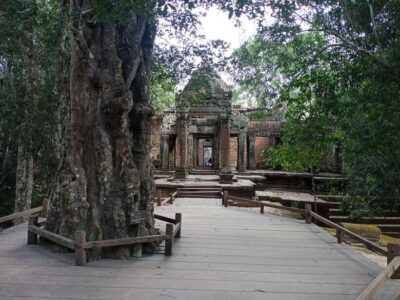
1-Day private Angkor Temple Tour from Siem Reap
Read our review →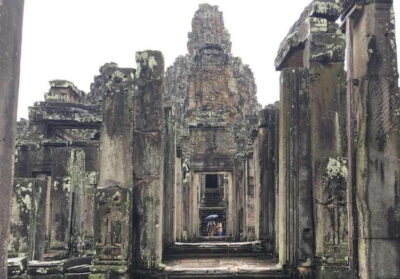

Private one-day tuktuk ‘small tour’ of the oldest Angkor temples
Read our review →Browse the lists this tour appears in