
Reviewed · ANGKOR TEMPLE TOURS
Phnom Bakheng Sunset Tour, Pre Rup, Neak Pean, Preah Khan
Phnom Bakheng is the finale, but the best part of this afternoon tour is the way it links four very different Angkor sites. You move from the red-brick geometry of Pre Rup to Neak Pean’s island shrine, then on to the roots and broken galleries of Preah Khan before ending high above the trees at sunset.
I like the mix of Hindu and Buddhist traditions, and I like that guide Son explains both with clear English and useful context. The tour also keeps the practical side simple with hotel pickup, cold water, local snacks, and transport. The main catch is the 200-step climb at Phnom Bakheng, plus the separate $37 temple pass.
Key points
- Pre Rup’s brick temple mountain gives you a strong look at 10th-century Khmer design.
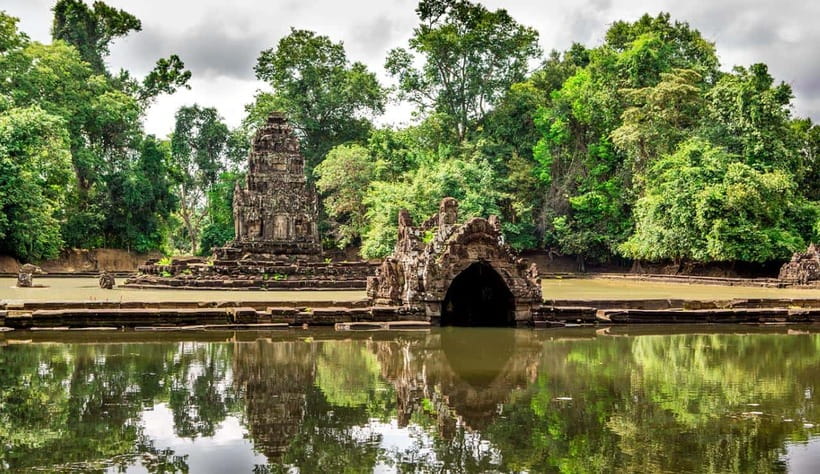
- Neak Pean sits on an artificial island in the large Jayatataka Baray reservoir.
- Preah Khan combines carved stone, tree roots, and ruins in a more atmospheric setting.
- Guide Son explains Hinduism and Buddhism and offers useful sightseeing tips.
- Phnom Bakheng sunset requires 200 steps, so sturdy shoes and some energy matter.
- The $55 price excludes the $37 temple ticket, but includes pickup, transport, water, and snacks.
Four Angkor sites in one carefully timed afternoon
This tour works because each stop feels different. You are not spending the whole afternoon walking through similar towers and courtyards. Instead, you see a state temple from the 10th century, a small shrine on an island, a large 12th-century complex, and a hilltop temple built several centuries earlier.
Pickup is scheduled for 12:30 pm at your hotel. You should wait in the lobby about 15 minutes early. The official duration is six hours, though the stated return time is around 7:30 pm, making the hotel-to-hotel outing closer to seven hours. That difference matters if you have evening plans in Siem Reap.
The transport depends on the size of your party. One to three people travel by shared tuk tuk, while groups of four or more use an air-conditioned vehicle. A tuk tuk fits the character of an Angkor day, but afternoon heat and dust can make air conditioning appealing. In either case, water is supplied and local snacks are included.
The tour costs $55 per person, not including the $37 temple pass. For one person, that means a total of $92 before any other personal spending. I see the value mainly in the guide, private hotel pickup arrangement, transport between widely separated sites, and the range of temples covered in one outing. If you already have transport and prefer exploring alone, the price may feel less attractive.
More temples within reach of Siem Reap:
- Siem Reap Tour: Angkor Wat Sunrise, Bayon, Ta Prohm, Banteay Srei
★ 5.0 · 931 reviews - Siem Reap: Bike the Angkor Temples – Full-Day 30km Tour
★ 5.0 · 463 reviews - Preah Vihear: Full-Day Preah Vihear and Koh Ker Temple Tour
★ 4.9 · 263 reviews
Pre Rup and the bold geometry of a 10th-century temple
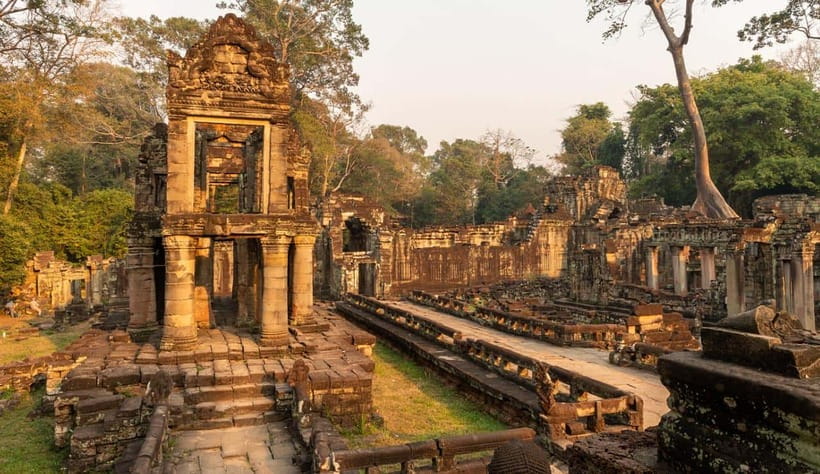
Pre Rup is the first major stop, and it gives you a fine introduction to the temple-mountain idea. Khmer King Rajendravarman built it as his state temple in 961 or early 962. Its structure uses brick, laterite, and sandstone, materials that create a warm, earthy appearance in the afternoon light.
The temple rises in a series of levels, leading your eye upward toward the central sanctuary. Pre Rup was a Hindu temple dedicated to Shiva, so this is a useful place to begin thinking about the religious ideas behind Angkor’s architecture. The temple mountain represented Mount Meru, the sacred center of the Hindu universe.
I like Pre Rup because its shape is easy to read. You can see the broad base, the climbing terraces, and the upper towers without the site feeling too complicated. The brickwork also gives it a different character from the gray sandstone temples that come later.
Your guide can help connect the building to Khmer kingship. This was not just a place for private prayer. As a state temple, it carried political weight, linking the king’s rule with the Hindu cosmos. That context makes the steep, ordered design more meaningful than a quick walk among old stones.
The practical issue is the heat. The stop comes in the afternoon, and there is not a promise of shade throughout the visit. Bring water even though more is provided, wear a hat, and use sunscreen. Comfortable shoes will help on uneven surfaces and steps.
Pre Rup is also a good place to set expectations. This is an archaeological site, not a restored monument with smooth floors and modern railings everywhere. You may find worn stone, rough ground, and exposed brick. That is part of the appeal, but it also means you should watch your footing.
Neak Pean and the island in Jayatataka Baray
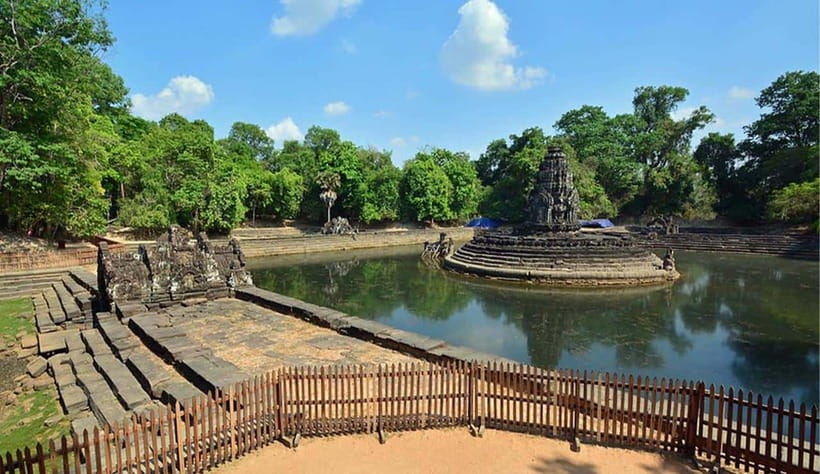
Next comes Neak Pean, a very different kind of stop. The temple sits on an artificial island in Jayatataka Baray, a large reservoir built during the 12th century. Reaching the shrine involves crossing toward the island, giving the visit a sense of approach rather than an immediate entrance through a large gateway.
The central temple is associated with a circular island and water-centered design. Its setting is the main attraction. After the strong vertical lines of Pre Rup, Neak Pean feels more open and unusual. The water and island arrangement help you understand how Khmer builders used reservoirs as part of both practical and religious planning.
This is a place where a guide adds real value. Without explanation, you might simply see a small temple surrounded by water. With context, you can better understand the role of the reservoir and the symbolic importance of water in the site’s design.
Do not expect Neak Pean to offer the scale of Preah Khan. It is a shorter, more focused stop. The appeal lies in the setting and the contrast with the larger temple complexes, not in a long list of galleries to explore.
Light and water conditions can affect the feel of the visit. The information provided does not promise a particular view or water level, so keep your expectations flexible. You are visiting an artificial island shrine, not signing up for a boat ride or a water activity.
Preah Khan, where trees and stone share the same space
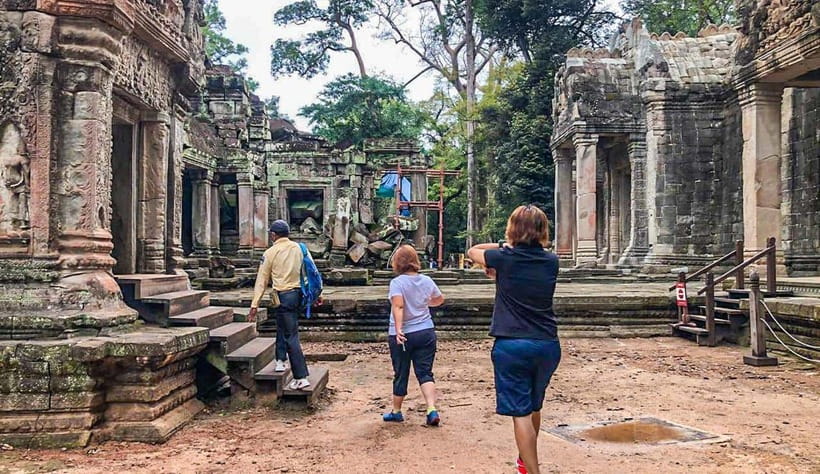
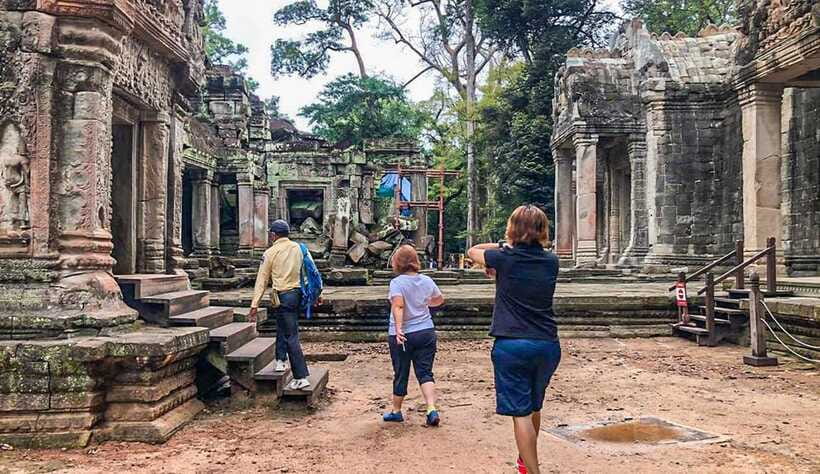
Preah Khan is the largest temple on this route. King Jayavarman VII built it to honor his father, and the complex lies northeast of Angkor Thom. Its size gives the tour a substantial middle section, with more corridors, courtyards, carved details, and partially ruined structures to examine.
Preah Khan is especially memorable for its mixture of tree roots and crumbling stone. Nature has not erased the temple, but it has become part of the way the site is experienced. Roots press against walls and old masonry breaks into irregular edges. The effect is dramatic without needing much decoration.
I like Preah Khan because it rewards patient walking. At the first glance, you may notice the broad ruins and large entrance. As you continue, smaller architectural details begin to appear. The complex feels less tidy than a fully restored monument, but that roughness helps you picture the long passage of time.
Jayavarman VII was a Buddhist king, and Preah Khan reflects the religious changes of the period. The tour also includes Hindu sites, so this stop helps create a wider picture of Angkor rather than presenting the temples as one uniform tradition. Guide Son is reported to explain Hinduism and Buddhism clearly, which is particularly useful here.
The size of Preah Khan can make it harder to know where to look. A guide can point out important areas and keep the visit moving so you still reach Phnom Bakheng at the right time. That timing is not a minor detail. A long stop here could reduce your chance of getting to the sunset viewpoint.
You should also expect uneven ground and sections of ruined architecture. This is not the easiest site for anyone who needs level paths throughout. The tour is specifically not suitable for pregnant women, and the later climb makes the full afternoon more demanding.
More sunset outings from Siem Reap:
- Angkor Wat Sunrise or Sunset Tour with Guide from Siem Reap
★ 5.0 · 12,109 reviews - Siem Reap: Angkor Wat: Small-Group Sunrise or Sunset Tour
★ 5.0 · 9,444 reviews - Sunset tour of Kampong Phluk stilts home village on the Tonle Sap
★ 5.0 · 4,865 reviews - Siem Reap: Angkor Wat 2-Day Tour with Sunrise and Sunset
★ 4.9 · 4,429 reviews
Phnom Bakheng and the 200-step sunset climb
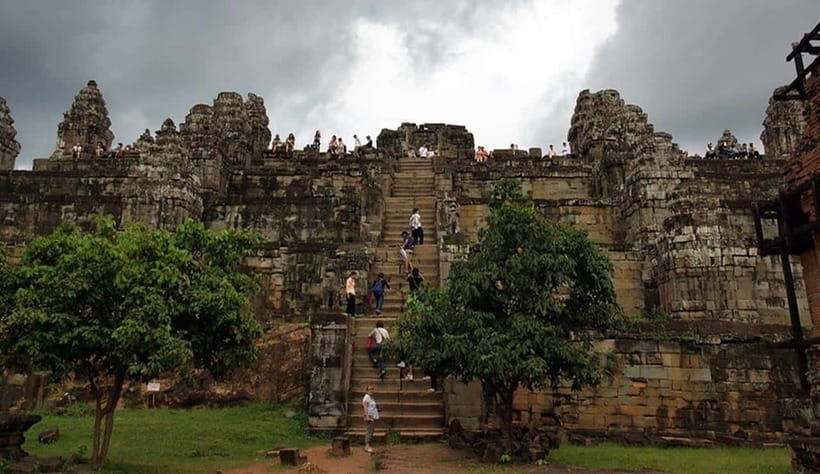
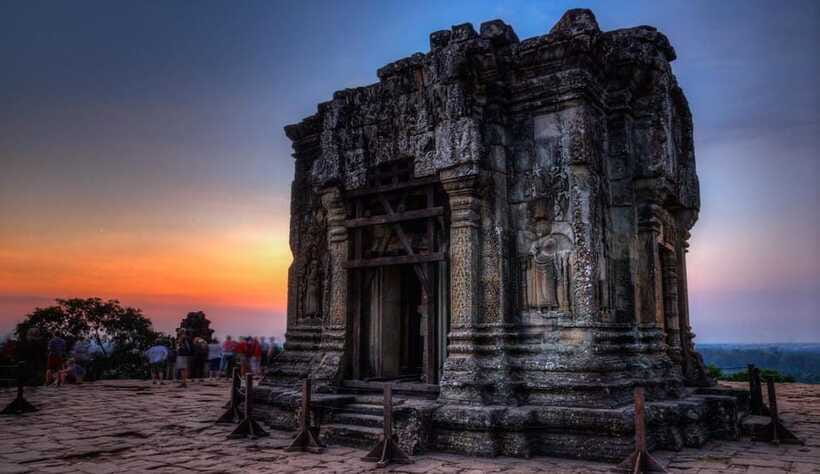
The tour ends at Phnom Bakheng, a Hindu temple mountain dedicated to Shiva. King Yasovarman built it at the end of the 9th century, making it older than the other major sites on this route.
The temple sits on a hill, and the climb to the top involves 200 steps. That number should guide your decision more than the phrase sunset tour. You need enough energy for an uphill walk after several temple visits, and you should take the ascent at your own pace.
At the top, the reward is the chance to watch the sun go down from a raised viewpoint. The appeal comes from the combination of temple architecture, height, and changing evening light. It is a fitting final stop after a day spent looking at how Khmer kings connected religion, power, water, and building design.
Sunset is also the least predictable part of the experience. Cloud cover can change the color and clarity of the view, and the exact atmosphere will vary by day. The tour promises sunset viewing, not a guaranteed cloudless sky or a specific photographic scene.
Wear shoes with a firm grip. Sandals may be comfortable in a tuk tuk, but they are less helpful on a long climb and uneven temple steps. Keep your belongings manageable, since carrying a heavy bag uphill will make the final stop harder.
If 200 steps sound like too much, you should not book this tour simply for the temples and plan to skip the climb without checking the arrangements. The sunset at Phnom Bakheng is the advertised finale, and the physical effort is central to it. Pregnant women should not take this activity.
A guide who shapes the afternoon
The guide is a key part of the experience. English is the tour language, and Son has been praised for professional, polite service, clear communication, practical tips, and strong knowledge of the temples and religious traditions. He also explains both Hinduism and Buddhism, which helps you read the sites as more than photogenic ruins.
That kind of explanation matters at Angkor. Pre Rup, Neak Pean, Preah Khan, and Phnom Bakheng were built in different periods and for different purposes. Without context, the sequence can blur into a series of towers and stones. With a guide, you can notice the differences in materials, layout, religion, and royal purpose.
Son has also worked well with families, sharing explanations while keeping children interested. That makes the tour a reasonable choice for families whose children can manage several hours of sightseeing and the final climb. The driver has been described as safe, helpful, and polite, which matters when you are moving between several sites in one afternoon.
Still, a guided tour does not remove the need for personal preparation. You will get more from the afternoon if you read the meeting time carefully, wear practical clothes, and tell the guide about any physical limits before the climb begins.
What the $55 package really covers
The $55 fee includes hotel pickup and drop-off, an English-speaking guide, local snacks, cold water, and transport. For a six-hour temple outing, that is a straightforward package. You are paying for an organized route that connects four sites, not just for a ride to one monument.
The temple ticket is separate and costs $37 per day. Add that amount before comparing this tour with other Angkor options. The total listed cost becomes $92 per person, excluding lunch and any personal purchases.
Lunch is not included. Since pickup is at 12:30 pm, you should eat before the tour or arrange your own meal earlier in the day. Snacks are supplied, but they are not a substitute for lunch.
The transport setup is worth considering. A shared tuk tuk is used for one to three people, while four or more people travel in an air-conditioned vehicle. The supplied information does not specify the exact group size beyond that transport arrangement, so do not assume you will have a private car or a private tuk tuk.
Free cancellation is available up to 24 hours before the start for a full refund. You can also reserve now and pay later, which is useful if you are still adjusting your Siem Reap plans. These policies do not change the physical demands of the route, but they reduce some booking risk.
Who will get the most from this route
I would choose this tour if you want a compact introduction to several different Angkor styles and prefer having a guide explain the religious and royal background. It is especially useful for a first visit, families who want help keeping the afternoon organized, and anyone who would rather not arrange transport between distant temples.
It also suits people who want something different from the most familiar Angkor circuit. Preah Khan provides the large, atmospheric ruin experience, while Neak Pean adds a water-centered setting and Pre Rup supplies strong early Khmer architecture. The route feels varied.
I would be more cautious if you dislike heat, uneven ruins, or uphill walking. The 200 steps at Phnom Bakheng are not a footnote. The tour also leaves Siem Reap after lunch and returns around 7:30 pm, so it is a long afternoon and evening.
This may not be the best choice if you want a slow, highly detailed study of each temple. Four sites plus sunset require careful timing. You will see a lot, but you may not have unlimited time at every courtyard and carving.
Final decision: book it for variety and a guided sunset
Book this tour if you want four contrasting temples, a clear English-speaking guide, hotel pickup, and a sunset finish without arranging the route yourself. Son’s calm explanations, religious context, and practical advice add real value, especially if this is your first time at Angkor.
Skip it if you want a relaxed pace, need a lunch break included, or cannot manage the 200-step climb. Also budget the extra $37 temple pass, since the $55 price is not the complete cost.
For an afternoon that combines Pre Rup’s brick towers, Neak Pean’s artificial island, Preah Khan’s roots and ruins, and Phnom Bakheng’s hilltop view, this is a well-balanced choice. Just treat the sunset as a physical outing, not a quick photo stop.
FAQ
What time does the tour begin?
Hotel pickup is scheduled for 12:30 pm. You should wait in the hotel lobby 15 minutes before pickup.
What time should I expect to return to Siem Reap?
The stated return time is around 7:30 pm.
How long is the tour?
The activity is advertised as six hours, though the listed pickup and return times describe an outing of about seven hours from hotel to hotel.
Is the temple ticket included?
No. The temple ticket costs $37 per day and is not included in the $55 tour price.
Is lunch included?
No. Lunch is not included, but local snacks and cold water are provided.
What transport is used?
One to three people travel by shared tuk tuk. Groups of four or more use an air-conditioned vehicle.
How many steps are there at Phnom Bakheng?
You will climb 200 steps to reach the top of Phnom Bakheng.
Is the tour suitable for pregnant women?
No. The activity is listed as not suitable for pregnant women.
Just added in Siem Reap
- Twilight Tastes of Siem Reap Include Dinner★ 5.0 · 13 reviews
- Ultimate Sunrise to Angkor Wat, Angkor Thom and Bayon Temple★ 5.0 · 3 reviews
- Trekking Tour at Phnom Kulen National Park from Siem Reap★ 5.0 · 3 reviews
- Full-Day Private Tour of Angkor Wat with Pick Up★ 5.0 · 12 reviews
- Private Day Trip to Angkor Temples with Expert Guide★ 5.0 · 4 reviews
- Siem Reap City Tour with War Museum and Killing Field★ 5.0 · 27 reviews
- Waterfall & River of 1000 Siva Linga- Kulen Mountain Private Tour★ 5.0 · 3 reviews
- Angkor Wat Experience Temple Pass and Siem Reap Food Tour★ 5.0 · 13 reviews
Angkor Temple Tours, compared.
Siem Reap Tour: Angkor Wat Sunrise, Bayon, Ta Prohm, Banteay Srei
Read our review →
Angkor Wat one Day Private Tour for All Highlight Angkor Temples
Read our review →
1-Day private Angkor Temple Tour from Siem Reap
Read our review →
Private one-day tuktuk ‘small tour’ of the oldest Angkor temples
Read our review →Browse the lists this tour appears in