
Reviewed · ANGKOR TEMPLE TOURS
Private Day Angkor Wat Temple and Banteay Srei Temple Tour
Angkor Wat is only part of this day. The route also takes you to tree-covered Ta Prohm, the finely carved Banteay Srei, and the royal center of Angkor Thom. I like the private format, which lets you adjust the pace and focus, and I like having air-conditioned transport between widely scattered temples. The main catch is the long day and the extra $37 temple pass, which brings the practical cost to about $80 per person.
Guide Chanra is especially useful if you want to shape the day around your interests. Communication through WhatsApp makes planning easier, and the guide has helped adapt access for a visitor using crutches by arranging closer vehicle access, a moped, and a tuk-tuk. That kind of care matters here, since even a temple route with limited climbing involves plenty of walking.
Key points to know before booking
- Angkor Wat gets three hours: You have enough time for the main temple rather than a rushed photo stop.
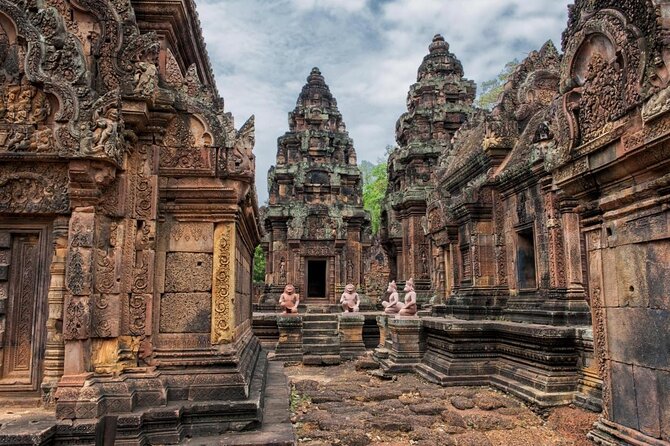
- Banteay Srei is far smaller but finely carved: Its 10th-century details reward close attention.
- The private guide can adjust the day: Chanra has helped shape visits around individual interests and mobility needs.
- You visit nine additional sites: Ta Prohm, Pre Rup, Angkor Thom, Bayon, Baphuon, Phimeanakas, and both royal terraces fill out the route.
- The temple pass is extra: Budget $37 per person for the one-day pass, on top of the $43 tour price.
- Transport includes useful basics: Air conditioning, cool water, towels, parking, road tolls, and airport pickup or drop-off are covered.
A full Angkor day for about $43, before the temple pass
At $43 per person, this is a strong value if you want a private vehicle and an English-speaking guide without paying for a multi-day package. The price covers about 8 hours and 30 minutes, transport, parking, road tolls, water, towels, and airport pickup or drop-off.
You still need to add the one-day temple pass, listed at $37 per person. That puts the main cost at about $80 per person before any other personal spending. I would judge the value on the transport and guiding, not just on the headline price. Angkor’s sites are spread over a large area, and private transport saves you from arranging separate rides between each stop.
The private setup is also more useful than a fixed group route if you have a specific wish list. Chanra has communicated through WhatsApp, accepted requests about what to see, and added suggestions of his own. You should raise your priorities before the day begins, especially if you want more time at Angkor Wat or Banteay Srei.
Other outlying temples from Siem Reap:
- Siem Reap: Kulen Mountain, Beng Mealea and Tonle Sap Tour
★ 5.0 · 1,483 reviews - Full-Day Banteay Srei & 4 Temples – Grand Tours Join-in Tour
★ 5.0 · 1,155 reviews - Siem Reap Tour: Angkor Wat Sunrise, Bayon, Ta Prohm, Banteay Srei
★ 5.0 · 931 reviews
Ta Prohm begins the day among tree roots
Ta Prohm is the first stop, with about an hour set aside. Its original name was Rajavihara, or monastery of the King, and King Jayavarman VII built it in 1186 as a Mahayana Buddhist monastery and university.
The temple is famous for its stone corridors and giant roots spreading across the ruins. The jungle setting gives Ta Prohm a different mood from the more open monuments later in the day. Here, you look for the way vegetation and masonry press against each other, with the roots covering parts of the structure.
An hour is a useful amount of time for a first visit, though the site can feel physically demanding. You may walk over uneven ground and through tight passages, so comfortable shoes matter. If anyone in your group has a foot injury or uses crutches, tell the guide early. The private format has allowed closer vehicle access and alternate transport arrangements, which can make the difference between seeing the site and sitting it out.
Pre Rup offers a short look at a 10th-century state temple
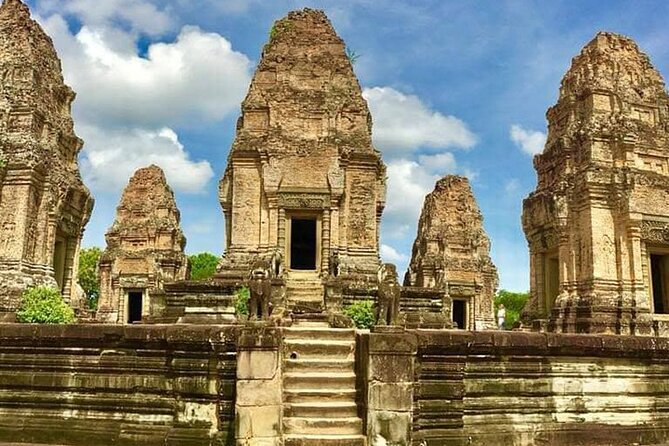
The stop at Pre Rup lasts about 20 minutes. King Rajendravarman built it as his state temple in 961 or 962, only nine years after East Mebon, located 1.3 kilometers to the north.
This is a brief stop, so you should treat it as a compact architectural visit rather than a long exploration. The temple adds an earlier period to a day otherwise shaped heavily by Jayavarman VII’s 12th-century monuments. I like that contrast, since it keeps the route from becoming a parade of similar ruins.
Twenty minutes will not support a slow examination of every detail. It does, however, give you time to see the structure and understand how the temples changed across different reigns.
Banteay Srei rewards close attention to detail
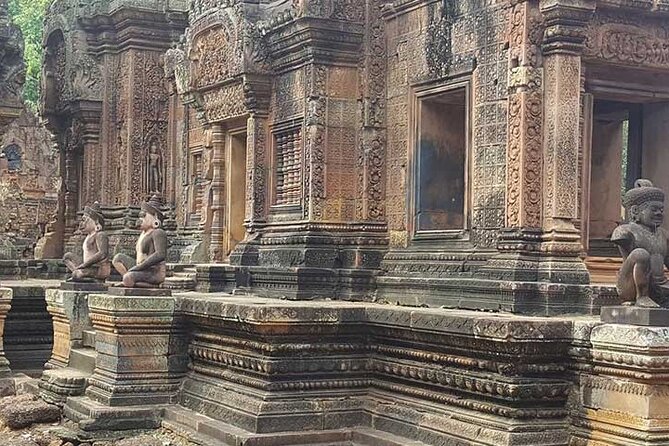
Banteay Srei receives about an hour, and I would protect that time. Built in the 10th century and dedicated to Shiva, this smaller temple is known as the Temple of Women or Pink Ladies Temple.
Its appeal is scale and detail. Instead of the enormous spaces at Angkor Wat, you get finely worked motifs, figures of gods, and tightly carved stone surfaces. The smaller size makes the decoration easier to appreciate at close range. I find it one of the best places on this route for noticing craftsmanship rather than simply taking in a grand view.
Banteay Srei is about 25 kilometers northeast of the main Angkor area near Phnom Dei, so the drive adds to the day. That distance is one reason a private car is useful. You are not spending the day trying to arrange separate rides or negotiate every transfer.
More temples within reach of Siem Reap:
- Siem Reap: Bike the Angkor Temples – Full-Day 30km Tour
★ 5.0 · 463 reviews - Preah Vihear: Full-Day Preah Vihear and Koh Ker Temple Tour
★ 4.9 · 263 reviews - From Siem Reap: Banteay Srei Temple & Grand 5 Temple Tour
★ 4.8 · 262 reviews - Angkor Wat one Day Private Tour for All Highlight Angkor Temples
★ 5.0 · 199 reviews
Angkor Thom begins at the South Gate
The Angkor Thom section opens with a 20-minute stop at the South Gate. A wide causeway crosses a 100-meter moat, flanked by naga balustrades and massive stone figures.
This approach gives you a sense of scale before you reach the monuments inside. The gate is not merely a quick entrance point. It frames Angkor Thom as a planned royal city, with the road, moat, sculptures, and gate working together.
Twenty minutes is enough for the approach and photographs, but you may want to ask the guide for a little time to explain the symbolism of the gate. The route then continues into the central monuments of the old capital.
Bayon’s stone faces need more than a quick photograph
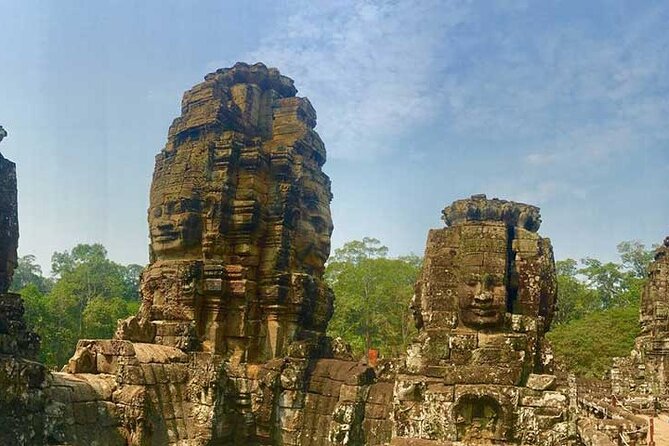
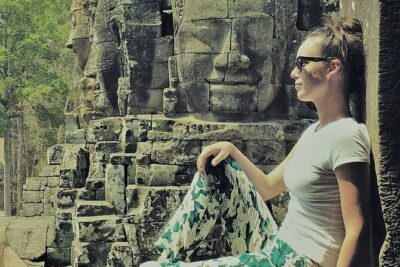
Bayon gets about 50 minutes. Its towers carry 173 remaining gigantic faces, and their identity remains a subject of debate. Local Khmer belief connects them with the four faces of Prohm, while the temple is also closely tied to the rule of Jayavarman VII.
The faces are the main attraction, but the experience comes from walking among the towers and seeing how the expressions appear from different angles. A guide can help you notice the arrangement rather than viewing Bayon as one large pile of carved stone.
The timing is fairly generous, yet Bayon can feel confusing because of its tight passages and layered towers. Keep your expectations realistic: this is an active exploration stop, not a single viewpoint.
Baphuon and Phimeanakas show Angkor Thom’s royal side
The Baphuon follows with about 40 minutes. King Udayadityavarman II built it as a state temple, and it sits inside Angkor Thom between the Royal Palace and Bayon.
Its position helps explain the city’s layout. You are no longer looking at an isolated temple in the forest. You are moving through the core of a royal center, where religious buildings and palace grounds occupied the same powerful setting.
Phimeanakas receives about 30 minutes. It is part of the royal enclosure and has a story connected to the palace area. You may pass through this section as you move between the larger monuments, so having the guide point out its place in the royal grounds makes the stop more meaningful.
These two sites are less instantly recognizable than Angkor Wat or Bayon. That is not a reason to skip them. They give the day useful context, showing how Angkor Thom functioned as a capital rather than only as a collection of famous photo spots.
The two royal terraces explain Angkor Thom’s public face
The Terrace of the Elephants takes about 30 minutes. Built by Jayavarman VII at the end of the 12th century, it stretches more than 300 meters from Baphuon in the south to the Terrace of the Leper King in the north.
Its long frontage faced the parade grounds. The scale makes more sense when you picture ceremonies and royal displays taking place in front of it. Carved elephants give the terrace its name and help you recognize its public, ceremonial role.
The Terrace of the Leper King follows with about 15 minutes. Together, the two terraces form the eastern boundary of the Royal Palace grounds. The shorter stop is enough to see the relationship between the terraces and the parade area, though it leaves little room for lingering.
I like this part of the route because it shifts your attention from individual towers to the city’s planning. You begin to see how the monuments were placed in relation to royal power, processions, and public space.
Angkor Wat gets the longest and most important visit
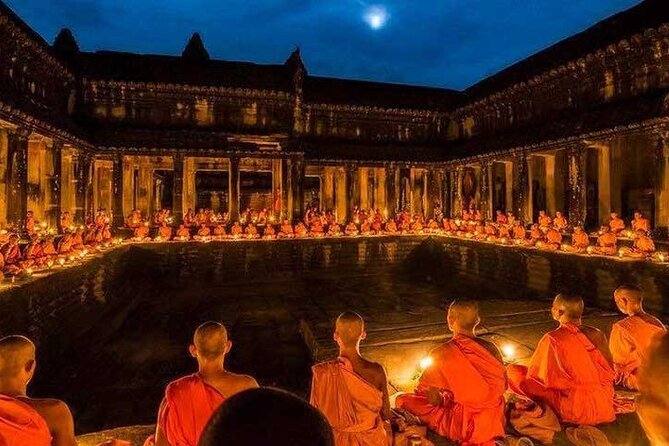
The final stop is Angkor Wat, with about three hours. That is the right amount of time for a first visit, since the complex is enormous and its details deserve patience.
The temple was designed as the earthly image of the abode of Hindu gods. Its five concentric rectangular walls and surrounding moats represent a cosmic chain of mountains and ocean, while the central tower represents Mount Meru, the center of the Hindu and Buddhist universe.
The symbolism is easier to grasp when you move through the structure in stages. First comes the broad approach and outer setting. Then the galleries, carvings, towers, and interior spaces draw you toward the center. A guide can help connect the layout with the beliefs that shaped it, rather than leaving you with only a series of impressive photographs.
Three hours also gives you room for the physical reality of the site. You will walk, pause, retrace parts of the route, and wait while others move through narrow areas. Do not treat the long visit as wasted time. Angkor Wat is the one place on this route where rushing can leave you with a grand view but little understanding.
Private transport makes the long route easier
The tour includes an air-conditioned vehicle, which matters in Cambodia’s heat, particularly on a day that combines ten stops. Cool water and towels are also supplied. Parking fees and road tolls are covered, so you are not handling small transport costs at every stage.
Pickup and drop-off at the airport are included, a useful feature if the timing of your visit matches your arrival or departure plans. The stated opening hours are 8:00 AM to 4:00 PM, Monday through Sunday, while the tour itself lasts about 8 hours and 30 minutes. Confirm the exact pickup time when booking so the full route fits your schedule.
This is a private activity, meaning only your group participates. That does not remove the walking or make the temples effortless, but it gives you a better chance to pause, shorten a stop, or spend more time at a favorite site.
Who should choose this Angkor route
I would choose this tour if you want to see the major Angkor highlights in one concentrated day and prefer not to share the vehicle with strangers. It suits first-time visitors who want an English-speaking guide to explain the religious symbolism, royal planning, and changing temple styles.
It is also a good fit for couples, families, or small groups with different energy levels. A private guide can respond to the needs of the group more easily than a fixed coach schedule. The assistance provided to a visitor with crutches shows why it is worth discussing mobility concerns before the tour begins.
I would think twice if you dislike full sightseeing days. The route includes long walks, nine stops before or around Angkor Wat, and a final three-hour visit at the largest complex. You may prefer a shorter private outing if you want a slow pace and time for meals or rest.
Should you book the $43 private tour?
Book it if your priority is broad coverage, private transport, and a guide who can adjust the day. The strongest features are the three-hour Angkor Wat visit, the inclusion of Banteay Srei and Ta Prohm, and the flexibility shown by Chanra when arranging a more accessible visit.
Budget for the additional $37 temple pass, and remember that the overall day will be active. If you can handle the walking, this route gives you an efficient first look at Angkor’s most important monuments without sacrificing the smaller, more detailed Banteay Srei.
FAQ
How long does the tour last?
The tour lasts approximately 8 hours and 30 minutes.
What is the price of the tour?
The listed tour price is $43 per person. The one-day temple pass costs an additional $37 per person.
Is this a private tour?
Yes. Only your group participates in the activity.
Is an English-speaking guide included?
Yes. An English tour guide is included.
Is transportation included?
Yes. The tour includes an air-conditioned vehicle, parking fees, road tolls, cool water, and towels.
Is airport pickup or drop-off available?
Yes. Pickup and drop-off at the airport are included.
Which temples are visited?
The route includes Ta Prohm, Pre Rup, Banteay Srei, Angkor Thom South Gate, Bayon, Baphuon, Phimeanakas, the Terrace of the Elephants, the Terrace of the Leper King, and Angkor Wat.
Can the tour help someone with limited mobility?
The private format can allow adjustments. Arrangements have included closer vehicle access, a moped, and a tuk-tuk for a visitor using crutches, but you should discuss your needs with the guide in advance.
Just added in Siem Reap
- Twilight Tastes of Siem Reap Include Dinner★ 5.0 · 13 reviews
- Ultimate Sunrise to Angkor Wat, Angkor Thom and Bayon Temple★ 5.0 · 3 reviews
- Trekking Tour at Phnom Kulen National Park from Siem Reap★ 5.0 · 3 reviews
- Full-Day Private Tour of Angkor Wat with Pick Up★ 5.0 · 12 reviews
- Private Day Trip to Angkor Temples with Expert Guide★ 5.0 · 4 reviews
- Siem Reap City Tour with War Museum and Killing Field★ 5.0 · 27 reviews
- Waterfall & River of 1000 Siva Linga- Kulen Mountain Private Tour★ 5.0 · 3 reviews
- Angkor Wat Experience Temple Pass and Siem Reap Food Tour★ 5.0 · 13 reviews
Angkor Temple Tours, compared.
Siem Reap Tour: Angkor Wat Sunrise, Bayon, Ta Prohm, Banteay Srei
Read our review →
Angkor Wat one Day Private Tour for All Highlight Angkor Temples
Read our review →
1-Day private Angkor Temple Tour from Siem Reap
Read our review →

Private one-day tuktuk ‘small tour’ of the oldest Angkor temples
Read our review →Browse the lists this tour appears in