
Reviewed · KILLING FIELDS & GENOCIDE MUSEUM TOURS
Private Half Day To Killing Field & S21 Genocidal Museum in Phnom Penh
The most important thing about this Phnom Penh tour is its human scale. At Tuol Sleng, a former high school turned prison, and Choeung Ek, the execution site known as the Killing Fields, you confront Cambodia’s recent past in the places where it happened. A private guide can help connect the rooms, photographs, mass graves, and memorials to the wider story of the Khmer Rouge years.
I like the private vehicle and hotel pickup, which save you from arranging separate tuk-tuks between two emotionally demanding sites. I also like the chance to request a guide such as Silong, Sreyneang, Lina, or Barang, all praised for clear explanations and, in some cases, personal family stories. The main drawback is that guide quality can vary, especially for English pronunciation, so clear communication matters on a tour where the spoken explanation is a large part of what you pay for.
Key points to know before booking
- Two essential sites in one morning or afternoon: Visit Tuol Sleng Genocide Museum and Choeung Ek, the two places most closely linked to Phnom Penh’s Khmer Rouge story.
- Private touring for up to six people: Your party travels together with its own guide and driver rather than joining a large coach group.
- Personal storytelling can add real weight: Guides including Barang and Sreyneang have shared family experiences connected to Cambodia’s painful past.
- Air-conditioned transport is included: Hotel pickup, drop-off, a private driver, and drinking water are part of the package.
- Budget for extra admission: The listed entrance fees are $5 per person for Tuol Sleng and $3 per person for Choeung Ek.
- Allow emotional space: This is serious historical education, not a light sightseeing stop, and younger children may find it difficult.
Why these two Phnom Penh sites belong together
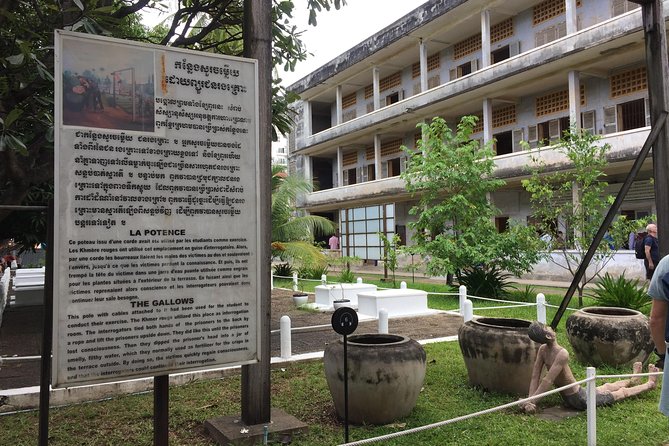
Tuol Sleng and Choeung Ek tell two connected parts of the same story. Tuol Sleng shows the machinery of detention, interrogation, and torture. Choeung Ek shows what happened to many prisoners after they were taken away from the prison.
That connection gives the half-day its force. You do not simply visit two unrelated museums. You follow the path from a former school in central Phnom Penh to an execution site outside the city. The first stop explains the system. The second gives you quiet space to think about its human cost.
The Khmer Rouge controlled Cambodia from 1975 to 1979. The sites focus on the regime’s persecution of political prisoners and ordinary people caught in its system of fear. Your guide may also explain the events that led to the genocide and what followed, since several guides are praised for placing the period within a wider story rather than reciting dates alone.
I would not plan this as a casual filler activity between meals and shopping. The subject is grim, and the best way to approach it is with time, attention, and respect.
More Killing Fields Tours in Phnom Penh
- The Killing Field and Toul Sleng Genocide Museum (S21) Tour
★ 5.0 · 1,977 reviews - Killing field and Toul Sleng genocide museum Tour
★ 5.0 · 610 reviews - Visit 11 Places in One Day including S21 & Killing Field
★ 5.0 · 361 reviews
Tuol Sleng: walking through a former school and prison
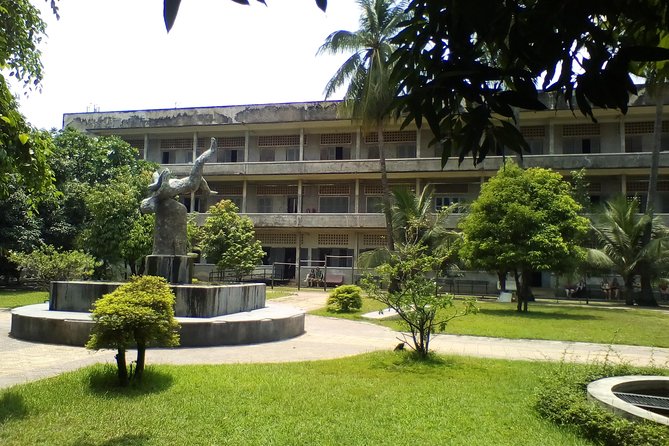
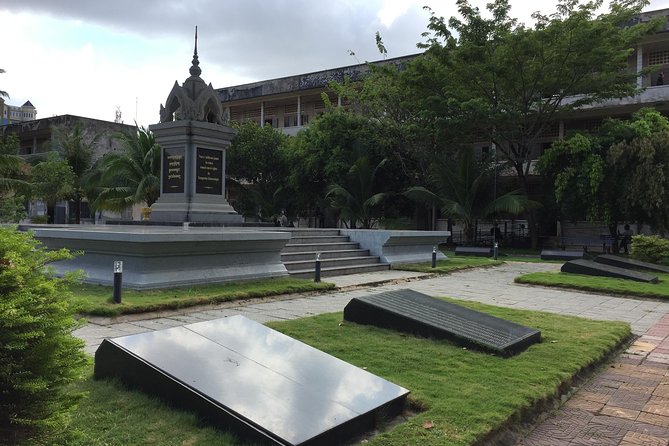
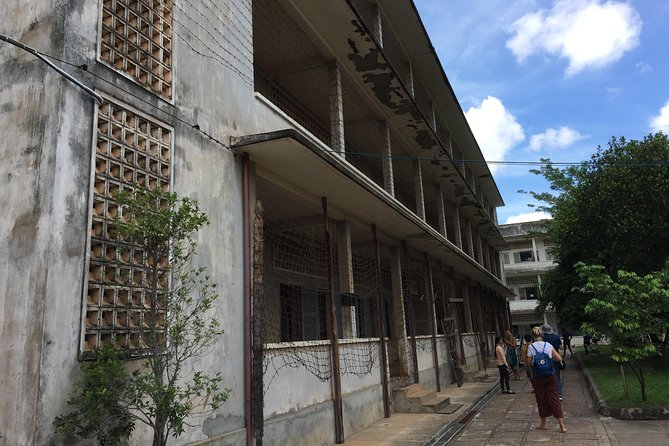
The tour generally begins at Tuol Sleng Genocide Museum, also known as S21. Before the Khmer Rouge took control, the site was a high school. Under the regime, it became a detention center where prisoners were interrogated, tortured, and killed.
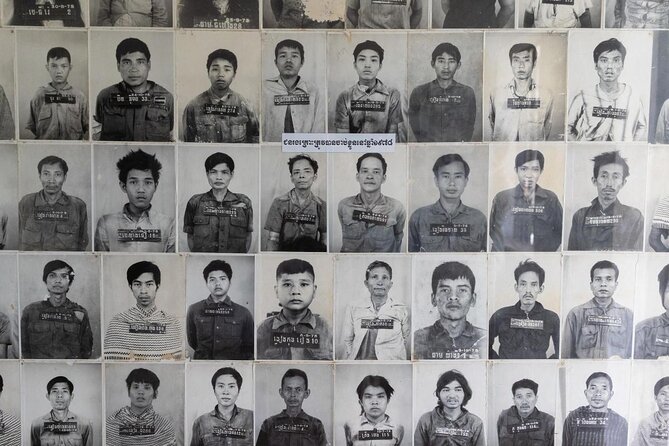
The change from school to prison is part of what makes the site so disturbing. The buildings and rooms help you picture how an ordinary place was turned into an instrument of terror. Inside, you can see materials and displays connected to prisoner interrogation, along with photographs, cells, and evidence of the conditions detainees faced.
The site records that around 17,000 people passed through its gates, with only seven known survivors. Those numbers can feel abstract until you see the rooms and the faces in the photographs. A good guide helps keep the focus on individuals rather than letting the visit become a string of shocking statistics.
Plan on about two hours here according to the stated schedule, though the overall experience is advertised as roughly three to four hours. That timing does not leave much room for delays, long conversations, or an extended visit at both sites, so treat the schedule as approximate.
Tuol Sleng is also the place where the guide’s English matters most. You will want to understand explanations about the prison, the victims, and the political setting. Several guides, including Silong and Sreyneang, receive strong praise for explaining difficult material in simple terms and answering questions clearly.
At the same time, one disappointed party reported difficulty understanding a guide’s strong accent. That is a fair concern. English is the working language of the tour, but it is not the first language of the Cambodian guides. If you are unsure during the visit, ask the guide to repeat or slow down. The private format makes that easier than it would be in a large group.
Choeung Ek: a quiet place with a terrible past
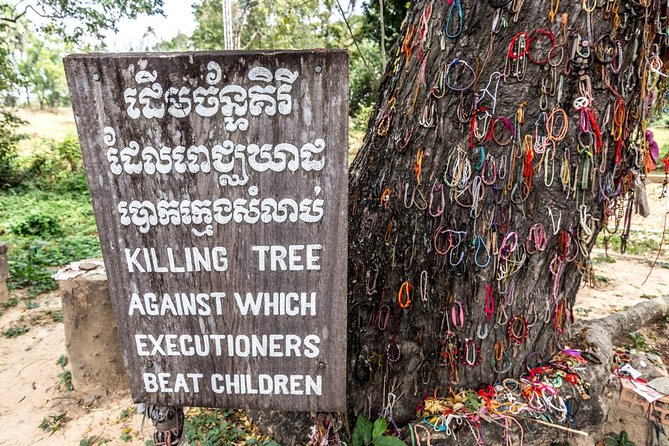
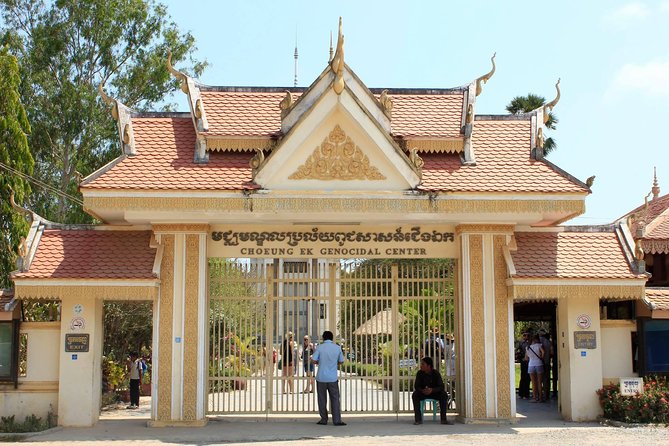
From Tuol Sleng, you continue by private vehicle to Choeung Ek Genocidal Center. The site was once a Chinese cemetery before it was used as an extermination camp for prisoners brought from Tuol Sleng and other detention centers.
The contrast with Tuol Sleng is striking. Choeung Ek is now described as peaceful and quiet, with open areas that give you room to reflect. That calm can feel unsettling because the ground beneath you is linked to mass executions and burial pits.
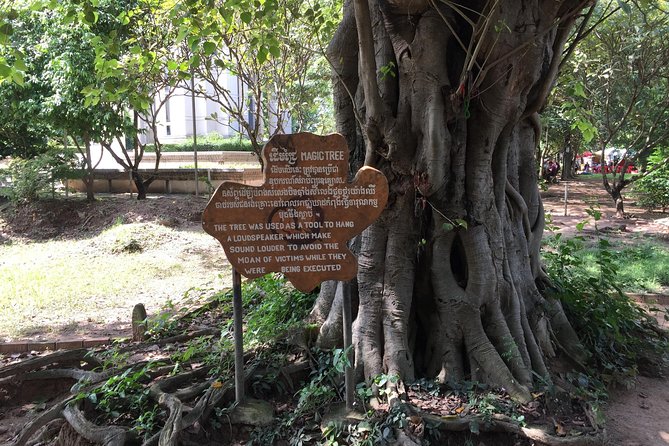
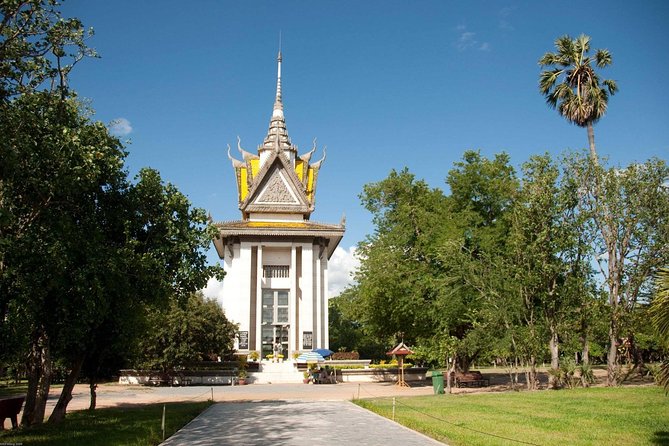
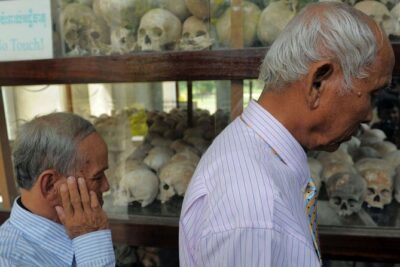
The memorial stupa contains remains recovered from mass graves. The site records that 8,985 bodies were exhumed. You may also see reminders of the graves and fragments of clothing that remained in the soil. These details bring the scale of the killings close to the present, but they also mean you should approach the site with care and respect.
Your guide can explain how prisoners were transported from S21 to Choeung Ek and how the two sites fit together. This is where a private tour earns its keep. You can ask about details that trouble or confuse you, then take quiet time when you need it.
One guide, Sam, was praised for knowing when to stop talking and allow silence. That is an important skill here. A guide who fills every moment with facts can make the visit feel rushed. At Choeung Ek, you should have space to process what you have seen.
The guides make the biggest difference
The strongest reason to choose a private tour is the guide, not simply the car. The company uses several English-speaking guides, and individual experiences can vary.
Silong is repeatedly praised for clear explanations, broad knowledge of the genocide, and useful advice about the rest of a Cambodia trip. Sreyneang, also called Neang, is praised for explaining dates and events in a structured way. Lina is described as thoughtful and sensitive, with strong command of the period.
Barang has shared personal family experiences connected to the Khmer Rouge years. That kind of account can make the history feel immediate, but it can also be emotionally heavy. You should not expect every guide to tell the same story or offer the same amount of personal detail.
Other named guides include Samnang, Sony, Sok, Sambath, and Thavy. Some accounts describe guides who added personal or family stories, while others praise their ability to answer questions or adjust the pace. One group even received an extra hour with its guide, though you should not assume that will happen on every booking.
The main limitation is consistency. One party had trouble following a guide’s accent and ended up relying heavily on museum signs and other group explanations. That does not mean the tour is unsuitable, but it does mean you should treat spoken English as an important factor when choosing a guide. If the booking process allows a request, asking for a guide by name may be sensible, though assignment cannot be guaranteed from the information provided.
Other history you should not skip in Phnom Penh:
- Killing Fields and Prison S21 Bus Tour
★ 4.0 · 206 reviews - Tuol Sleng Genocide Museum (S-21) and Choeung Ek Killing Fields Tour
★ 5.0 · 123 reviews - Phnom Penh City Tour, Silver Pagoda, Genocide Museum, Killing Fields
★ 5.0 · 123 reviews - A Full Day Tour for Royal Palace, S21, Killing Fields & More
★ 5.0 · 115 reviews
Private transport and timing in Phnom Penh
The package includes hotel pickup and drop-off in an air-conditioned private vehicle. A licensed private driver, drinking water, and travel insurance are also listed. For Phnom Penh’s heat and traffic, air conditioning is more than a small comfort, especially after walking through emotionally intense exhibits.
Private transport also lets you stay with your own group of up to six people. You do not need to wait for strangers at each stop, and you can ask the driver or guide about places you pass on the way. Sony, for example, was praised for answering questions about the surrounding area during the drives.
The experience is advertised as lasting about three to four hours. The two listed stops each allow about two hours, so the actual pace may depend on traffic, how long you spend at each site, and how much discussion you want. If you have a flight, train, or fixed restaurant reservation afterward, leave a generous buffer.
Hotel pickup is included, but the supplied details do not specify every pickup area or a precise start time. Confirm your location and meeting time when you book. One account describes airport pickup, but you should not assume airport collection is automatically included for every reservation.
What the $130 group price really buys
The price is $130 per group of up to six people, not $130 per person. That makes the cost reasonable for a small party that values private transport and a dedicated guide. For six people, the base price works out to about $21.67 per person before admission fees. For two people, it is $65 each before entrance fees.
Admission is separate. The listed charges are $5 per person for Tuol Sleng and $3 per person for Choeung Ek, making $8 per person for both sites. Meals and drinks beyond the provided water are not included.
You are paying for more than a ride between museums. The price covers the guide, driver, vehicle, pickup and drop-off, and the ability to ask questions without competing with a busload of people. If your group is large enough to share the cost, the value improves quickly.
If you are a solo visitor or a couple on a tight budget, you may compare this with visiting independently. The private option makes the most sense if you want context, transportation, and a conversation tailored to your questions. It makes less sense if you prefer to read signs quietly and do not need a guide.
Preparing yourself for a difficult visit
This is not a comfortable sightseeing experience. You will encounter accounts of torture, photographs of victims, prison cells, human remains, and reminders of mass executions. The emotional effect varies, but you should expect the visit to stay with you.
I would not recommend it for young children. An adult family group with children aged 24 and 26 found it worthwhile, but that is very different from bringing small children into a museum centered on torture and murder.
Wear practical clothing and shoes suitable for walking, though the supplied information does not specify a dress code. Bring water if you want more than the bottle provided, and avoid scheduling a demanding activity immediately afterward if you know difficult sites affect you strongly.
The best approach is to listen, ask respectful questions, and accept periods of silence. You do not need to force an emotional response. The places speak clearly enough.
Who will get the most from this tour
This experience suits first-time visitors to Phnom Penh who want to understand Cambodia’s recent past rather than see only its temples and markets. It is particularly useful if you prefer history explained in plain language and want to connect two important sites in one outing.
It also suits families with older teenagers or adults, couples, and small groups of friends. The private format is helpful when group members need different amounts of time at the displays or want to ask personal questions.
You may want another option if you dislike guided interpretation, find graphic historical material overwhelming, or need a tightly fixed three-hour schedule. You should also think carefully about booking if no one in your party is comfortable communicating with a guide whose English pronunciation may vary.
Cancellation is free if you cancel at least 24 hours before the start time. Changes or cancellations made within 24 hours are not accepted for a refund, and the cutoff follows Phnom Penh local time.
Should you book this Phnom Penh tour?
I would book it if you want the two sites explained together, prefer a private vehicle, and value a human guide over an audio guide. The best guides, including Silong, Sreyneang, Lina, Barang, and Sam, can add context, answer questions, and help you know when to pause.
I would be more cautious if spoken English is your main concern or if you need exact timing. Ask about guide availability and pickup details before paying, and remember to add the $8 per person in entrance fees.
For a small group, the $130 price is fair because it includes transport, a driver, hotel service, and private guidance. This is a serious half-day, but it is one of the clearest ways to begin understanding Phnom Penh and the people shaped by Cambodia’s darkest period.
FAQ
How long does the tour last?
The experience is advertised as approximately three to four hours. The stated schedule allows about two hours at Tuol Sleng and two hours at Choeung Ek, so the exact duration may vary.
What sites are included?
The tour visits Tuol Sleng Genocide Museum, also called S21, and Choeung Ek Genocidal Center, commonly known as the Killing Fields.
Is hotel pickup included?
Yes. Hotel pickup and drop-off are included, along with private transportation in an air-conditioned vehicle.
How many people can join the private tour?
The $130 group price covers up to six people. Only your group participates in the private activity.
Are entrance fees included?
No. Tuol Sleng admission is listed as $5 per person, and Choeung Ek admission is listed as $3 per person.
Is a guide included?
Yes. The package includes a private English-speaking tour guide. Named guides associated with the experience include Silong, Sreyneang, Lina, Barang, Samnang, Sony, Sok, Sambath, and Thavy.
Is food included?
No. Meals and drinks are not included, though pure drinking water is provided.
Can I cancel for a full refund?
Yes, if you cancel at least 24 hours before the experience start time. Cancellations or changes made less than 24 hours before the start time are not accepted for a refund.
Just added in Phnom Penh
- Oudong Mountain And Floating Village Cycle Tour★ 5.0 · 25 reviews
- A Half Day Tour in Phnom Penh City★ 4.5 · 36 reviews
- Half-Day Phnom Penh City Tours★ 5.0 · 22 reviews
- Phnom Penh To Siem Reap Private Transfer Mini-Van-Car★ 5.0 · 56 reviews
- Visit 9 Places in 3 Hours by Private Tuk-Tuk★ 5.0 · 73 reviews
- Phnom Penh Vital Discovery-Full Day Tour (Including all services)★ 5.0 · 67 reviews
- From Phnom Penh: Oudongk Mountain and Koh Chen Island Tour★ 4.8 · 68 reviews
- A day Trip Sightseeing Phnom Penh – Siem Reap – Private English Speaking Driver★ 5.0 · 67 reviews
Killing Fields & Genocide Museum Tours, compared.
Killing field and Toul Sleng genocide museum Tour
Read our review →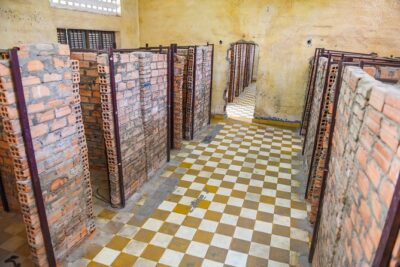
Tuol Sleng Genocide Museum (S-21) and Choeung Ek Killing Fields Tour
Read our review →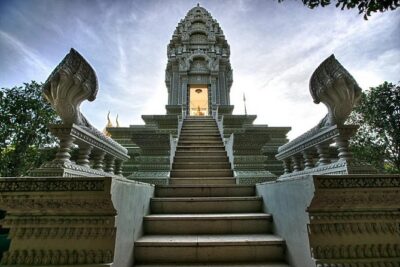
Phnom Penh City Tour, Silver Pagoda, Genocide Museum, Killing Fields
Read our review →
A Full Day Tour for Royal Palace, S21, Killing Fields & More
Read our review →Browse the lists this tour appears in