
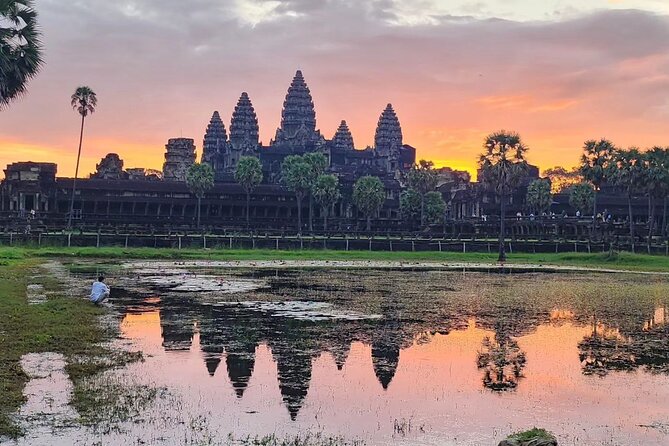
Reviewed · ANGKOR TEMPLE TOURS
Siem Reap Shared Full-Day Guided Tour of Angkor Temples
Angkor is far easier to understand with a guide, and this eight-hour tour gives you the major temples in one well-packed day. You’ll see the smiling stone faces at Bayon, the tree-covered ruins of Ta Prohm, and the grand galleries of Angkor Wat. I like the small-group choice, capped at six people, and the clear route through the main sights. Guides such as Buth have been praised for making the history easy to follow.
I also like the practical setup: hotel pickup, cold water, and transport by tuk-tuk or air-conditioned van. The main catch is cost clarity. The advertised $25 covers the tour, but you still need to buy the $37 one-day temple pass and pay for lunch, bringing the basic day to at least $62 before food.
Key things to know before booking
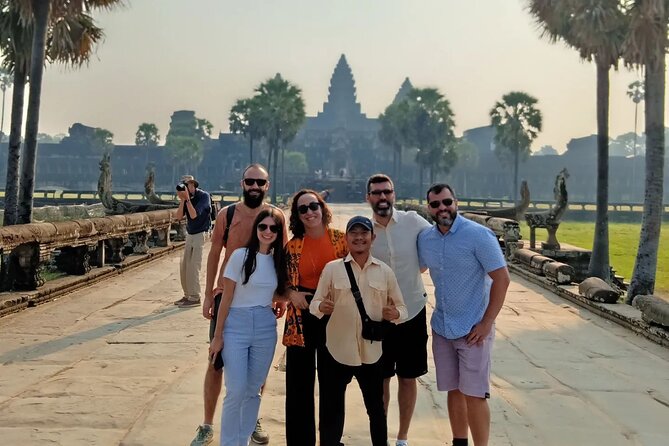
- Small group option: Choose the premium shared tour for a maximum of six people and more time near your guide.
- Four major temple stops: Angkor Thom, Bayon, Ta Prohm, and Angkor Wat form the core of the day.
- Temple pass is extra: Budget $37 per person for the one-day Angkor Archaeological Park ticket.
- Transport depends on group size: One or two people ride by tuk-tuk, while groups of three or more use an air-conditioned van or minibus.
- Dress matters: Cover your shoulders and knees, especially at Angkor Wat, where the rule is enforced.
- Long but useful day: Pickup is around 8:30 to 9:00 AM, with a return near 5:00 PM.
A full day built around Angkor’s essential temples
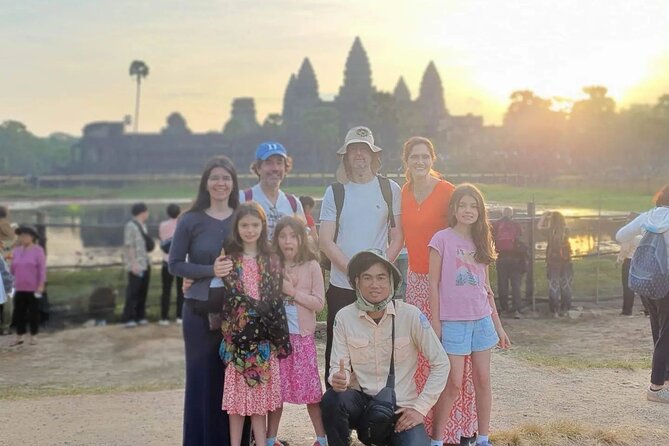
This is the classic first-day route through Angkor. It covers the monuments most people hope to see, but it does so with enough time at each major temple to make the day worthwhile.
You leave Siem Reap in the morning and return around 5:00 PM. That sounds like a long day, and it is. Still, Angkor is spread over a large area, so trying to see the main sites in only a few hours would leave you rushing from one gate to the next.
The tour offers two shared-group formats. The premium version has no more than six people. The standard version allows up to 15. I would choose the smaller group if the price difference is reasonable for your date, especially if you want to ask questions, take photos without holding up a crowd, or move through the temples at a steady pace.
The tour is not a quiet private outing. You share the guide and vehicle with other people. But the smaller group keeps it from feeling like a large procession, and the route gives you a useful introduction to the Angkor complex in one day.
More temples within reach of Siem Reap:
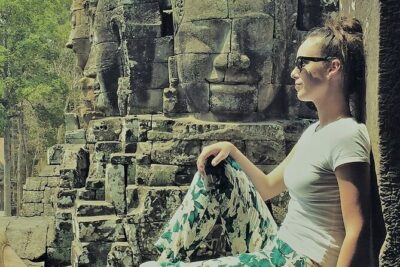
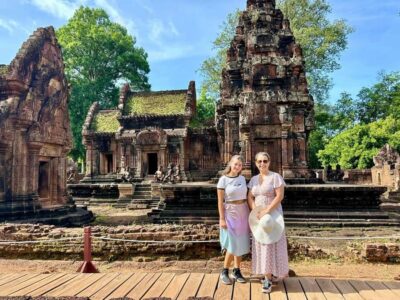
- Siem Reap Tour: Angkor Wat Sunrise, Bayon, Ta Prohm, Banteay Srei
★ 5.0 · 931 reviews - Siem Reap: Bike the Angkor Temples – Full-Day 30km Tour
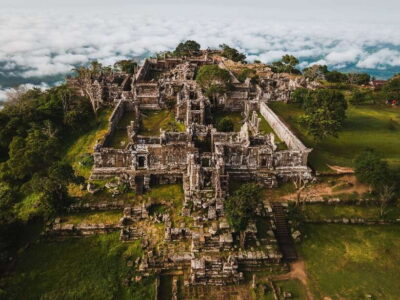
★ 5.0 · 463 reviews - Preah Vihear: Full-Day Preah Vihear and Koh Ker Temple Tour
★ 4.9 · 263 reviews
Starting at your hotel and buying the temple pass
Pickup takes place at your hotel lobby between 8:30 and 9:00 AM, with departure scheduled for about 9:00. You first go to the ticket office if you have not already bought your Angkor pass.
The one-day pass costs $37 per person and is not included in the tour price. You can also buy it online in advance. I strongly recommend doing that, because the morning is better spent at the temples than waiting to sort out admission.
This separate ticket is the biggest point to understand before booking. The $25 tour price sounds low because it covers the guide, shared transport, hotel transfers, and cold water, but not entry or lunch. With the pass added, the day costs at least $62 per person, before your midday meal.
That total can still be good value. A guide who explains the carvings, religious ideas, and royal buildings gives you far more than transport alone. If you only want a driver to drop you at the gates, you may find a cheaper arrangement. If you want context and a planned route, this tour makes better sense.
Passing through Angkor Thom’s South Gate
The first proper stop is the South Gate of Angkor Thom. The approach is one of the memorable sights of the morning, with large stone figures lining the causeway and enormous carved faces above the gate.
You get about 15 minutes here. That is enough for a quick look and photographs, but not a long lesson on every figure. Keep your camera ready as the vehicle approaches, since the gate itself is part of the experience rather than just a point on the way to the next temple.
Angkor Thom was a huge royal city, and the gate gives you an immediate sense of its scale. The smiling faces also prepare you for Bayon, where similar faces appear again and again in a more crowded, vertical setting.
Bayon and its maze of smiling faces
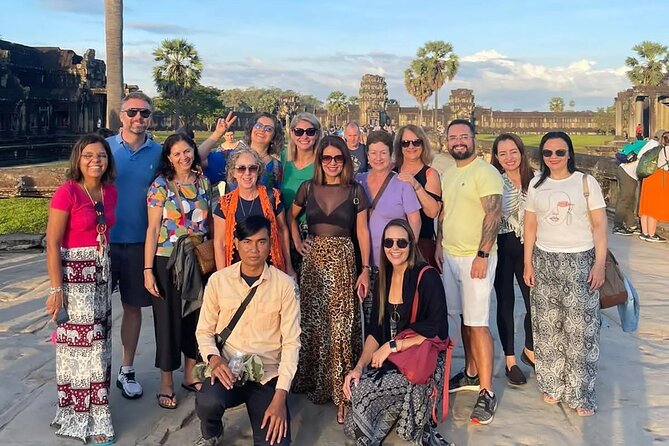
Bayon receives about 45 minutes, which is a useful amount of time for a first visit. The temple is famous for its towers carved with large faces, often viewed from several angles as you walk through the stone corridors.
This is one of the places where a guide adds real value. Without explanation, Bayon can feel like a maze of towers and narrow passages. With help, you can pay attention to the faces, the layout, and the way the temple formed part of Angkor Thom’s royal center.
The stone is weathered, and some routes may feel uneven. Wear shoes you can walk in comfortably, and do not expect every part of the temple to be open or easy to reach. Forty-five minutes gives you a focused visit, but it will not cover every corner.
A few more things to do in Siem Reap worth a look
- Siem Reap: Full-Day Angkor Wat Guided Tour with Sunset
★ 4.9 · 3,803 reviews - Full-Day Angkor Wat Sunrise Private Tour with Guide from Siem Reap
★ 5.0 · 2,920 reviews - Siem Reap: Angkor Wat Sunrise and Full-Day Sightseeing Tour
★ 4.9 · 2,828 reviews - Full-Day Guided Sunset Tour of Angkor Wat
★ 5.0 · 1,507 reviews
Baphuon, a steep temple mountain
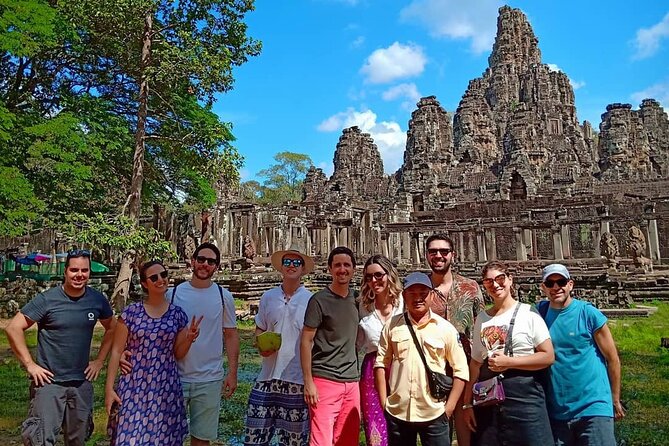
Next comes Baphuon, another 45-minute stop. This pyramid-shaped temple was built in the 11th century and was originally dedicated to Shiva. Its design gives you a different experience from Bayon, with a stronger sense of climbing toward a high central structure.
The name and history can be hard to keep straight when you are seeing several temples in one day. That is another reason the guide matters. A clear explanation helps you separate Baphuon from Bayon and understand that the Angkor complex was not built all at once or for one single purpose.
The stop involves walking, and the temple’s raised form can be more demanding than the broad courtyards around other monuments. If you have limited mobility, ask the operator for practical details before booking. The tour information says most people can participate, but it does not promise step-free access.
The Terraces of the Elephants and Leper King
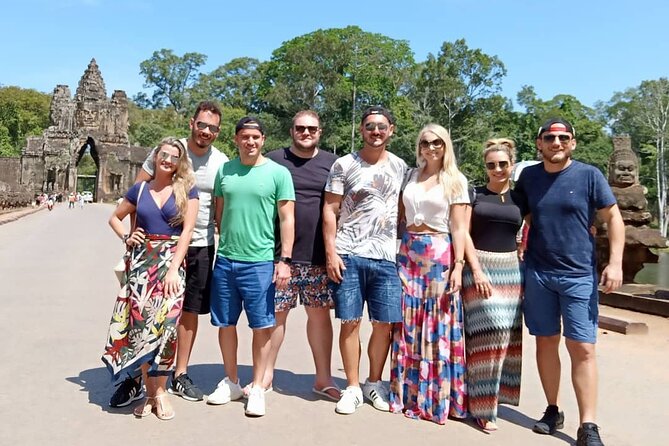
The Terrace of the Elephants takes about 15 minutes. This long ceremonial platform was used by King Jayavarman VII to watch royal processions and public events.
It is not a temple visit in the same sense as Bayon or Ta Prohm. The attraction is the carved platform and its role in the royal city. Because the stop is short, you will mainly walk along the terrace, hear the explanation, and take in its scale.
The nearby Terrace of the Leper King gets another 15 minutes. Its name comes from a moss-covered statue traditionally connected with the figure of Yama, the god of death. The terrace has hidden carvings and a more enclosed feel than the open platform beside it.
These two stops are brief, but they help fill out the picture of Angkor Thom as a functioning capital, not just a collection of isolated ruins. I would not book this tour solely for the terraces, but they make a worthwhile addition between the larger temple visits.
Ta Prohm and the power of atmosphere
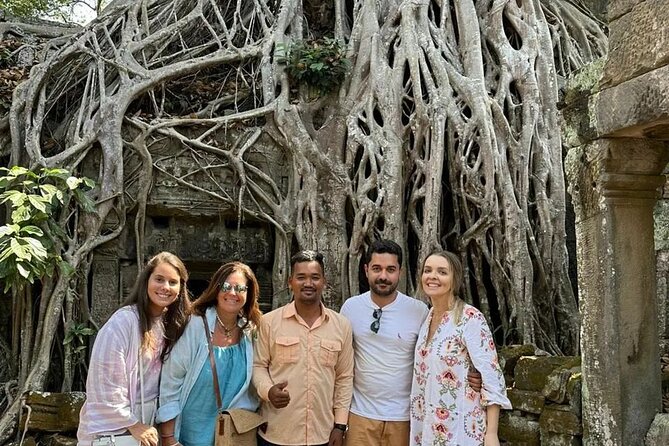
Ta Prohm is scheduled for one hour, and that is one of the better time allowances of the day. The 12th-century Buddhist temple is famous for its trees growing around and over the stone, as well as for its appearance in Tomb Raider.
The movie connection draws many people here, but the temple is more than a film setting. Ta Prohm shows how architecture and nature can appear to push against each other. Roots wrap around walls, doorways frame broken courtyards, and the remaining carvings have a rougher feel than the polished grandeur of Angkor Wat.
Your guide can help you notice details that are easy to miss, such as the Buddhist character of the site and the way its galleries were arranged. One hour is enough to walk the main route without treating the temple like a quick photo stop.
This is also a place where group size matters. Small groups can gather near a carving, listen for a few minutes, and move on without creating a large knot of people. In a group of up to 15, the guide may need to keep everyone together more carefully.
Lunch near Srah Srang, with the bill on you
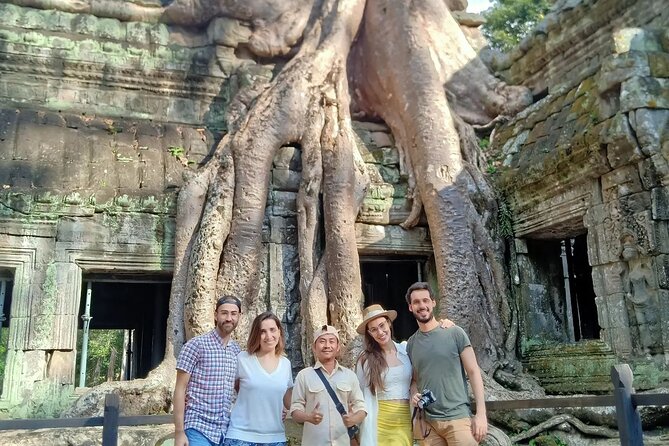
The midday break takes about an hour near Srah Srang. Lunch is not included, but the guide recommends a nearby Cambodian restaurant.
This arrangement keeps the tour simple, though you should carry cash for your meal unless you have confirmed another payment method. The supplied information does not give a fixed menu or meal price, so do not assume lunch is part of the $25 fee.
Srah Srang is a useful pause after several hours of walking. The stop helps break up the day before Angkor Wat, which receives the longest visit. You can also use this time to refill your water or ask the guide about the final temple.
Cold water is included during the tour, but it is still sensible to bring any extra drinks you need. Cambodia’s heat can make a full day among stone courtyards tiring, even when the vehicle is comfortable.
Angkor Wat gets the final two hours
The day ends at Angkor Wat, with about two hours set aside for the world-famous temple. This is the longest stop, and rightly so. Angkor Wat is the largest religious monument in the world and the centerpiece of the Angkor complex.
The scale takes time to absorb. You walk through broad approaches, courtyards, galleries, and carved walls rather than visiting one compact building. A guide can point out the temple’s design, its religious purpose, and the scenes shown in the bas-reliefs.
Two hours is enough for a strong first look, but it is not a complete study of every gallery. You will need to follow the group’s timing, so speak up early if there is a particular section you want to see.
Pay close attention to the dress rules here. Your pants or skirt must cover the knees, and your shirt must cover the shoulders. Miniskirts, shorts, tank tops, and revealing clothing are not accepted. A scarf may help at many temples, but for Angkor Wat, proper clothing is the safer choice.
The afternoon timing also means this is not the sunrise version of the experience. A sunrise option is mentioned separately, with pickup around 4:30 to 5:00 AM. Confirm that you have selected the correct option if an early start is important to you.
Tuk-tuk or air-conditioned van?
Transport changes with group size. One or two people travel by tuk-tuk. Groups of three or more use an air-conditioned van or minibus.
A tuk-tuk gives you open-air movement between the temples and a closer feel for the roads around Siem Reap. The tradeoff is exposure to heat, dust, and traffic. An air-conditioned vehicle is more restful during a full day, particularly during the hottest part of the afternoon.
The tour includes hotel pickup and drop-off, so you do not need to arrange separate transport to a meeting point. Pickup is at the hotel reception, but you should be ready during the full 8:30 to 9:00 window rather than expecting an exact minute.
The maximum group size is listed as 15, while the premium option limits the group to six. Check the option name carefully when booking. The smaller group and standard group are not the same product, even though both use shared transport and an English-speaking guide.
How strong is the guiding?
The guide is the main reason to choose this experience instead of arranging transport alone. The day includes several monuments with similar stonework, royal names, and religious references. A good explanation keeps Bayon, Baphuon, Ta Prohm, and Angkor Wat from blurring together.
Buth is specifically praised for making the day interesting and informative. Another account describes a German-language day with Vannak, who explained the history of three major temples at length. The standard details identify the guide as English-speaking, so if you need German or another language, confirm that before paying.
The small group should make it easier to hear the guide and ask questions. That matters in courtyards where sound can carry poorly. It also gives you a better chance of getting a direct answer instead of waiting for the guide to finish with a large crowd.
Still, the experience depends partly on the individual guide assigned that day. The tour includes a professional English-speaking guide, but the exact person is not guaranteed. If Buth or Vannak is important to you, ask the provider whether that guide is available.
Who gets the best value from this tour?
I would recommend this tour to a first-time visitor with one full day for Angkor. It covers the main monuments without forcing you to plan roads, ticket stops, or temple order on your own.
It suits couples, families with older children, and solo visitors who prefer some company. The premium six-person version is especially useful if you want a more personal feel but do not want to pay private-tour rates.
It is less suitable if you want a slow, photographic study of one or two temples. The schedule is full, and the short stops at the South Gate and the two terraces are designed to fit more into one day.
Children under 12 are not eligible for the shared tour. The supplied details say children under 12 may join free on a private tour only, so families with younger children should choose the private option rather than assume the shared price applies.
Free cancellation is available if you cancel at least 24 hours before the start time. Changes or cancellations inside that window are not accepted for a refund.
Should you book it?
Book this tour if you want the major Angkor sights explained by a guide, with hotel pickup and transport arranged for you. The $25 tour fee is attractive, but remember to add the $37 temple pass and lunch when comparing it with other options.
Choose the small group of up to six if you value easier conversation and less waiting. Choose the standard group of up to 15 if keeping the base price low matters most.
I would skip it only if you want total freedom over timing, already have a guide, or plan to visit Angkor over several days. For a single, organized day, the route is sensible, the temple selection is strong, and the guide can turn a vast collection of ruins into a story you can follow.
FAQ
How long does the Angkor temple tour last?
The tour lasts about eight hours. Pickup is scheduled between 8:30 and 9:00 AM, and return to your Siem Reap hotel is expected around 5:00 PM.
Is hotel pickup included?
Yes. The guide meets you in your hotel lobby, and hotel drop-off is included at the end of the day.
Is the Angkor temple pass included?
No. The Angkor Archaeological Park ticket costs $37 per person for one day and must be purchased separately. You can buy it online in advance or at the ticket office.
Is lunch included?
No. Lunch is not included. The guide recommends a nearby Cambodian restaurant during the one-hour break near Srah Srang.
What is the maximum group size?
The premium small-group option has a maximum of six people. The standard group option allows up to 15 people.
What transport is used?
One or two people travel by tuk-tuk. Groups of three or more travel by air-conditioned van or minibus.
Is the guide English-speaking?
Yes. The tour includes a professional English-speaking guide. If you need another language, confirm availability before booking.
Can children under 12 join?
Children under 12 cannot join the shared tour. The information states that children under 12 may join free on a private tour only.
What should I wear to Angkor Wat?
Wear pants or a skirt covering the knees and a shirt covering the shoulders. Miniskirts, shorts, tank tops, and other revealing clothing are not allowed at Angkor Wat.
Can I cancel for a refund?
Yes, if you cancel at least 24 hours before the experience start time. Cancellations or changes made less than 24 hours in advance are not refundable.
Just added in Siem Reap
- 1-Day Angkor Wat Private Tour with Spanish Tour Guide.★ 5.0 · 9 reviews
- Angkor Wat: Small-Group Tour with Balloon Ride and Lunch★ 4.6 · 13 reviews
- Sky Venture Microlight Siem Reap★ 4.9 · 18 reviews
- Angkor Wat plus Balloon Ride with Khmer Lunch★ 5.0 · 46 reviews
- Angkor Wat Tour by Tuk-Tuk with English Speaking Driver★ 4.5 · 65 reviews
- Authentic Cambodian Countryside Jeep Experience★ 5.0 · 62 reviews
- Siem Reap: Angkor 1-Day Private Tour with Sunset or Sunrise★ 4.9 · 61 reviews
- Floating Village Bike & Boat Sunset / E-Bike Available★ 5.0 · 78 reviews
Angkor Temple Tours, compared.
Siem Reap Tour: Angkor Wat Sunrise, Bayon, Ta Prohm, Banteay Srei
Read our review →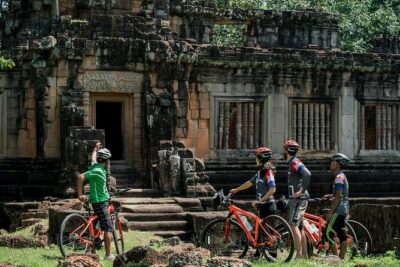
Angkor Wat one Day Private Tour for All Highlight Angkor Temples
Read our review →
1-Day private Angkor Temple Tour from Siem Reap
Read our review →

Private one-day tuktuk ‘small tour’ of the oldest Angkor temples
Read our review →Browse the lists this tour appears in