
Reviewed · ANGKOR WAT SUNRISE TOURS
Angkor Wat Sunrise Tour
Angkor Wat is at its most powerful before breakfast, when you enter through the eastern side in darkness and wait for first light to touch its towers. This tour then carries you through Angkor Thom, Bayon, and Ta Prohm in one long, well-packed day.
I like the early eastern entrance, which offers a calmer approach to Angkor Wat, and the air-conditioned vehicle, bottled water, and cold towels, which matter once the heat arrives. Guides such as Bun, Pi, Nimol, Setha, and Sokpee are praised for explaining both temple art and everyday Cambodian life.
The main catch is the schedule. Pickup begins around 4:30 a.m., and eight hours of temple steps, corridors, and open courtyards can wear you down. The listed price also excludes the $37 temple pass, so your basic cost is about $63 per person before food.
Key points to know before booking
- Sunrise begins before dawn: Hotel pickup is usually between 4:30 and 4:45 a.m., depending on the season.
- Four major temple areas fit into one day: You visit Angkor Wat, Angkor Thom, Bayon, the Terrace of the Elephants, and Ta Prohm.
- The $26 price is not the full cost: Add the required $37 Angkor temple pass, paid directly at the site.
- Your guide can shape the whole experience: Guides including Bun, Pi, Nimol, Setha, Samnang, and Sokpee are noted for temple knowledge, Cambodian history, and help with photos.
- Practical comforts are included: Hotel pickup and drop-off, an air-conditioned vehicle, drinking water, and cool towels.
- Dress rules are firm: Your shoulders and knees must be covered, and a scarf alone cannot be used to cover bare shoulders.
Why the sunrise start is worth the lost sleep
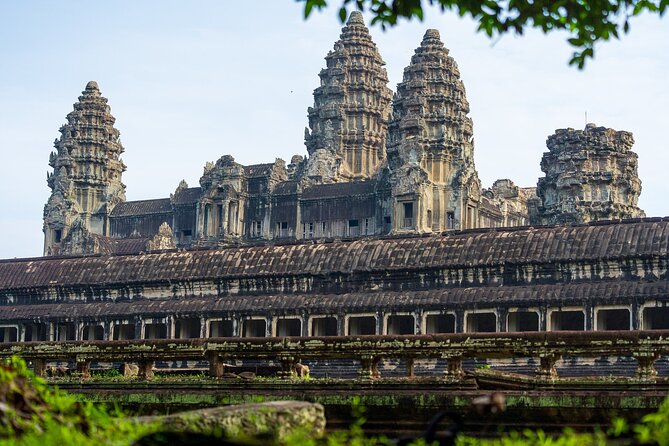
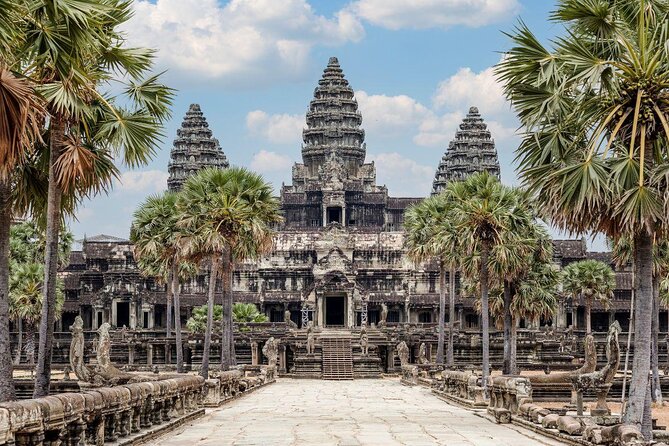
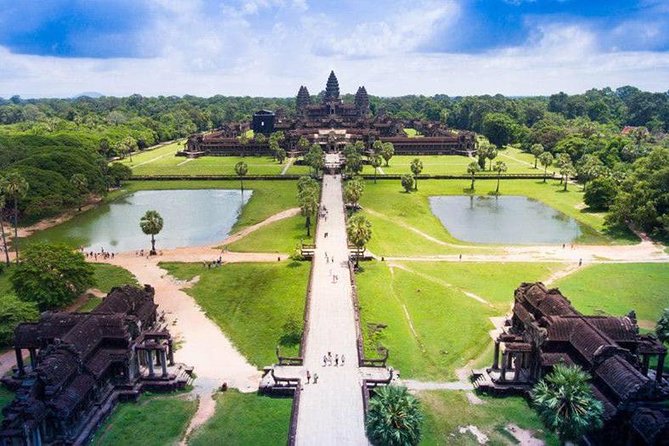
Angkor Wat is not simply a monument you glance at and photograph. Its long galleries, towers, courtyards, and carved walls reward a slow approach, and the pre-dawn hour gives the place a different mood from the bright, hot middle of the day.
You leave your Siem Reap hotel around 4:30 or 4:45 a.m. The exact pickup time changes with the season because sunrise shifts. The drive is handled in an air-conditioned vehicle, and the tour includes hotel pickup and return, so you do not need to arrange a tuk-tuk or find your way through the park in the dark.
The eastern entrance is a particularly useful detail. Many visitors focus on the famous western approach, but this tour enters Angkor Wat from the less-visited eastern side. You walk through the temple while it is still dark, then make your way toward a sunrise viewing position.
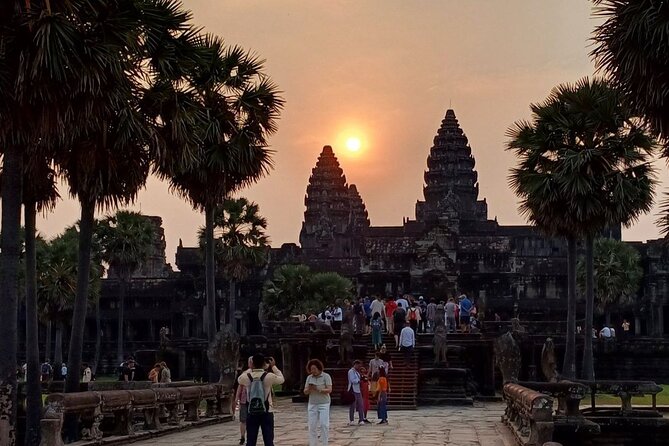
Sunrise itself is never guaranteed to deliver a perfect red sky. Clouds, haze, and the season all play a part. Still, the temple is worth seeing at this hour even when the colors are muted. The darkness makes the galleries feel more enclosed and mysterious, while the first daylight slowly reveals the scale of the building.
Plan to carry only what you need. You will be walking for hours, and comfortable shoes are recommended. Bring a phone or camera if you want photographs, but do not let the sunrise stop be the only reason you book. The larger value comes from seeing how Angkor Wat connects with the other temples later in the day.
Other early starts at the temples from Siem Reap:
- Angkor Wat Sunrise or Sunset Tour with Guide from Siem Reap
★ 5.0 · 12,109 reviews - Angkor Wat Sunrise tour with Small – Group and Guide tours
★ 5.0 · 3,655 reviews - Full-Day Angkor Wat Sunrise Private Tour with Guide from Siem Reap
★ 5.0 · 2,920 reviews
Angkor Wat: corridors, carvings, and a long first stop
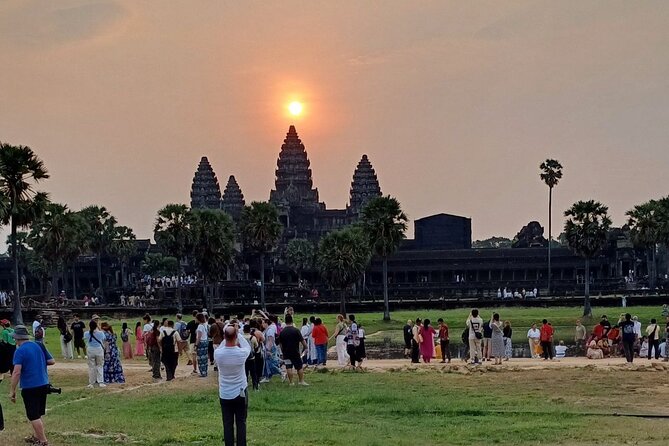
The tour allows about three hours at Angkor Wat. That is useful because the temple is too large for a quick visit, especially when you include the sunrise wait, the outer areas, the galleries, and the central sections.
A good guide helps you read the building rather than merely walk through it. Guides such as Pi, Bun, and Nimol are known for explaining religious ideas, Khmer royal power, and the role of Angkor within the wider story of Cambodia. Several guides also use photographs or tablet images to show how parts of the temple looked in earlier periods.
You should expect plenty of walking on uneven surfaces. Angkor Wat has long corridors and stone steps, and the combination of darkness at the start, early waking, and later heat makes the first stop physically important. Take the water offered by the driver and listen to your guide’s advice about where to pause.
The temple pass is not included in the tour price. It costs $37 per person and must be paid directly to the site. Visa cards are accepted, and the pass can be purchased on the morning of the visit before sunrise. This arrangement keeps the advertised tour price low, but you should include the pass when comparing this experience with other Angkor options.
If your hotel provides breakfast, ask for a breakfast pack before you leave. The supplied advice is to enjoy it after sunrise at Angkor Wat. That small bit of planning is helpful because the tour does not include food or drinks.
Angkor Thom and the South Gate
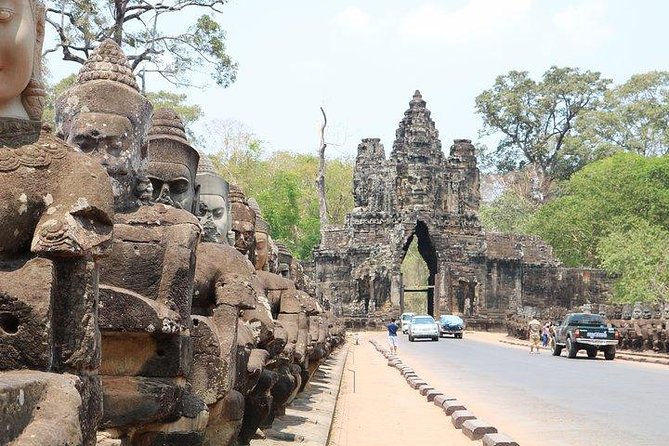
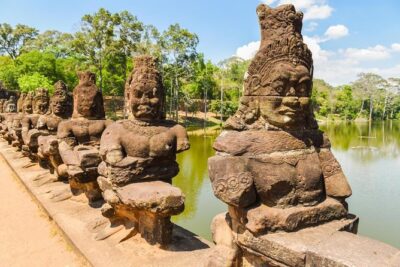
After Angkor Wat, the route moves to Angkor Thom, the former capital of the Khmer Empire. The South Gate is the best-preserved entrance, and reaching it means crossing a causeway over a moat.
The causeway is lined with stone figures associated with the traditional story of the churning of the ocean of milk. Even before you reach Bayon, the gate gives you a sense of the city’s grand scale. It is an excellent place to pause and understand that Angkor was not just a collection of isolated temples. It was a royal capital with roads, gates, religious centers, and ceremonial spaces.
The stop at Angkor Thom and Bayon lasts about two hours. That makes this part less rushed than a simple photo stop, though the day remains tightly scheduled. Your guide can point out the faces on the towers and explain how Bayon differs from Angkor Wat in purpose and design.
Bayon’s stone faces and the power of close viewing
Bayon is the emotional center of this route for many people. Its towers carry large carved faces that appear from different angles as you move around the temple. The effect is easy to miss if you hurry, so stay close to your guide and allow time to look upward and back through the passages.
The temple is more enclosed and visually complex than Angkor Wat. Angkor Wat gives you long axes, broad views, and a clear central form. Bayon gives you crowded towers, shadowed galleries, and faces that seem to watch over the stone passages.
This is where a good English-speaking guide makes a major difference. Guides such as Sokpee, who has experience with Buddhist monastic life, can add useful context about religion and Khmer culture. Others, including Setha, Samnang, and Horn, are praised for connecting the temple details to Cambodian history and daily life.
Do not expect every minute to be spent inside Bayon. The tour also includes the South Gate and the Terrace of the Elephants, so the two-hour estimate covers several related areas. That is a sensible balance for a first visit, but anyone wanting slow photography or extended study of carvings may prefer a longer private itinerary.
Same base, a different kind of day out:
- Siem Reap: Angkor Wat: Small-Group Sunrise or Sunset Tour
★ 5.0 · 9,444 reviews - From Siem Reap: Kampong Phluk Floating Village Tour by Boat
★ 4.9 · 6,979 reviews - Sunset tour of Kampong Phluk stilts home village on the Tonle Sap
★ 5.0 · 4,865 reviews - Siem Reap: Angkor Wat 2-Day Tour with Sunrise and Sunset
★ 4.9 · 4,429 reviews
The Terrace of the Elephants and royal ceremony
The Terrace of the Elephants runs for about 350 meters and served as a giant reviewing platform for public ceremonies. It also formed the base for the king’s audience hall.
This stop is less about entering a complete temple and more about understanding how the royal city functioned. The long terrace faces the Central Square, and its scale helps you picture processions, ceremonies, and formal gatherings in the capital.
The carved elephants and other reliefs give the terrace its name, but the broader value is spatial. You can see how the Khmer court used architecture to control movement and display authority. A guide can make this connection clear, especially if you are seeing Angkor for the first time and the many monuments begin to blur together.
By this stage, the heat may be building. The included air-conditioning, bottled water, and cold towels are not decorative extras. They provide a real break between temple visits, particularly after the early start and the exposed walkways around Angkor Thom.
Ta Prohm and the temple reclaimed by trees
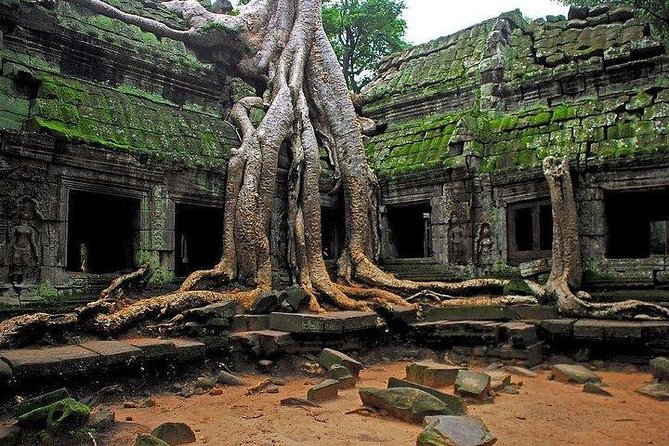
Ta Prohm is the final major temple stop and receives about two hours. It is one of the most atmospheric places in the Angkor complex because large tree roots wrap around walls, doorways, and carved stone.
The temple once housed 2,740 monks. Today, its partly collapsed galleries and tree-covered walls give you a strong sense of a site that has been left close to its condition when French explorer Henri Mouhot encountered it in the 1850s.
Ta Prohm is popular, so it may feel less quiet than the early eastern side of Angkor Wat. The benefit of the tour is that your guide can help you move beyond the most obvious photo points. Sakrya, for example, is praised for showing visitors the echo effect in one of the buildings, made by leaning against a wall and striking your chest.
That small detail captures the value of a local guide. You can see the trees and carvings by yourself, but a guide may show you features you would otherwise walk past. Ta Prohm also rewards patience. Look at how roots follow the stonework, how doorways frame other chambers, and how the carved figures survive beside the damaged walls.
The guides are a major part of the value
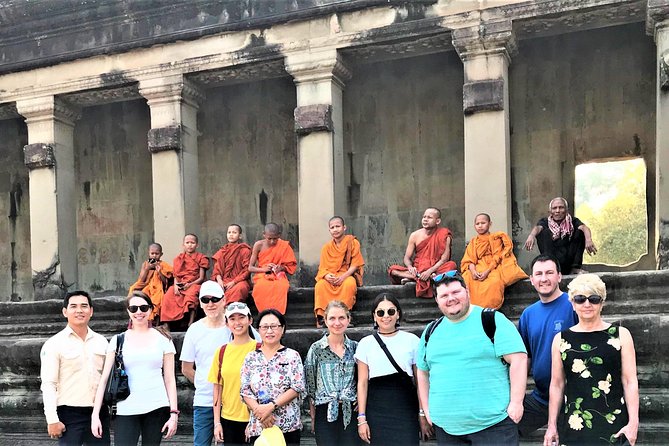
The tour uses licensed English-speaking guides, and the strongest part of the experience is likely to be the individual guide assigned to you. Names connected with especially strong experiences include Bun, Pi, Nimol, Setha, Samnang, Sokpee, Sok, Vantha, Horn, and Bunpheng.
Their strengths vary. Bun is praised for combining temple information with stories about life in Cambodia. Pi is known for making the visit memorable and explaining Angkor and Cambodian history in clear English. Nimol is also noted for taking well-positioned photographs, which is useful if you want pictures of your whole group rather than endless selfies.
Samnang is described as prompt, professional, fun, and helpful with photos. Sokpee brings religious insight from having previously lived as a monk. Bunpheng is praised for finding good sunrise locations and keeping the explanations engaging.
You cannot usually select a particular guide when booking, so these names are best understood as examples of the level of service you may receive, not a guarantee. The important point is that guide quality matters here. The temples are impressive on their own, but context helps you understand why Bayon feels different from Angkor Wat and why Ta Prohm was built as more than a scenic ruin.
The private format also helps. Only your own group participates, which gives you more freedom to ask questions, stop for photos, or request a slower pace within the fixed route. It is a better fit than a large group if you value conversation and personal attention.
Cost, comfort, and the full day schedule
The tour price is $26 per person. That includes the guide, vehicle, hotel pickup and drop-off, bottled water, and cool towels. The required $37 temple pass is extra, bringing the basic combined cost to about $63 per person.
At that price, the tour offers good value for a first visit because transport and guiding are handled for you. You are not paying only for a driver. You are getting a full route through the main Angkor highlights with explanations in English.
Food and beverages are not included. Request a breakfast pack from your hotel if possible, and bring any additional snack you need. The tour is about eight hours, so breakfast planning matters more than it might on a short morning outing.
The schedule is demanding. You start before dawn, walk through several large sites, and remain outdoors for much of the day. The air-conditioned vehicle gives you a place to cool down between stops, but it does not turn the day into a leisurely outing.
Dress, walking, and small details that matter
Angkor is an active religious site, not only an archaeological attraction. You must cover your shoulders and knees. A scarf used over bare shoulders is not accepted, so wear a shirt or top that covers your shoulders from the start.
Comfortable walking shoes are essential. The route includes long corridors, uneven ground, stone steps, and large open areas. Sandals may be less comfortable over eight hours, particularly if they offer little support.
Carry water, sun protection, and a light layer for the early morning. The tour provides bottled water and cool towels, but those supplies do not replace sensible clothing and footwear.
The experience is described as suitable for most participants, but the amount of walking and the pre-dawn start should guide your decision. If you sleep lightly, have trouble with uneven ground, or dislike full-day sightseeing schedules, a later and shorter temple visit may suit you better.
Free cancellation is available up to 24 hours before the start time. Changes or cancellations made later are not accepted for a refund, so check the local cutoff time before you commit.
Who should book this Angkor Wat tour?
I would choose this tour if you have one full day in Siem Reap and want the major Angkor sights without arranging transport, entry procedures, and a guide separately. It is especially useful for first-time visitors who want historical and religious context rather than only a list of photo stops.
It also suits couples, families, and small private groups that prefer to ask questions and move at their own pace. The guide’s help with photographs is an added benefit, especially at sunrise and around Ta Prohm.
I would think twice if you want a quiet, slow study of each temple. Four major areas in eight hours is efficient, but it is still a packed day. You should also budget for the temple pass and plan breakfast before leaving your hotel.
For most people, the best reason to book is the combination of timing and coverage. You see Angkor Wat in the dark before sunrise, study Bayon’s faces, walk the royal terrace, and finish among Ta Prohm’s roots. That gives you a strong first introduction to the ancient Khmer capital without wasting time on transport details.
FAQ
What time does the tour start?
Hotel pickup begins around 4:30 a.m. to 4:45 a.m., depending on the time of year and the sunrise schedule.
How long does the tour last?
The experience lasts approximately eight hours.
Is the Angkor temple pass included?
No. The temple pass costs $37 per person and must be paid directly to the site. Visa cards are accepted, and the pass can be purchased on the day before sunrise.
What temples and sites are visited?
The route includes Angkor Wat, Angkor Thom and its South Gate, Bayon Temple, the Terrace of the Elephants, and Ta Prohm Temple.
Is hotel pickup provided?
Yes. Hotel pickup and drop-off are included, along with transport in an air-conditioned vehicle.
What should I wear?
You must cover your shoulders and knees. A scarf alone cannot be used to cover bare shoulders. Comfortable walking shoes are recommended.
Is food included?
No. Food and beverages are not included. If your hotel offers breakfast, request a breakfast pack to eat after sunrise at Angkor Wat.
Should you book it?
Book this tour if you want the main Angkor sights in one carefully arranged day and you value a guide who can explain Khmer religion, politics, society, and daily life. The $26 tour price is attractive, but remember to add the $37 temple pass and plan for the early start.
Skip it if you want a slow temple-by-temple visit or cannot manage a pre-dawn departure. For everyone else, the eastern entrance into Angkor Wat, personal guide format, cool vehicle, and strong route make this a practical first look at Siem Reap’s great temples.
Just added in Siem Reap
- 1-Day Angkor Wat Private Tour with Spanish Tour Guide.★ 5.0 · 9 reviews
- Angkor Wat: Small-Group Tour with Balloon Ride and Lunch★ 4.6 · 13 reviews
- Sky Venture Microlight Siem Reap★ 4.9 · 18 reviews
- Angkor Wat plus Balloon Ride with Khmer Lunch★ 5.0 · 46 reviews
- Angkor Silk Farm & Lotus Silk Farm: Siem Reap Discovery Tour★ 4.8 · 68 reviews
- Angkor Wat Sunrise Tour By E-Bike Experience With Breakfast Included★ 5.0 · 76 reviews
- Siem Reap: 1-Hour Cambodian Buddhist Water Blessing★ 4.9 · 68 reviews
- Angkor Wat Sunrise Private Experience with Guide from Siem Reap★ 5.0 · 62 reviews
Angkor Wat Sunrise Tours, compared.
Angkor Wat Sunrise or Sunset Tour with Guide from Siem Reap
Read our review →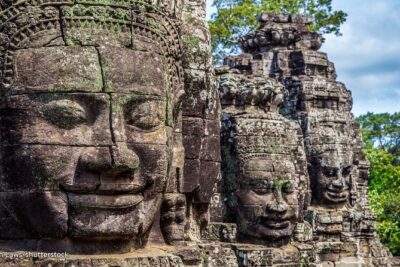
Angkor Wat Sunrise tour with Small – Group and Guide tours
Read our review →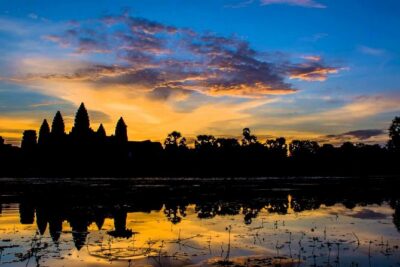
Full-Day Angkor Wat Sunrise Private Tour with Guide from Siem Reap
Read our review →
Angkor Wat Sunrise & 3 Main Temples with Breakfast – Small Group
Read our review →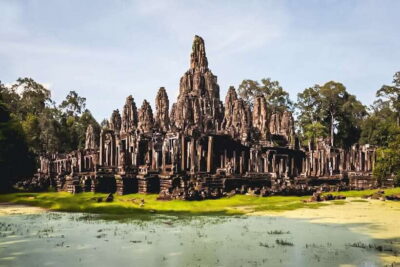
Angkor Wat Sunrise and Full-Day Sightseeing Tour
Read our review →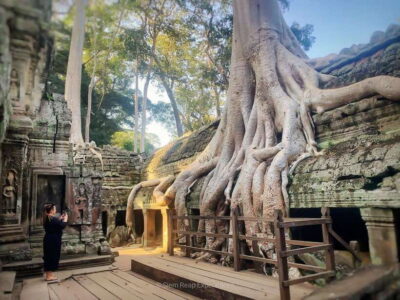
2 Days Exclusive Temple Highlights with Sunset and Sunrise Tour
Read our review →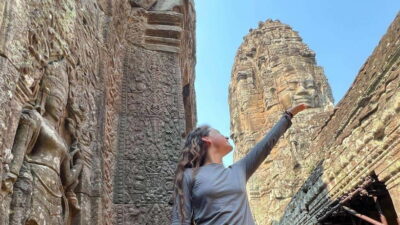
Angkor Sunrise 1- or 2-Day Guided Temples Tour
Read our review →Browse the lists this tour appears in