
Reviewed · SUNSET TOURS & CRUISES
Siem Reap: 2-Day Temple Highlights Sunrise and Sunset Option
Angkor is best seen at a measured pace, and this two-day temple circuit gives you time for both the grand monuments and the quieter corners. You begin with Pre Rup, Banteay Srei, Neak Pean, and Preah Khan, then return before dawn for Angkor Wat, Ta Prohm, Ta Nei, and Angkor Thom. It is a smart way to avoid cramming Cambodia’s greatest sights into one sweaty day.
I like two things here. First, the guides make the stones readable, explaining Hindu and Buddhist ideas, Khmer kings, carvings, and temple design rather than simply naming each building. Second, the driver keeps the practical side under control, with hotel pickup, air conditioning, cold water, and cool towels waiting after hot walks. The main drawback is the pace: even over two days, you cover a lot of ground, and the sunrise start means a very early morning.
Key points to know before booking
- Banteay Srei is the detailed showpiece: Its small sandstone buildings carry some of Cambodia’s finest carved decoration.
- Sunrise begins in darkness: Bring a torch or phone light for the eastern entrance and cloistered passages at Angkor Wat.
- The guide matters: Guides such as Pi, Sak, Pal, Chhay, Bun, and So are often praised for clear explanations, humor, photographs, and good timing.
- Cooling breaks are built into the day: Air conditioning, bottled water, and cool towels make a real difference in Cambodia’s heat.
- The sunset depends on the booking: Private tours include a rice-field sunset drink, while small-group tours include sunset at Bakheng Temple.
- The $46 price is not the full cost: You must add the $62 Angkor pass, and meals are separate.
Why two days makes sense at Angkor
Angkor is not one temple with a few nearby ruins. It is a large archaeological area spread across roads, forest, reservoirs, and former city walls. A rushed one-day visit can cover the famous names, but it often leaves you with a blur of towers and stone corridors.
This tour divides the experience sensibly. The first day reaches the outlying temples, including Banteay Srei, then finishes with a quieter sunset. The second day focuses on the central monuments and starts with Angkor Wat at sunrise. You still have busy days, but the schedule gives each site room to register.
The air-conditioned vehicle is more important than it may sound. You will walk over uneven ground, climb temple steps where permitted, and spend time in open courtyards. Returning to a cool van with water and a fresh towel can restore you faster than another bottle of warm water from a roadside stall.
The tour is offered as a small group, and some departures are private. Group size can vary, with some departures reported at fewer than ten people and others reaching around fifteen. That affects how easily you can ask questions or pause for photographs, so a private option is worth considering if you want a slower, more personal day.
More sunset outings from Siem Reap:
- Angkor Wat Sunrise or Sunset Tour with Guide from Siem Reap
★ 5.0 · 12,109 reviews - Siem Reap: Angkor Wat: Small-Group Sunrise or Sunset Tour
★ 5.0 · 9,444 reviews - Sunset tour of Kampong Phluk stilts home village on the Tonle Sap
★ 5.0 · 4,865 reviews
Day one begins at Pre Rup
Pre Rup is a strong opening stop because it introduces the temple mountain form before you reach the more famous monuments. Built as a state temple for King Rajendravarman and dedicated in 961 or early 962, it combines brick, laterite, and sandstone.
You will see stacked levels rising above the surrounding ground, with towers and stairways arranged around a central summit. The design reflects the Hindu idea of a sacred mountain, and your guide can explain how a temple’s height, layout, and direction carried religious meaning.
Pre Rup is also exposed and sun-baked. I would visit with water, a hat, and shoes with a firm sole. The steps can feel steep, and the broad setting offers little shade, so this is a good place to use the first cool towel of the day rather than saving every comfort for later.
Banteay Srei and Cambodia’s finest carvings
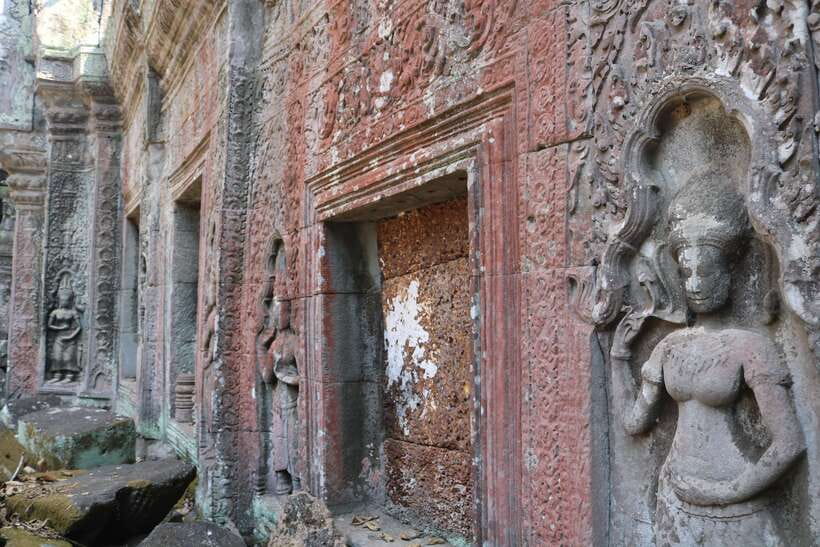
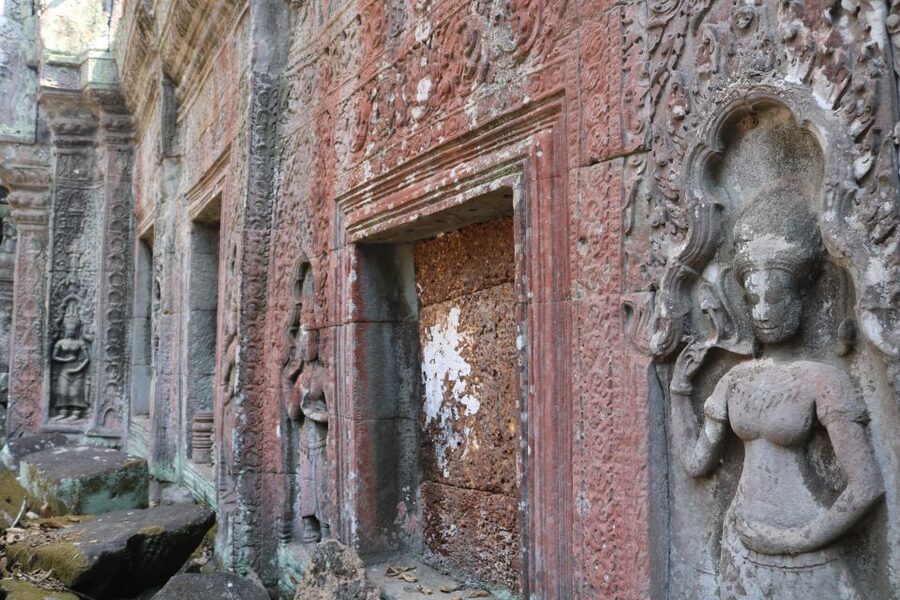
Banteay Srei is the day one highlight for many visitors. It is smaller than Angkor Wat, but that is part of its appeal. The pinkish sandstone buildings are covered with tightly cut figures, floral patterns, guardians, and scenes drawn from Hindu stories.
The carving is unusually fine because the structure is compact and the stone allows for precise detail. Rather than viewing it as a grand avenue and tower complex, you look closely at door frames, lintels, pediments, and small figures. A guide is especially useful here, since the best details are easy to miss when you are focused only on the overall shape.
The temple became accessible to visitors only in the late 1990s after the Khmer Rouge left the area. That recent history adds weight to the visit, but it also means you should treat the site with care and follow access instructions.
Banteay Srei lies farther from the central Angkor temples, so the drive takes time. That is the tradeoff. You spend part of the day in the vehicle, but the reward is a temple with a different scale and style from Angkor Wat, Bayon, and Ta Prohm.
Neak Pean and Preah Khan’s quieter mood
Neak Pean sits on an artificial island in the Jayatataka Baray, a large reservoir connected with the reign of Jayavarman VII. You approach it by a long walkway over the water, which makes the arrival feel different from the usual temple climb.
The central Buddhist shrine sits on a circular island, with pools and symbolic water arrangements around it. Much of the experience comes from the setting and the unusual plan rather than from a long list of intact buildings. If the water level or light is not dramatic, you may find the site less immediately impressive than Banteay Srei. Its value is its design and atmosphere.
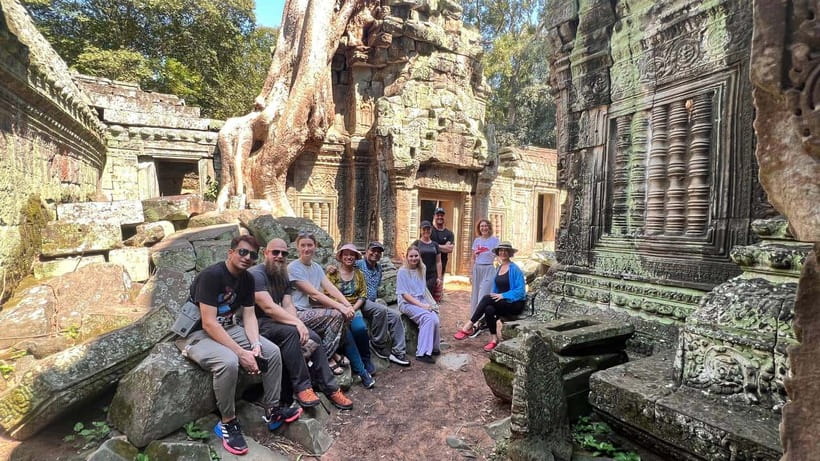
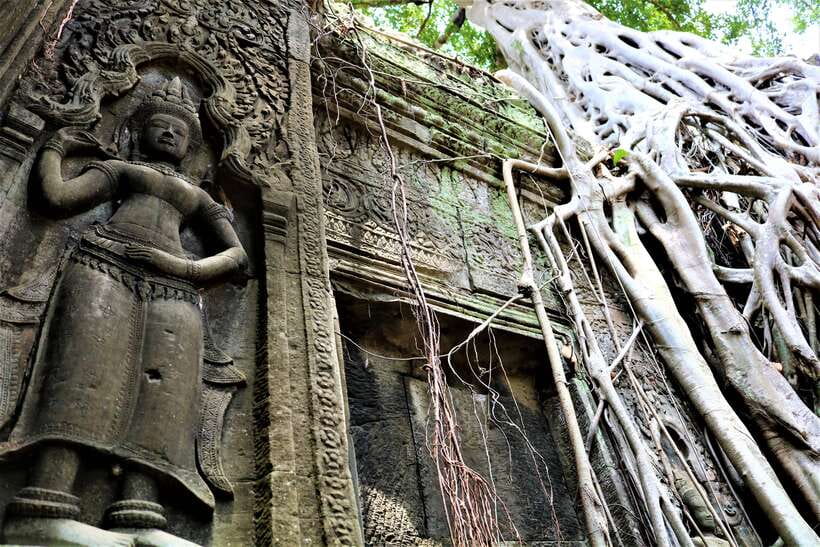
Preah Khan offers a stronger sense of a ruined city. Tree roots, broken walls, narrow passages, and carved stone create a setting that feels less formal than Angkor Wat. Jayavarman VII commissioned it in honor of his father, and its Buddhist connections sit alongside older Hindu imagery.
The World Monument Fund is restoring parts of Preah Khan, and some sections remain in notably good condition. You will find places where the structure feels stable and legible, followed by corners where vegetation and collapse dominate. I like this contrast because it shows how Angkor survives through both conservation and time.
Your guide may use the drive between sites to explain Jayavarman VII, the shift between Hindu and Buddhist traditions, or the daily life that supported these huge temple complexes. This is one of the most useful parts of the tour. You are not spending every minute standing in front of a wall while the guide talks.
A few more things to do in Siem Reap worth a look
- Siem Reap: Angkor Wat 2-Day Tour with Sunrise and Sunset
★ 4.9 · 4,429 reviews - Angkor 2-Day Sunset & Sunrise Small-Group Tour
★ 5.0 · 2,567 reviews - 2 Days Exclusive Temple Highlights with Sunset and Sunrise Tour
★ 5.0 · 1,157 reviews - Siem Reap: Angkor Sunrise 1- or 2-Day Guided Temples Tour
★ 4.9 · 1,132 reviews
Choosing the first sunset
The sunset finish differs by tour type. The private option includes a rice-field sunset drink, giving you a calmer end to the day away from the temple crowds. The small-group option includes sunset at Bakheng Temple.
Bakheng is a hilltop temple with broad views, but access and timing can make it a busy choice. If you select the small-group version, expect the guide and driver to manage the timing carefully. The sunset may be beautiful, but the setting can feel less quiet than the rice fields.
For the private option, the rice-field stop may suit you better if you want a gentle pause after several temples. It also gives you a chance to see a more ordinary rural setting, rather than ending every day at another monument. Check the exact inclusion when booking, since the two versions do not offer the same sunset experience.
Angkor Wat at sunrise requires preparation
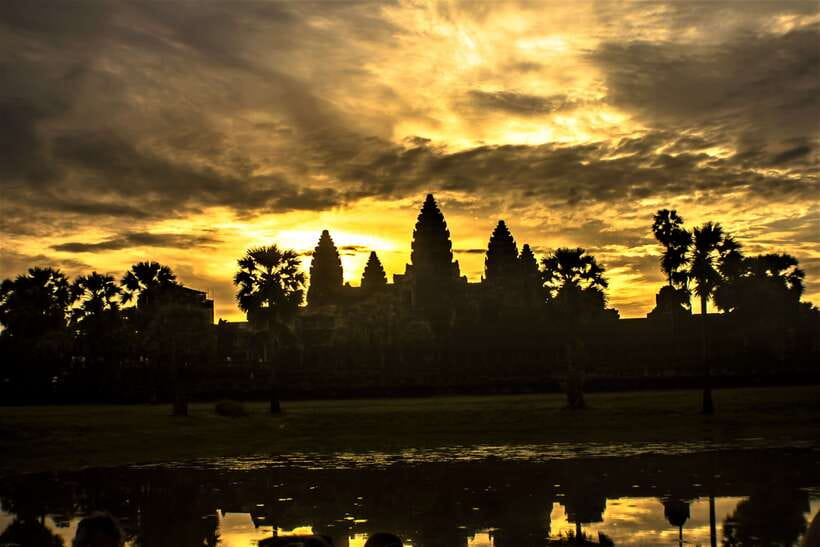
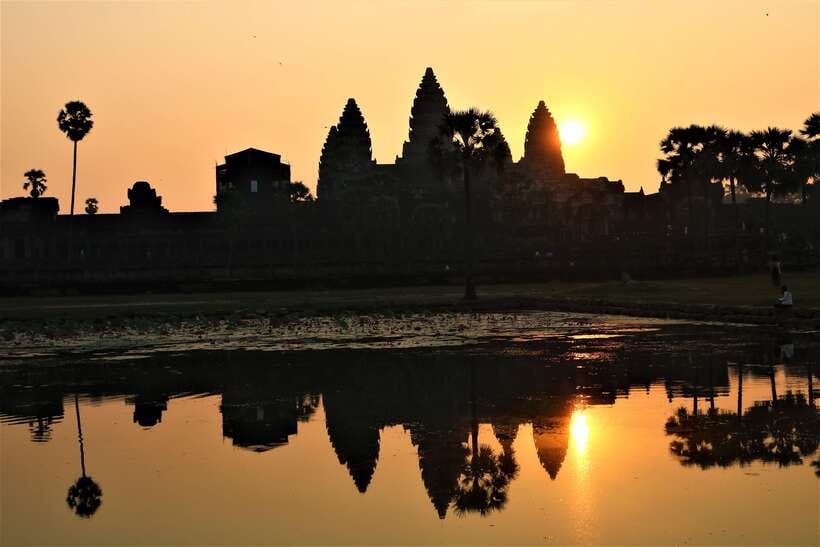
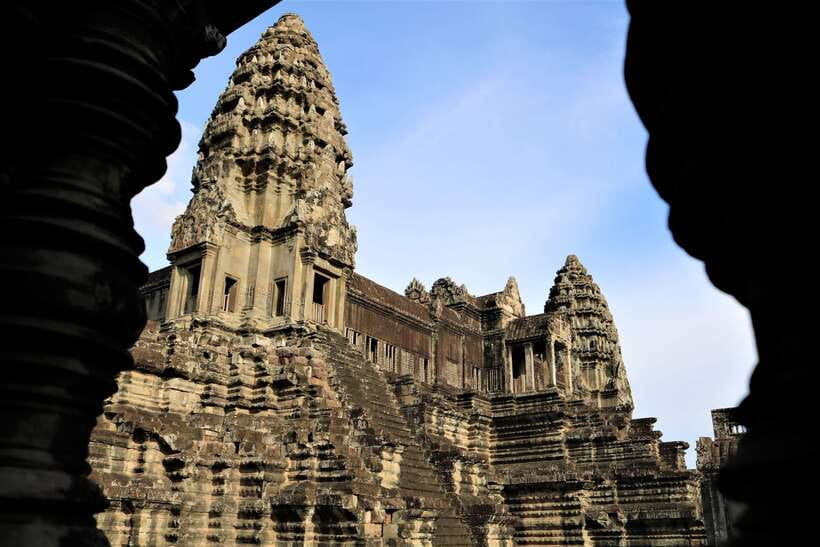
Day two starts before dawn. You enter Angkor Wat in darkness from the eastern side, a less-used approach, so bring a torch or make sure your phone light is charged.
The early walk takes you through cloistered corridors and toward the central temple. As daylight builds, the towers and reflecting water gradually become visible. Sunrise conditions are never guaranteed, but the changing light is why this start is worth the lost sleep.
Your guide’s positioning matters here. Several guides, including Sak, Pi, Chhay, and others, are praised for getting groups into good viewing spots without rushing them. You should still expect other people. Angkor Wat at sunrise is one of Cambodia’s most popular sights, and even a less-used entrance does not make the temple private.
After sunrise, you can explore the temple while the light improves. The long bas-reliefs are a major reason to take your time. They show battles, processions, religious scenes, and figures in carefully arranged sequences. A guide can point out the order and meaning, while you can later wander back for photographs or quiet viewing.
Breakfast is taken outside the temple rather than inside the complex. Meals are not included, so budget for breakfast and lunch separately. That arrangement also gives you a chance to sit down before the next round of walking.
Ta Prohm and Ta Nei after breakfast
Ta Prohm is the famous jungle-covered temple associated with the Tomb Raider film. Its appeal is not only the film connection. The site preserves a powerful mix of carved galleries, collapsed stone, trees, and narrow passages.
Ta Prohm was once home to 2,740 monks. Today, its partly ruined form looks much as it did when French explorer Henri Mouhot encountered it in the early 1850s. Some areas are carefully managed for safety, while others retain the tangled appearance that made the temple famous.
It is also one of the busiest stops, and the paths can feel tight when groups arrive together. Your guide can help you avoid standing in the middle of the main flow, but you should expect less solitude than at Preah Khan or Ta Nei. Wear shoes with traction because roots and uneven stones are part of the route.
Ta Nei is a useful contrast. This late 12th-century stone temple is smaller and quieter, set within Angkor’s wooded area. It lacks Ta Prohm’s fame, but that makes it a good place to slow down and notice construction details without the same level of pressure.
The sequence works well: Ta Prohm gives you the iconic image, while Ta Nei lets you see a less polished and less crowded ruin. If you have already seen photographs of Ta Prohm, Ta Nei may be the more surprising stop.
Angkor Thom and the faces of Bayon
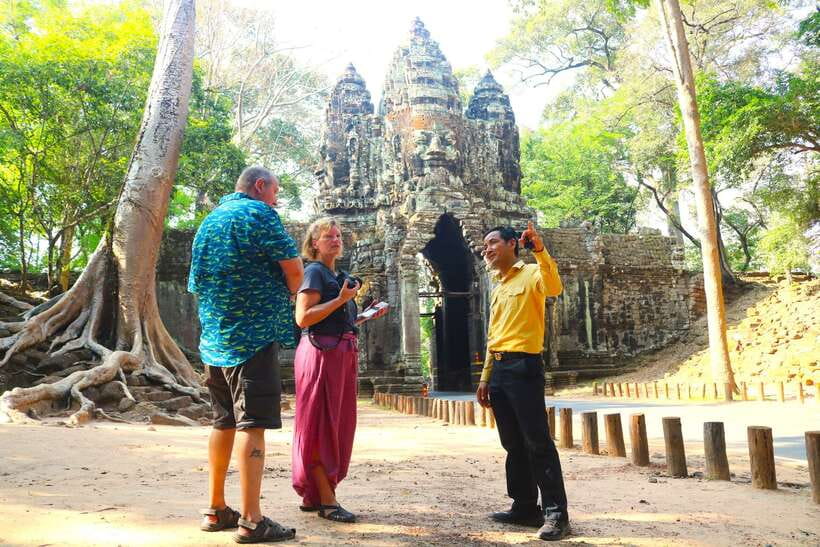
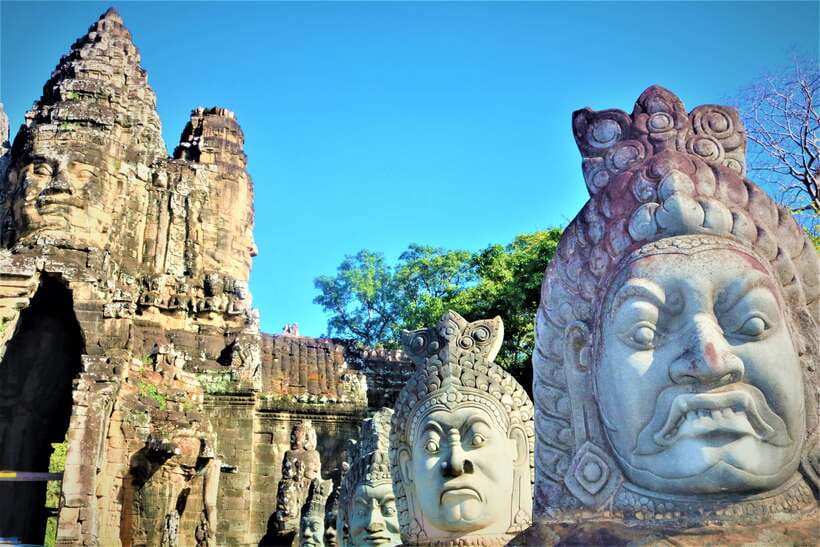
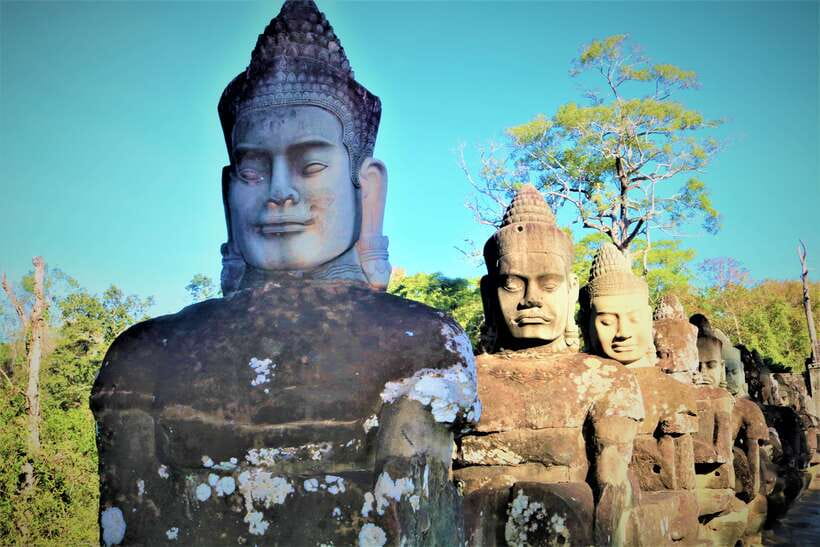
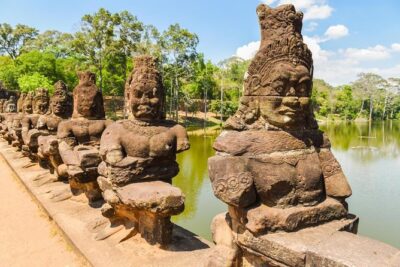
The southern gate of Angkor Thom is one of the most memorable approaches in the complex. A row of 54 stone figures lines each side of the causeway, with gods on the left and demons on the right. They hold a naga, or serpent, as they pull in opposing directions.
This is not just decoration. The arrangement connects with the Hindu creation story of the Churning of the Ocean of Milk, and your guide can explain how the gate presents a balance of forces. The worn faces and missing pieces also show how long these sculptures have endured.
Inside the fortified city, Bayon is the main focus. More than 200 enormous faces cover its central towers, creating an unusual temple experience. As you move between the towers, faces appear, disappear, and reappear from different angles.
Bayon can be confusing without help. Its galleries and levels do not reveal their meaning at a glance, and some carvings are tucked into dark corners. A good guide will identify the faces linked with Jayavarman VII and explain the Buddhist and royal ideas behind the design.
The final stops are the Terrace of the Leper King and the Terrace of Elephants. These long platforms once formed part of the ceremonial center of Angkor Thom. The Leper King terrace is especially interesting for its layered carvings, while the Terrace of Elephants gives you a sense of the scale of royal processions and public events.
By this point, you may be tired. That is normal. The second day combines a pre-dawn start with several major temples, so take the offered breaks and do not feel obliged to inspect every corner.
The guides and the value of good explanations
The strongest part of this experience is the human one. Guides such as Pi, Sak, Pal Saruon, Chhay, Bun, So, Yuth, and Sam are praised for clear English, humor, cultural context, and patient answers. The exact guide depends on the departure, so you cannot assume a particular person will lead your group.
The best guides do more than repeat dates. They explain Hinduism and Buddhism, show how religious ideas shaped the buildings, and connect the Khmer Empire with modern Cambodian culture. Some use maps, photographs, or audiovisual material during the drives. Several also help with photographs and know where to stand for a better angle.
That service can change the entire visit. Without context, Angkor can become a succession of impressive stones. With context, a carved lintel becomes a story, a temple plan becomes a statement of faith, and the city gates begin to make political sense.
The reviews of individual guides are nearly all glowing, but you should still remember that guiding style is personal. Some people prefer frequent stories and conversation. Others want long periods alone with the ruins. Tell your guide early if you want more explanation, more quiet time, or extra photo pauses.
Comfort, clothing, and physical demands
You need covered shoulders and knees at the temples. Shorts are not allowed, so pack light trousers or a longer skirt, along with a shirt that covers the shoulders. Comfortable walking shoes are essential.
Insect repellent is also recommended. The route includes wooded areas, water, rice fields, and open ground, so it is sensible to carry some even if insects do not bother you in town.
This is not a wheelchair-accessible activity and is not suitable for children under eight, people with mobility impairments, or wheelchair users. The uneven surfaces, steps, long walks, and early departure explain those restrictions.
The vehicle helps, but it does not remove the physical work. On hot days, especially when humidity is high, you can expect to sweat heavily. The driver typically provides bottled water and a cool towel after temple visits, and that simple service is one of the tour’s real practical strengths.
What the $46 price really covers
At $46 per person, the tour offers a useful combination of transport, a licensed English-speaking guide, hotel pickup and drop-off, and two full days of sightseeing. The price is particularly sensible if you want to visit Banteay Srei and the smaller temples without arranging separate transport.
But the advertised price is not your final spend. The Angkor pass costs $62 per person for a two or three-day visit, and meals are excluded. Add those costs before comparing this tour with a private car and guide.
The value comes from organization. You do not need to negotiate transport between distant temples, work out the sunrise route in the dark, or search for a driver after each stop. You also get the benefit of a guide who can explain what you are looking at.
Private departures cost more than the basic per-person figure, but they include the rice-field sunset drink and may suit couples, families with older children, or anyone who wants more control over the pace. Small groups are a good middle ground if you want company without a large coach.
Free cancellation is available up to 24 hours in advance, and you can reserve now and pay later. Those terms are useful when temple passes, weather, and transport plans are still being arranged.
Who should book this temple tour
I would choose this experience if you have two days in Siem Reap and want the major temples presented as part of a larger story. It suits first-time visitors especially well, but it also works for repeat visitors who want more detail than they got on a self-guided visit.
It is a good fit for people who value comfort and instruction over complete independence. You will not set every departure time yourself, and the days are full. In exchange, you get a carefully planned route, a guide, and reliable transport.
I would hesitate if you dislike pre-dawn starts, dislike group schedules, or want to photograph every temple in solitude. The sunrise is early, Ta Prohm and Angkor Wat can be crowded, and even a well-paced two-day itinerary involves plenty of walking.
For most visitors, though, the balance is right: the famous temples are here, the smaller sites add variety, and the air-conditioned vehicle keeps the heat from taking over the trip.
FAQ
How long is the activity?
The experience lasts two days.
What temples are included?
The route includes Angkor Wat, Angkor Thom, Bayon, Ta Prohm, Ta Nei, Pre Rup, Banteay Srei, Neak Pean, Preah Khan, and Bakheng Temple, depending on the sunset option.
Is sunrise at Angkor Wat included?
Yes. Day two begins with a pre-dawn departure for sunrise at Angkor Wat.
What is included in the $46 price?
The price includes hotel pickup and drop-off, air-conditioned transport, a licensed English-speaking guide, bottled water, and cool towels. Sunset inclusions vary by tour type.
Is the Angkor temple pass included?
No. The two or three-day temple pass costs $62 per person and must be purchased separately.
Are meals included?
No. Breakfast, lunch, and other meals are not included.
What sunset option is available?
Private tours include a rice-field sunset drink. Small-group tours include sunset at Bakheng Temple.
What language is the tour conducted in?
The live tour guide speaks English.
Where can pickup take place?
Pickup is available from hotels throughout Siem Reap city.
What should I bring?
Bring comfortable walking shoes, insect repellent, and a torch for entering Angkor Wat before sunrise. Dress with covered shoulders and knees.
Is the tour wheelchair accessible?
No. The activity is not wheelchair accessible and is not suitable for people with mobility impairments.
Can children join the tour?
Children under eight are not suitable for this activity.
Just added in Siem Reap
- 1-Day Angkor Wat Private Tour with Spanish Tour Guide.★ 5.0 · 9 reviews
- Angkor Wat: Small-Group Tour with Balloon Ride and Lunch★ 4.6 · 13 reviews
- Sky Venture Microlight Siem Reap★ 4.9 · 18 reviews
- Angkor Wat plus Balloon Ride with Khmer Lunch★ 5.0 · 46 reviews
- Angkor Silk Farm & Lotus Silk Farm: Siem Reap Discovery Tour★ 4.8 · 68 reviews
- Angkor Wat Sunrise Tour By E-Bike Experience With Breakfast Included★ 5.0 · 76 reviews
- Siem Reap: 1-Hour Cambodian Buddhist Water Blessing★ 4.9 · 68 reviews
- Angkor Wat Sunrise Private Experience with Guide from Siem Reap★ 5.0 · 62 reviews
Sunset Tours & Cruises, compared.
Angkor Wat Sunrise or Sunset Tour with Guide from Siem Reap
Read our review →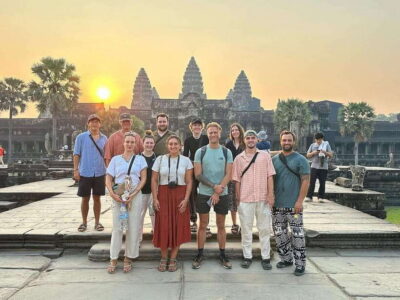
Angkor Wat: Small-Group Sunrise or Sunset Tour
Read our review →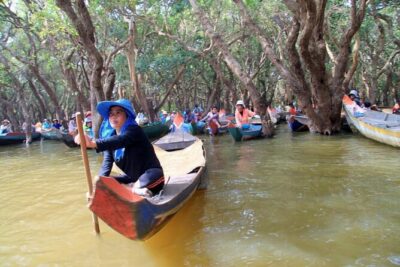
Sunset tour of Kampong Phluk stilts home village on the Tonle Sap
Read our review →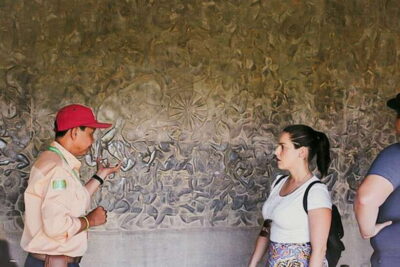
Angkor Wat 2-Day Tour with Sunrise and Sunset
Read our review →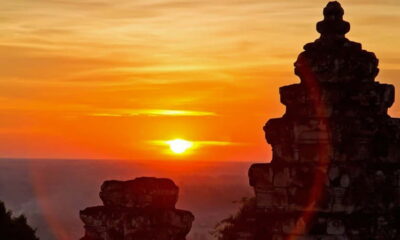
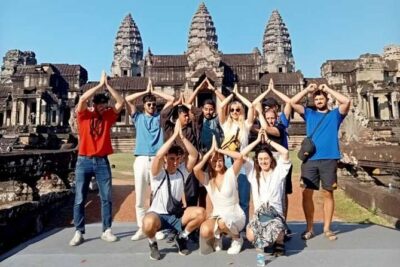
Angkor Wat Sunset Small Group Tour with Lunch Included
Read our review →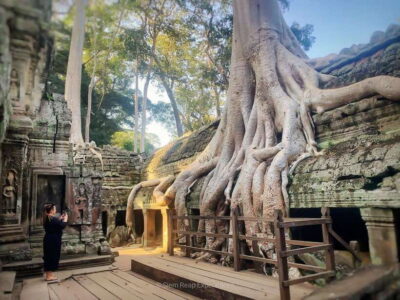
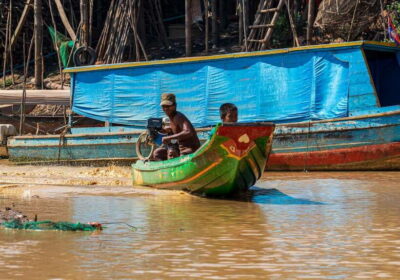
Siem Reap Floating Village Kampong Phluk Sunset with Boat
Read our review →Browse the lists this tour appears in