
Reviewed · ANGKOR WAT SUNRISE TOURS
Private 2 Days Angkor Wat Sunrise and Discover all Major Temples
Angkor Wat at first light is the hook, but the real strength of this two-day trip is the range. You get the great icons, including Angkor Wat and Bayon, then move beyond the standard circuit to Ta Nei, Banteay Kdei, Banteay Samre, and other less-visited temples. I also like the private format: guides such as Sara and Leap can adjust the pace, while drivers such as La, Ry, and Sophal handle the long, hot transfers.
The price is $149.46 per person, with hotel pickup, a private air-conditioned vehicle, guide, water, cool towels, service charges, and VAT included. That is good value if you want a guide and transport for a packed two-day visit. The catch is the early start and busy schedule. The Angkor Pass, meals, and tips cost extra, and the first day begins around 4:30 a.m.
Key points to know before booking
- Sunrise starts around 4:30 a.m. at Angkor Wat, so your first morning will be an early one.
- A private guide and vehicle let you ask questions, change the pace, and avoid joining a large group.
- The route covers far more than Angkor Wat, from Bayon’s stone faces to Banteay Srei’s fine carvings.
- The Angkor Pass is not included, and your guide helps you buy it at the park entrance.
- Meals are separate, with local restaurant dishes generally priced from $3 to $10.
- The days are full and active, with walking, temple steps, heat, and repeated stops in the open air.
Why two days works well at Angkor
Angkor is not one temple with a few ruins nearby. The archaeological zone covers about 390 square miles, or 1,000 square kilometers. Its monuments were built over several centuries, under rulers with different religious ideas and building styles.
That scale is why I prefer this two-day plan to trying to cram everything into one long outing. Day one concentrates on Angkor Wat and Angkor Thom, the old royal city. Day two reaches farther out to Banteay Srei and then loops through several important temples on the Grand Circuit.
You will still be busy. The schedule includes roughly ten stops on the first day and seven on the second, plus driving and meal breaks. The private setup matters here. If a carved doorway catches your attention, you can spend longer there. If the heat wins, you can retreat to the air-conditioned vehicle and cool down with bottled water and a fresh towel.
The tour is best for people who want context, not only photographs. A licensed English-speaking guide explains the Khmer Empire, the function of each temple, and the differences between Hindu and Buddhist monuments. The strongest guide names connected with this experience include Sara and Leap, while drivers such as Mr La, Ry, Pheap, Sophal, and Paul have been praised for being careful, kind, and helpful.
Other early starts at the temples from Siem Reap:
- Angkor Wat Sunrise or Sunset Tour with Guide from Siem Reap
★ 5.0 · 12,109 reviews - Angkor Wat Sunrise tour with Small – Group and Guide tours
★ 5.0 · 3,655 reviews - Full-Day Angkor Wat Sunrise Private Tour with Guide from Siem Reap
★ 5.0 · 2,920 reviews
Day one: Angkor Wat before the crowds
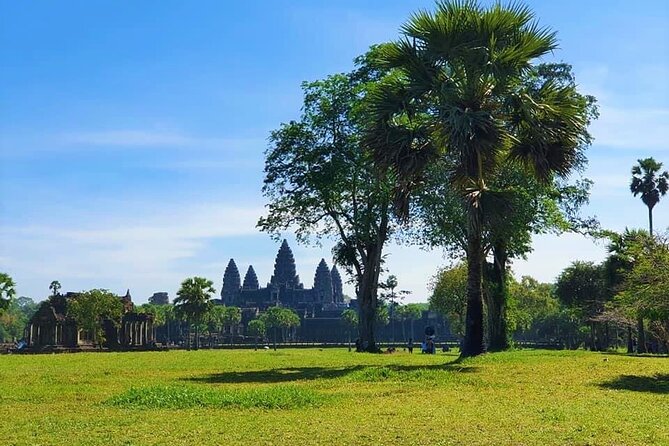
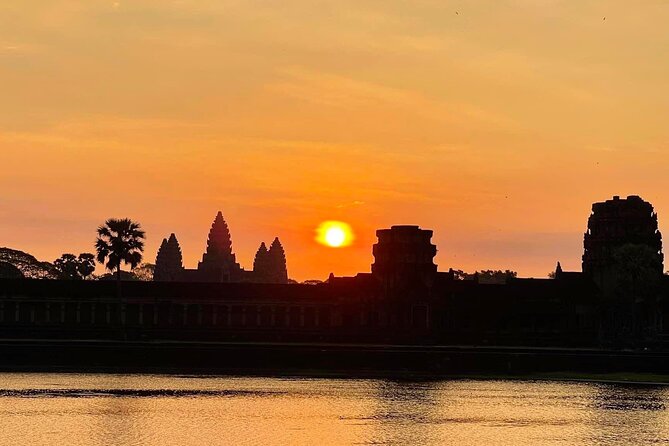
Your first pickup is around 4:30 a.m. for Angkor Wat. The temple is Cambodia’s national emblem, and its five-tower silhouette is the image most people carry home from Siem Reap.
The sunrise is the obvious draw, but give yourself time to look beyond the sky. Angkor Wat was built as a Hindu temple dedicated to Vishnu and later used as a Buddhist sanctuary. Its galleries carry long carved scenes, and the proportions of the central towers only make sense once you walk through the outer courtyards.
The tour allows about two hours here. That is enough for a useful first look, but not enough for every gallery and corner. If sunrise photography is your top priority, tell your guide clearly. The sunrise view can be affected by clouds, crowds, and the exact position chosen near the reflecting pools. The experience includes the sunrise visit, but the Angkor Pass is extra.
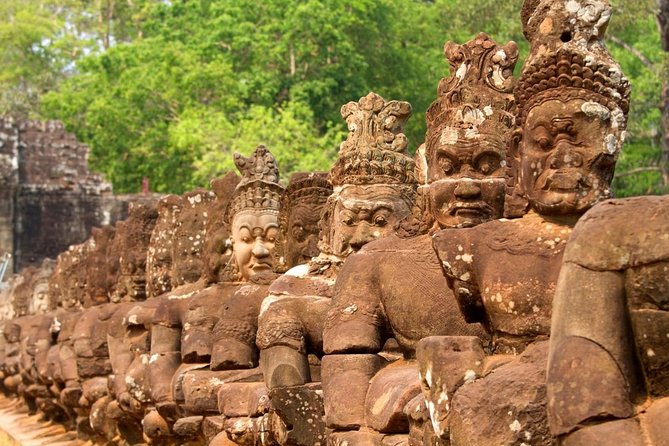
After Angkor Wat, you move to the South Gate of Angkor Thom. The gate crossing is one of the most memorable entrances in the park. A stone causeway crosses the roughly 100-meter-wide moat, lined with large figures pulling a serpent in the famous Churning of the Ocean of Milk scene.
The stop lasts about 40 minutes. Look closely at the figures rather than rushing straight through. The South Gate gives you a quick lesson in Khmer symbolism and a clear sense that Angkor Thom was planned as a royal city, not just a collection of temples.
Bayon, Baphuon, and the royal city
Angkor Thom means Great City. It served as the Khmer capital after Angkor Wat’s main period of construction. The city contains several monuments, so the schedule moves quickly but sensibly through its central area.
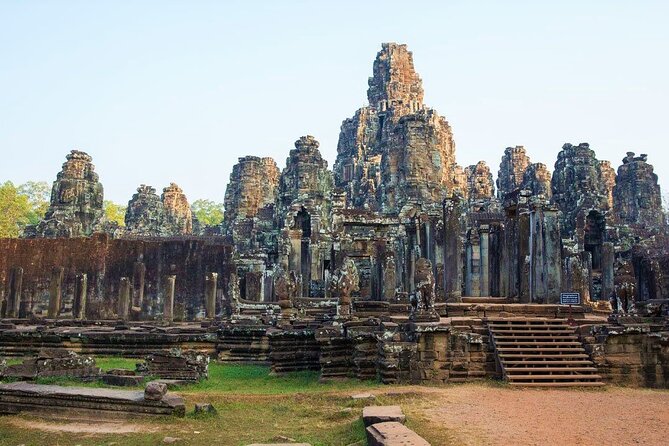
Bayon is the star here. Built around 1200 during the reign of Jayavarman VII, it is famous for its large stone faces. The faces appear on towers throughout the temple, creating a strange, watchful feeling as you move among the narrow passages.
You have about 90 minutes at Bayon, one of the more generous stops on day one. Use that time for both the upper levels and the carved scenes around the lower galleries. The reliefs show military scenes and daily life, giving you something more human than royal portraits and religious symbols.
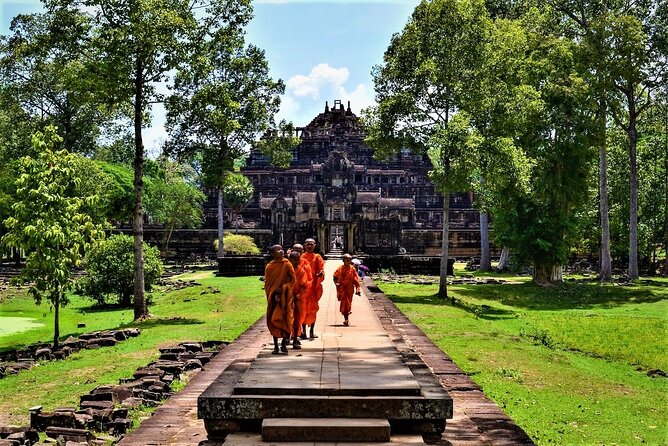
Baphuon follows, with about an hour. It was one of the largest Khmer temples before Angkor Wat was built. Its long raised walkway and tall structure make it feel different from Bayon, even though the two are close together.
Phimeanakas receives about 20 minutes. It is smaller and more stripped back than the headline temples, but the name, meaning Aerial Palace or Celestial Temple, points to its importance within the royal enclosure. This is a short stop, useful for orientation rather than detailed study.
The Terraces of the Elephants and the Leper King sit along the edge of the old Royal Square. The first is a long platform decorated with elephants and other carvings. The second has particularly detailed relief work on its inner walls.
Allow about 30 minutes at each terrace. These are open-air monuments, so shade is limited. Your guide can help you understand how the terraces worked as public and ceremonial spaces instead of treating them as another quick photo stop.
Ta Nei and Banteay Kdei add variety
Ta Nei is one of the more appealing choices on the first day because it feels quieter and less polished than Angkor Wat or Bayon. Built in the late 12th century under Jayavarman VII, it was dedicated to the Buddha and sits near the old East Baray reservoir.
The visit lasts about 50 minutes. Expect rougher stonework and a more atmospheric setting. This is a good place to ask your guide how the smaller temples supported the larger royal centers.
Banteay Kdei takes another 50 minutes. Its eastern gate is near the meeting point of the Small Circuit and Grand Circuit, across from the Srah Srang reservoir. The temple was built under Jayavarman VII and has the layered, Buddhist character associated with his reign.
Banteay Kdei is not as visually complete as Angkor Wat, but that is part of its appeal. You can see collapsed galleries, worn carvings, and trees pressing into the old structure. The stop also helps balance the day, giving you something less formal after the heavy monuments of Angkor Thom.
The first day includes a sunset experience as part of the tour’s overall plan. The exact viewpoint and timing should be confirmed with the operator, since the listed temple schedule and seasonal light conditions can affect the order. Pre Rup on day two is traditionally associated with evening views, but do not assume the sunset stop will be placed there without checking.
A few more things to do in Siem Reap worth a look
- Siem Reap: Angkor Wat 2-Day Tour with Sunrise and Sunset
★ 4.9 · 4,429 reviews - Angkor 2-Day Sunset & Sunrise Small-Group Tour
★ 5.0 · 2,567 reviews - 2 Days Exclusive Temple Highlights with Sunset and Sunrise Tour
★ 5.0 · 1,157 reviews - Siem Reap: Angkor Sunrise 1- or 2-Day Guided Temples Tour
★ 4.9 · 1,132 reviews
Day two: Banteay Srei and the outer temples
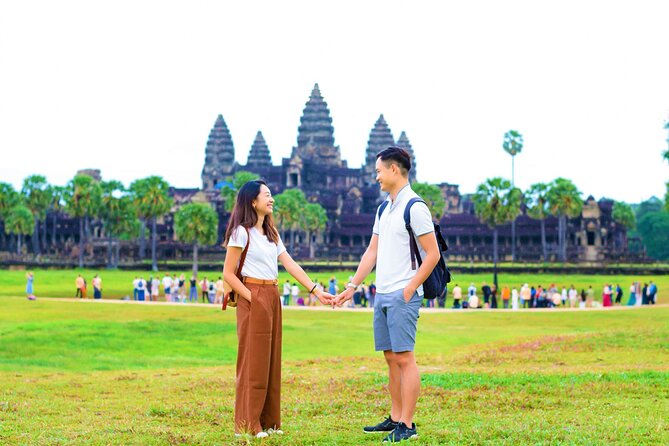
Day two begins with Banteay Srei, about 37 kilometers from the central Angkor area. The two-hour visit is worthwhile because this temple looks different from the giant monuments.
Banteay Srei is a 10th-century Hindu temple built from fine pink sandstone. Its small scale and detailed carvings make it one of the easiest places to appreciate Khmer decoration up close. The lintels and doorways are covered with precise figures and patterns.
The drawback is the distance. You spend more time in the vehicle than on the central circuit, and the visit adds another early start to a tiring two-day program. Still, I would keep it in the plan. Banteay Srei gives you a better sense of the range of Khmer architecture, and the two-hour stop is long enough to look carefully rather than simply arrive, photograph, and leave.
Banteay Samre follows for about 50 minutes. Built in the early 12th century during the reigns of Suryavarman II and Yasovarman II, it is a Hindu temple near the East Baray. Its enclosed layout can feel more compact and easier to read than the huge central monuments.
There is also a stop at Preah Dak Village, known for local souvenirs, objects, and art. Treat this as a chance to see a small part of the local economy rather than a required shopping session. If you prefer not to buy anything, you can simply look around and continue.
Preah Khan, Neak Pean, and Ta Som
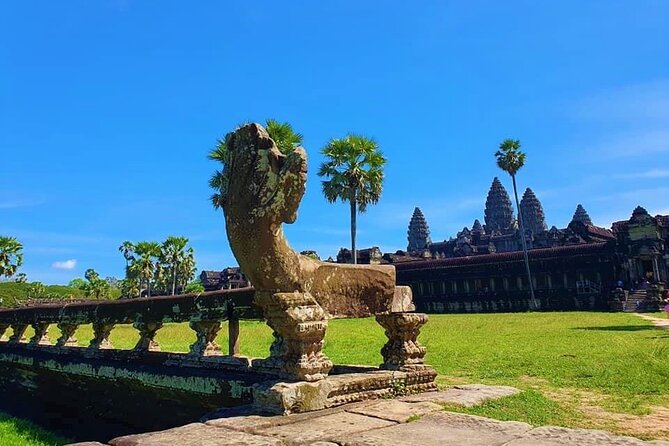
Preah Khan is one of day two’s major stops, with about an hour to explore. Jayavarman VII dedicated it in 1191 to his father, and its central statue represented Jayavarmeshvara, or Jayavarman, Lord of the World.
The temple has long corridors, courtyards, and a mix of religious imagery. It rewards a guide who can explain how royal memorials, religious centers, and working communities overlapped at Angkor. Ask about its role rather than focusing only on the stones in front of you.
Neak Pean takes about an hour and is unlike most other temples in the park. It was built on an artificial island within a large reservoir, with a central sanctuary and associated pools. The layout reflects a sacred water system, so the setting is as important as the structure itself.
This stop may be less instantly impressive than Bayon, especially if you prefer tall towers and carved faces. I like it because it shows the Khmer interest in water, healing, and religious planning from a different angle.
Ta Som gets about 40 minutes. Built during the late 12th century under Jayavarman VII, it is a smaller Buddhist temple with a more intimate feel. The stop is useful after the larger Preah Khan because it lets you study details without facing another enormous complex.
The schedule is brisk here. You may not have time to inspect every corridor, so tell the guide if you want to focus on carvings, architecture, or photography. That is one of the practical advantages of a private tour.
Eastern Mebon and Pre Rup finish the circuit

Eastern Mebon was built in the 10th century by Rajendravarman II and dedicated to Shiva. It was originally positioned in the middle of the East Baray, a huge reservoir, though the water has gone.
The temple is a mountain-style monument with a strong central platform. About 30 minutes gives you enough time to see its main features, including the elephant figures associated with the corners. Your guide can explain how the temple once related to the reservoir, which makes the bare setting easier to understand.
Pre Rup is the final listed temple, with about an hour. Founded in 961, it is the major surviving monument of Rajendravarman II. Its tiered form gives you a clear view of how Khmer temple mountains were designed.
The stone can become very hot, and climbing uneven steps is part of the visit. Take your time and use the private vehicle as a cool-down space afterward. If the operator schedules sunset here, the upper levels can make a memorable closing point, but confirm that arrangement in advance.
What the $149.46 price really covers
At $149.46 per person, the price is strongest for couples, families, or small private groups that want a guide and transport without arranging each temple independently. You receive hotel pickup and drop-off, an official licensed guide, private air-conditioned transfers, bottled water, cool towels, service charges, and government VAT.
The price does not include the Angkor Pass. The guide assists with buying it at the entrance to Angkor Park, but you should budget for that separately. Meals are also extra. Local restaurants offer vegetarian and non-vegetarian dishes, with menu prices listed at about $3 to $10 per dish.
Tips for the guide and driver are not included. You are not required to tip, but it is sensible to plan for it if Sara, Leap, or your assigned team gives you useful historical context, handles the early starts well, or adapts the route to your needs.
For families, the private vehicle is particularly useful. A family with two young children completed the two-day route without feeling unsafe, and the private format allows breaks that would be harder in a fixed group. Still, the two-day schedule is demanding for young children because of the early sunrise and the number of temple stops.
Who should book this experience
I would choose this tour if you want to see the major Angkor temples but also want Banteay Srei, Ta Nei, Banteay Kdei, Banteay Samre, and the Grand Circuit. It suits first-time visitors who want historical explanations rather than a driver who only points out the entrances.
It also fits you if you value flexibility. The private format means your group alone participates, and the guide can shape the pace around your interests. Several guide and driver pairings have been praised for friendly service, careful driving, clear English, and a willingness to help beyond the basic route.
I would hesitate if you dislike early mornings, long temple days, or frequent stops. You can see a great deal, but you will not have endless time at each monument. If your ideal Angkor visit means sitting quietly at one temple for half a day, a slower private itinerary would suit you better.
Cancellation is free if you cancel at least 24 hours before the local start time. Changes or cancellations made later are not accepted for a refund.
Should you book the two-day Angkor tour?
Book it if you want an efficient first visit with sunrise, sunset, the major monuments, and several quieter temples in one private plan. The guide, air-conditioned vehicle, water, and cool towels make the price fair, especially when shared by two or more people.
Before paying, confirm your hotel pickup time, the exact sunset location, the Angkor Pass cost, and the guide assigned to your group. Pack light clothing, sun protection, sturdy footwear, and patience for the 4:30 a.m. start. If you can manage the pace, this is a strong way to see the breadth of Angkor without spending your entire visit arranging transport and temple order yourself.
FAQ
Is hotel pickup and drop-off included?
Yes. Pickup and drop-off at your hotel in Siem Reap are included. You need to provide the hotel name when booking.
Is the Angkor Pass included in the price?
No. The Angkor Pass is separate and covers the temples in the itinerary. Your guide assists you with purchasing it at the entrance to Angkor Park.
Are meals included?
No. Lunches are at your own expense. Local restaurants offer vegetarian and non-vegetarian dishes, with menu prices listed at about $3 to $10 per dish.
What time does the first day begin?
The first morning begins around 4:30 a.m. for sunrise at Angkor Wat.
Is this a private tour?
Yes. Only your group participates, and transportation is provided in a private air-conditioned vehicle.
Can I cancel for a full refund?
Yes, if you cancel at least 24 hours before the experience start time. Cancellations or changes made less than 24 hours before the start are not accepted for a refund.
Just added in Siem Reap
- Twilight Tastes of Siem Reap Include Dinner★ 5.0 · 13 reviews
- Ultimate Sunrise to Angkor Wat, Angkor Thom and Bayon Temple★ 5.0 · 3 reviews
- Trekking Tour at Phnom Kulen National Park from Siem Reap★ 5.0 · 3 reviews
- Full-Day Private Tour of Angkor Wat with Pick Up★ 5.0 · 12 reviews
- Private Day Trip to Angkor Temples with Expert Guide★ 5.0 · 4 reviews
- Siem Reap City Tour with War Museum and Killing Field★ 5.0 · 27 reviews
- Waterfall & River of 1000 Siva Linga- Kulen Mountain Private Tour★ 5.0 · 3 reviews
- Angkor Wat Experience Temple Pass and Siem Reap Food Tour★ 5.0 · 13 reviews
Angkor Wat Sunrise Tours, compared.
Angkor Wat Sunrise or Sunset Tour with Guide from Siem Reap
Read our review →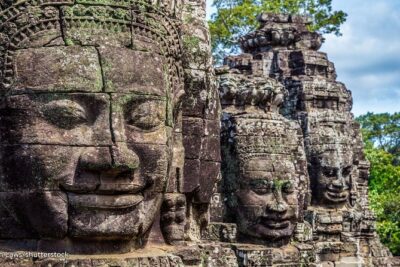
Angkor Wat Sunrise tour with Small – Group and Guide tours
Read our review →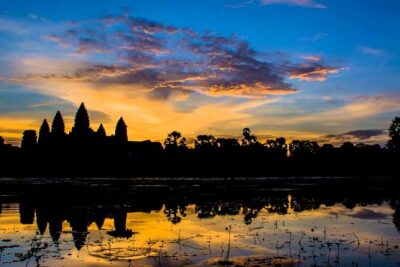
Full-Day Angkor Wat Sunrise Private Tour with Guide from Siem Reap
Read our review →
Angkor Wat Sunrise & 3 Main Temples with Breakfast – Small Group
Read our review →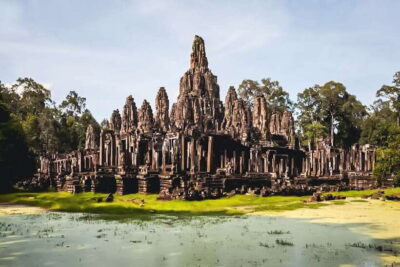
Angkor Wat Sunrise and Full-Day Sightseeing Tour
Read our review →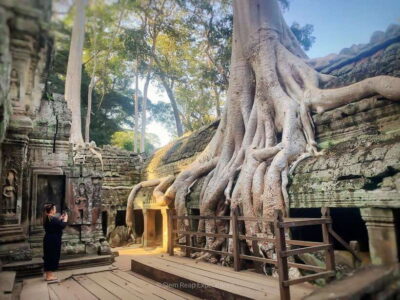
2 Days Exclusive Temple Highlights with Sunset and Sunrise Tour
Read our review →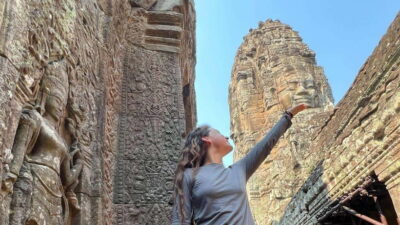
Angkor Sunrise 1- or 2-Day Guided Temples Tour
Read our review →Browse the lists this tour appears in