
Reviewed · ANGKOR TEMPLE TOURS
Private Tour: (Avoid Crowds & Heat) 2-Day Angkor Temples
Angkor Wat may be the headline, but the smartest part of this two-day tour is how it gives you time for less crowded temples before tackling the famous monuments. Day one covers Banteay Srei, Banteay Samre, Pre Rup, Preah Khan, and Neak Pean. Day two brings the big names, including Angkor Wat, Bayon, Ta Prohm, and Angkor Thom.
I like the private format, since your guide can adjust the pace and route for your group. I also like the small comforts: air-conditioning, cold drinks, snacks, and hotel pickup in Siem Reap. The catch is cost planning. The tour is listed at $62, but the Angkor Archaeological Park ticket costs another $62 per person for a two or three-day visit. Expect many stairs, uneven ground, and plenty of walking.
Key points before you book
- Two days with a sensible rhythm: Quieter outer temples come first, then Angkor’s major sights.
- A private guide and vehicle: Only your group participates, with hotel pickup and air-conditioned transport.
- Strong guide roster: Guides named in the experience include Tay, Sopheara, Viet, Kim, and Tai.
- The park pass is extra: Budget another $62 per person for the two or three-day Angkor ticket.
- A complimentary timing option: Tell your guide on day one if you want sunrise or sunset the following day.
- Expect real walking: Stairs, rough paths, heat, and temple climbs are part of the day.
Why two days works better than one
Angkor is not a single temple. It is a huge collection of monuments spread across an area where distances and heat can wear you down. Trying to cram the main sights into one long day often leaves you staring at stones without understanding what you are seeing.
This tour gives you a useful split. The first day reaches temples farther from the central Angkor circuit, including Banteay Srei and Banteay Samre, then returns through Pre Rup and the larger eastern temples. The second day is reserved for Angkor Wat, Angkor Thom, Ta Prohm, and Ta Nei.
That order has practical value. You get the less familiar sites while your energy is fresh, then use the second day for the monuments most people have come to see. The guide can also work around crowds when possible. A private tour is especially useful here because your group does not have to follow the pace of strangers.
You start at about 7:30 a.m. in Siem Reap. Hotel pickup and drop-off are included, along with an air-conditioned private vehicle, snacks, and refreshments. The exact length of each day can feel full, but the vehicle gives you a place to cool down between temple stops.
More temples within reach of Siem Reap:
- Siem Reap Tour: Angkor Wat Sunrise, Bayon, Ta Prohm, Banteay Srei
★ 5.0 · 931 reviews - Siem Reap: Bike the Angkor Temples – Full-Day 30km Tour
★ 5.0 · 463 reviews - Preah Vihear: Full-Day Preah Vihear and Koh Ker Temple Tour
★ 4.9 · 263 reviews
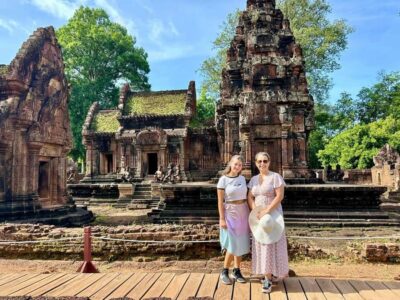
Banteay Srei: fine carvings far north of Angkor
Banteay Srei is one of the most rewarding stops on day one. It was built in the second half of the 10th century, more than 20 kilometers north of Angkor, and is famous for its pink sandstone and unusually delicate carving.
The temple is smaller than Angkor Wat, but that is part of its appeal. The scale lets you look closely at the decorative work rather than simply taking in a huge structure from a distance. You have about one hour here, enough for a guided walk and time to examine the carved details.
The ride out also changes the feel of the day. You are away from the central cluster of famous ruins, and the stop helps you see that the Khmer building tradition was not limited to one grand capital. Ask your guide to explain the carvings and the temple’s place in the wider Angkor period.
Banteay Srei is a good reason to choose this tour over a basic Angkor Wat outing. It requires extra driving, but the added time is justified if you care about architecture and ornament.
Banteay Samre: a quiet temple with Angkor Wat echoes
Banteay Samre follows with about 45 minutes at an isolated temple in a peaceful setting. It dates from the first half of the 12th century, and the form of its towers has similarities to Angkor Wat.
This is a useful contrast with Banteay Srei. Instead of focusing mainly on fine pink sandstone carving, you get a more enclosed temple layout and a quieter atmosphere. The shorter stop keeps the day moving, though you should not expect the same amount of time for close inspection as at Banteay Srei.
I like this pairing because the two temples feel different. One is known for detailed decoration, the other for its setting and architectural relationship to the larger Angkor style. A guide can help you notice those differences instead of treating every temple as another pile of stones.
Pre Rup: brick, laterite, and a high climb
Pre Rup takes about 30 minutes. Built in the middle of the 10th century, it combines laterite, brick, and sandstone in a way that gives the temple a distinct color and texture.
The name Pre Rup means turning the body. The temple rises in terraces, so expect stairs and a climb. That brief visit may be enough for a look around, but it is not a leisurely stop. Anyone with limited mobility should think carefully about the physical demands of the tour before booking.
Pre Rup also signals a shift in the day. You have moved from the refined carvings of Banteay Srei to a more substantial temple platform where height and structure matter. Wear shoes with a firm grip and keep water close.
A few more things to do in Siem Reap worth a look
- Siem Reap: Angkor Wat 2-Day Tour with Sunrise and Sunset
★ 4.9 · 4,429 reviews - Angkor 2-Day Sunset & Sunrise Small-Group Tour
★ 5.0 · 2,567 reviews - 2 Days Exclusive Temple Highlights with Sunset and Sunrise Tour
★ 5.0 · 1,157 reviews - Siem Reap: Angkor Sunrise 1- or 2-Day Guided Temples Tour
★ 4.9 · 1,132 reviews
Preah Khan: a long, layered temple complex
Preah Khan receives about one hour, and it deserves the time. Jayavarman VII built it in the late 12th century as a Buddhist university and city. Its corridors and courtyards create a more extended exploration than the compact outer temples.
The atmosphere can remind you of Ta Prohm, but Preah Khan has its own architectural details, including a distinctive round-columned, two-story building. These unusual features are easy to miss if you rush through behind a group.
This is one of the stops where an informed guide adds real value. The temple can feel confusing, with passageways leading into courtyards and carved surfaces appearing around corners. A guide such as Tay, Sopheara, Viet, Kim, or Tai can connect the layout to the religious and civic role of the site.
You should also expect uneven footing and more walking than the 60-minute stop may suggest. The listed time covers the visit, not just a quick photo stop.
Neak Pean: a small shrine on the water
Neak Pean takes about 30 minutes and offers a very different view of Khmer temple design. Built in the late 12th century under Jayavarman VII, it was intended for miraculous healing.
The unusual central monument appears in the middle of a pond, giving the site a strong symbolic quality. Water is not just scenery here. It is part of the meaning of the place and its healing purpose.
This is a shorter stop, and your experience depends on conditions around the pond and the pace of the day. Do not expect a large temple complex like Preah Khan. Neak Pean is about the setting, the symbolism, and the oddity of a monument surrounded by water.
Angkor Wat: allow two hours for the main event
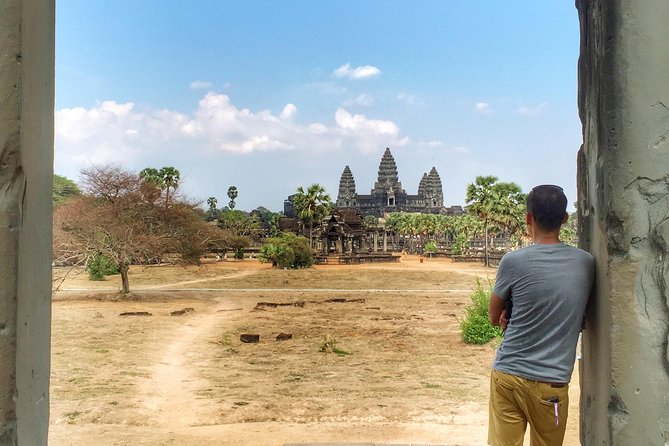
Day two begins with Angkor Wat, the world’s largest religious monument, with about two hours set aside. That sounds generous, but the complex is enormous and has several levels of interest.
You can spend time taking in the long approach, the towers, the galleries, and the carved scenes. The scale is difficult to grasp from a single viewpoint. A guide helps you break it into sections and understand what you are looking at instead of wandering without a plan.
Two hours gives you a strong introduction, but it is not enough to inspect every corner. Your guide will need to manage the route and the heat. This is also a good place to ask for a slower pace if you want more time with the carvings rather than moving quickly from one viewpoint to the next.
You can request sunrise or sunset for the following day at no added charge, but you must tell your guide on day one. That is a useful option if you want a special light or cooler timing. It is not automatic, so mention it early.
Angkor Thom and Bayon: a city, not just one temple
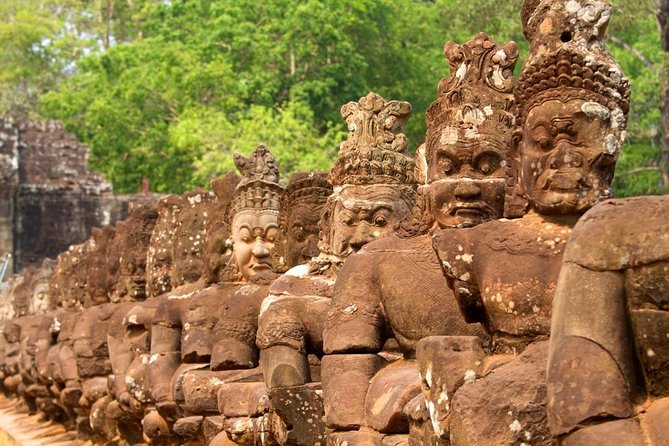
The two-hour visit to Angkor Thom covers a walled Khmer capital that contains several important monuments. Bayon is the best known, with its huge carved faces, but the city also includes Baphuon, Phimeanakas, the Terrace of the Elephants, the Terrace of the Leper King, Prah Palilay, and other remains.
This part of the tour rewards context. Angkor Thom was not merely a backdrop for one temple. It was a planned capital with religious, civic, and ceremonial spaces inside its walls.
The time can pass quickly because there is so much to see. Bayon alone invites close inspection, while Baphuon and the terraces require more walking. You may not get equal time at every monument, so tell your guide which features matter most to you.
The city also involves steps and uneven paths. If you tire easily, use the private format to ask for a pause. You are not locked into the pace of a large group.
Ta Prohm: trees, ruins, and the busiest stop
Ta Prohm takes about one hour and is famous for its strangler figs and silk-cotton trees growing through the ruins. The trees and stone are so closely linked that the temple has a romantic, almost theatrical look.
It is also known as a filming location, which adds to its popularity. That means Ta Prohm can feel busier than the other temples on the route. The tour aims to avoid crowds when possible, but no private guide can make a famous site empty.
Your guide’s route and timing matter here. A good guide can steer you toward less congested sections and explain what you are seeing while you wait for a clear view. The private vehicle also helps you move on when the site becomes tiring.
Ta Prohm is one of the places where you should balance photographs with care. The trees are the visual draw, but the remaining galleries and carved details deserve attention too.
Ta Nei: a quiet finish in the trees
Ta Nei is a small Buddhist temple built during the reign of Jayavarman VII in the late 12th century. The 30-minute stop is designed as a quieter counterpoint to Ta Prohm.
Its main advantage is atmosphere. You get a smaller, less crowded ruin after one of the most popular sites in the Angkor area. Ta Nei may not have the grand scale of Angkor Wat or the famous faces of Bayon, but it gives the day a calmer finish.
This is also where the tour’s avoid-the-crowds idea works best. You are not only ticking off the standard monuments. You are seeing a modest temple that helps show how varied the Angkor area can be.
The guide makes the difference
The tour includes a professional licensed guide, and the private setup lets that person shape the visit around your group. Names associated with the experience include Tay, Sopheara, Viet, Kim, and Tai.
Specific guide quality can vary by assignment, but the guide is central to the value. The best moments come when someone explains why a temple was built, points out a detail you would have missed, or changes the order to reduce waiting and crowding.
The strongest guide feedback highlights careful route management, clear English, strong knowledge of Cambodian history and culture, patience, and a willingness to answer questions. One guide, Sopheara, was singled out for being highly educated and especially well versed in the temples. Tai was praised for combining temple knowledge with good timing, while Viet was noted for shaping the experience around the group.
If you care about history, ask questions. If you care more about photographs, say so. A private guide can only tailor the day when you explain what you want.
What the $62 price really covers
The tour price is listed as $62, but the Angkor Archaeological Park pass is not included. The required two or three-day ticket is listed at another $62 per person, so factor in a total of $124 per person before any other personal costs.
That makes the tour more expensive than the headline price suggests, but the price also includes private transport, hotel pickup and drop-off, a licensed guide, snacks, and refreshments over two days. You are paying for transport and planning as well as temple access.
For a solo visitor, the total may feel high. For a couple, family, or small private group, the value improves because the vehicle and guide cost is shared. The group discount feature may also help, though the exact discount is not specified.
The private format matters most on a hot day. You can return to an air-conditioned vehicle between sites, carry less water and gear, and avoid being tied to a large group’s schedule.
Heat, stairs, and what to pack
This is an active sightseeing experience. Pre Rup and other temple areas involve stairs, and the route includes uneven ground, long walks, and exposed heat. One practical warning is worth taking seriously: this is not an easy ride-and-photo tour.
Bring light clothing, water, sun protection, and shoes suited to rough surfaces. The operator supplies snacks and refreshments, but you should still plan for personal hydration and the physical effort of two full days.
Most people can participate, according to the tour information, but that does not remove the need to judge your own stamina. Tell your guide if you need more breaks. The private setup gives you more flexibility than a large group, but it cannot remove the stairs or distances.
Cancellation is free if you cancel at least 24 hours before the start time. Changes or cancellations made inside that window are not refunded.
Who should book this private Angkor tour?
I would choose this tour if you are visiting Cambodia for the first time, want the major Angkor sights, and also care about quieter temples and historical context. It is particularly well suited to couples, families, and small groups who value a private vehicle and flexible pacing.
It is a good fit for history fans who want more than Angkor Wat. Banteay Srei, Preah Khan, Neak Pean, and Ta Nei give the trip variety, while Angkor Wat, Angkor Thom, Bayon, and Ta Prohm cover the essentials.
I would hesitate if you want a slow, highly specialized photography trip, because the itinerary includes many sites across two days. I would also think twice if stairs and long walks are difficult for you.
For most first-time visitors who can manage the heat and climbing, this is a well-planned introduction to Angkor. Just budget for the separate park ticket, tell the guide early about sunrise or sunset, and ask for the guide to be assigned to your interests.
FAQ
Is the Angkor entrance ticket included?
No. The Angkor Archaeological Park ticket is separate and is listed at $62 per person for a two or three-day visit.
What is included in the tour price?
The tour includes a professional licensed guide, hotel pickup and drop-off, a private air-conditioned vehicle, snacks, and refreshments.
Is this a private tour?
Yes. Only your group participates, so you do not share the guide or vehicle with other groups.
What time does the tour start?
The stated start time is 7:30 a.m. Pickup begins in Siem Reap.
Can I request sunrise or sunset?
Yes. Tell your guide on day one if you would like sunrise or sunset on the following day. This option is complimentary.
Which temples are visited on day one?
Day one includes Banteay Srei, Banteay Samre, Pre Rup, Preah Khan, and Neak Pean.
Which temples are visited on day two?
Day two includes Angkor Wat, Angkor Thom, Ta Prohm, and Ta Nei.
Is the tour suitable for most people?
The tour information says most people can participate. You should still expect stairs, climbing, uneven ground, and substantial walking.
Can I cancel for a refund?
Yes, if you cancel at least 24 hours before the experience begins. Cancellations or changes made less than 24 hours before the start time are not refunded.
Just added in Siem Reap
- 1-Day Angkor Wat Private Tour with Spanish Tour Guide.★ 5.0 · 9 reviews
- Angkor Wat: Small-Group Tour with Balloon Ride and Lunch★ 4.6 · 13 reviews
- Sky Venture Microlight Siem Reap★ 4.9 · 18 reviews
- Angkor Wat plus Balloon Ride with Khmer Lunch★ 5.0 · 46 reviews
- From Siem Reap: Battambang Day Trip Return or to Phnom Penh★ 4.9 · 73 reviews
- Apsara Dance Performance – Including Buffet Dinner & Hotel Pickup★ 5.0 · 68 reviews
- Angkor Wat Tour by Tuk-Tuk with English Speaking Driver★ 4.5 · 65 reviews
- Authentic Cambodian Countryside Jeep Experience★ 5.0 · 62 reviews
Angkor Temple Tours, compared.
Siem Reap Tour: Angkor Wat Sunrise, Bayon, Ta Prohm, Banteay Srei
Read our review →

Angkor Wat one Day Private Tour for All Highlight Angkor Temples
Read our review →
1-Day private Angkor Temple Tour from Siem Reap
Read our review →
Private one-day tuktuk ‘small tour’ of the oldest Angkor temples
Read our review →Browse the lists this tour appears in