
Reviewed · ANGKOR TEMPLE TOURS
Two Day Angkor Temples Tours
Angkor is too large and varied for a rushed one-day sweep. This two-day private tour gives you time to see the famous monuments while also reaching quieter temples such as Banteay Srei, Neak Pean, and Ta Som. The route moves from delicate pink sandstone carvings to enormous city gates, jungle-wrapped ruins, and broad temple mountains.
I like the flexible guiding and the chance to travel in an air-conditioned vehicle between sites. I also like the human touch: guides such as Borey, Kim, Bunleat, Kim, and Kimhoeun are associated with clear English, Cambodian history, religious context, and practical photography help. The main drawback is that the days are full, and entrance tickets plus GST are not included in the quoted $102.57 price.
Key points to know before booking
- Private touring: Only your own group participates, making it easier to ask questions or adjust the pace.
- Two very different temple days: Day one covers several outlying and lesser-visited monuments, while day two focuses on Angkor Wat, Angkor Thom, and Ta Prohm.
- Strong guide focus: Borey is noted for family connections to Siem Reap and for helping with photo spots. Kim, Bunleat, and Kimhoeun are also named as guides connected with the experience.
- Air-conditioned transport: This matters in Cambodia’s heat, especially with seven stops on the first day.
- Temple admission is extra: Every stop is marked as excluding admission, so budget separately for the required temple access.
- A full schedule: Several stops last 30 to 50 minutes, while Angkor Wat and Angkor Thom receive about two hours each.
Why two days works better than a quick Angkor visit
Angkor is not one temple. It is a large archaeological area with monuments from different centuries, rulers, religions, and building traditions. A short visit often leaves you with impressive photographs but little sense of how the pieces fit together.
This tour divides the experience sensibly. The first day moves through temples east and north of the main Angkor Wat area, ending with two dramatic pyramid temples. The second day gives the biggest share of time to the monuments most people hope to see first.
The private format is important here. You can ask why a carving shows Vishnu rather than Shiva, how a temple functioned as a city center, or why tree roots were left at Ta Prohm. You are not trying to squeeze your questions into a large group’s schedule.
The guides connected with this tour are especially useful for visitors who want more than names and dates. Borey is praised for strong English, Cambodian and Angkorian history, and photography suggestions. One guide, Bunleat, is associated with especially detailed explanations, which can make the day longer than expected. That is good news if you enjoy context, but you should say so clearly if you prefer a quicker visit.
More temples within reach of Siem Reap:
- Siem Reap Tour: Angkor Wat Sunrise, Bayon, Ta Prohm, Banteay Srei
★ 5.0 · 931 reviews - Siem Reap: Bike the Angkor Temples – Full-Day 30km Tour
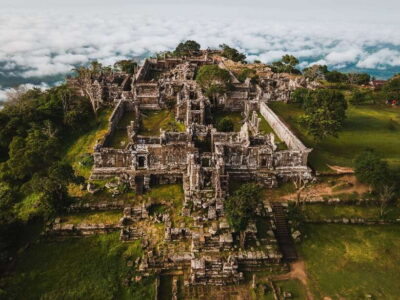
★ 5.0 · 463 reviews - Preah Vihear: Full-Day Preah Vihear and Koh Ker Temple Tour
★ 4.9 · 263 reviews
Day one: delicate carvings and quieter monuments
Banteay Srei, the pink sandstone masterpiece
Banteay Srei is the first stop and receives about an hour. Built in the 10th century for the Hindu god Shiva, it is smaller than Angkor Wat but famous for its fine carving and pinkish sandstone.
I like this opening because it immediately shows you that Angkor is not only about size. The detail here is the point. Look closely at the lintels, pediments, figures, and floral patterns. The smaller scale lets you study the craftsmanship without feeling swallowed by a huge complex.
The drawback is simple: one hour passes quickly. If your guide explains the Hindu scenes in detail and helps you find good photo angles, you may want more time. This is one reason the private format helps. Your guide can tell how much detail your group wants before moving on.
Admission is not included, so remember that the tour price does not cover temple entry.
Banteay Samre, a quieter cousin to Angkor Wat
Banteay Samre dates from the 12th century, the same broad period as Angkor Wat, and was built under Suryavarman II for Vishnu. You have about an hour here.
The temple has a more enclosed, fortress-like feel than Banteay Srei. Its preservation makes it useful for comparing Angkorian design across sites. I would pay attention to the galleries, towers, and carved entrances rather than rushing straight through the central sanctuary.
This is also a good place to let your guide connect architecture with belief. The temples were not built as empty monuments. Their layouts, images, and central towers reflected Hindu ideas about the universe and the place of the gods.
A few more things to do in Siem Reap worth a look
- Siem Reap: Angkor Wat 2-Day Tour with Sunrise and Sunset
★ 4.9 · 4,429 reviews - Angkor 2-Day Sunset & Sunrise Small-Group Tour
★ 5.0 · 2,567 reviews - 2 Days Exclusive Temple Highlights with Sunset and Sunrise Tour
★ 5.0 · 1,157 reviews - Siem Reap: Angkor Sunrise 1- or 2-Day Guided Temples Tour
★ 4.9 · 1,132 reviews
Preah Khan, corridors and carved stone
Preah Khan means Sacred Sword and is one of the largest complexes in the Angkor area. The scheduled visit is about an hour, though the maze of corridors can make that feel short.
This is one of the most rewarding stops for visitors who enjoy atmosphere. You move through vaulted passages, courtyards, and stonework marked by age. Preah Khan provides a useful contrast with Ta Prohm, which comes on day two. Both have a sense of ruin and vegetation, but Preah Khan feels larger and more layered.
Ask your guide to help you read the plan of the temple. Without context, it can seem like a series of beautiful walls. With explanation, the complex becomes easier to understand as a major religious and civic center.
Neak Pean, a small temple on an artificial island
Neak Pean receives about 40 minutes. This Buddhist temple was built by Jayavarman VII on an artificial island in the man-made Jayatataka reservoir.
The approach and setting are part of the experience. Compared with the heavy stone mass of Preah Khan, Neak Pean feels compact and carefully framed by water and open space. It is a welcome change of scale during a day filled with large structures.
Do not expect a long temple exploration here. The stop is brief, and the appeal comes from the design, the water setting, and the story behind it. Your guide can explain its Buddhist purpose and the role of the surrounding reservoir.
Ta Som, a brief but worthwhile pause
Ta Som is a small late 12th-century temple built by Jayavarman VII. The visit lasts about 30 minutes.
This is a quick stop, but it adds another variation to the day. Look for the eastern gate and the large carved head described in the tour details. The temple is often appreciated for its compact scale and signs of nature reclaiming the stone.
Thirty minutes is enough for an introduction and photographs, but not for a slow study of every section. If you are especially interested in smaller ruins, tell your guide. A private tour gives you a better chance of making that preference known.
Eastern Mebon, once surrounded by water
Eastern Mebon was built in the 10th century by Rajendravarman II. It once sat on an island in the Eastern Baray, a large reservoir that has since dried up, leaving the temple on dry land.
You have about 50 minutes here. The site helps explain how water shaped Angkorian planning. The reservoir was not just scenery. It was part of the engineering and religious setting of the capital.
I like this stop because it adds historical scale. You are not only looking at towers and carvings. You are seeing how a temple once related to an enormous body of water. The present-day setting is different, and that difference is worth asking about.
Pre Rup, a strong finish to day one
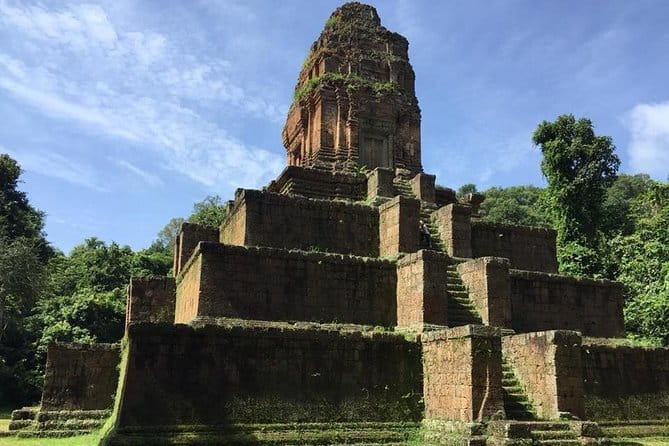
Pre Rup is about a kilometer south of Eastern Mebon and receives roughly 40 minutes. Rajendravarman II built this 10th-century temple as a pyramid-shaped temple mountain with three upper levels.
The steep tiers give Pre Rup a solid, geometric appearance. After the enclosed corridors of Preah Khan and the small scale of Neak Pean and Ta Som, this final stop feels bold and monumental.
Be ready for steps and uneven stone. The tour advises a moderate level of physical fitness, and that is sensible across the two days. You do not need to be an athlete, but temple floors, stairs, and outdoor walking require care, particularly in hot weather.
Day two: Angkor’s most famous monuments
Angkor Wat, the essential two-hour visit
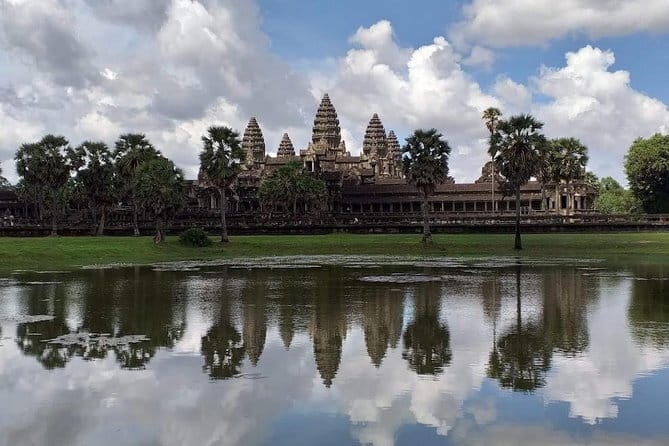
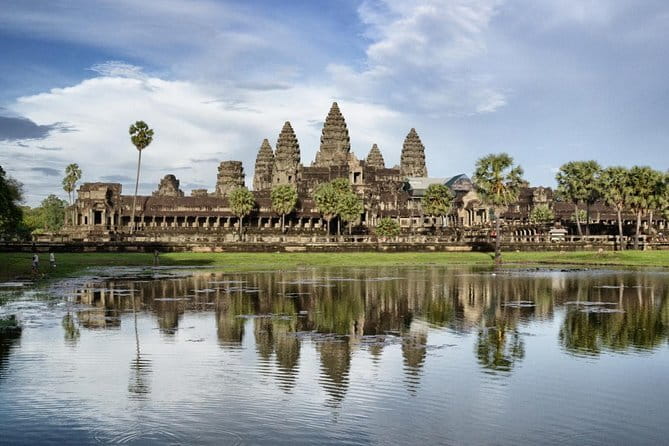
Angkor Wat receives about two hours, the longest single stop on the tour. Suryavarman II built it in the 12th century as a Hindu temple dedicated to Vishnu.
Two hours gives you a reasonable introduction, though the complex is vast. You can study the long galleries, towers, courtyards, and carved scenes, then pause to understand how the temple was organized.
This is the place where a good guide earns their keep. The scale can overwhelm you, and it is easy to walk past important details. A guide who explains the Hindu stories, the role of the central towers, and the temple’s connection to its king can turn a grand facade into a readable place.
The schedule is still tight for anyone who wants to examine every gallery. If photography matters to you, tell the guide early. Borey is specifically associated with photography tips and finding useful picture spots, including advice for phone photography.
Phnom Bakheng, a very short stop
Phnom Bakheng dates from the early 10th century and was built by Yasovarman I. It is known as one of the first temple mountains near Angkor, with five tiers and seven levels.
The stated stop is only one minute, so treat this as a brief viewing point rather than a full temple visit. The schedule does not promise a long climb or extended exploration. If Phnom Bakheng matters greatly to you, confirm the intended timing with the operator before booking.
This is one of the few parts of the plan that may feel too compressed. The private format may help with adjustments, but changes should never be assumed.
Angkor Thom, the last great city
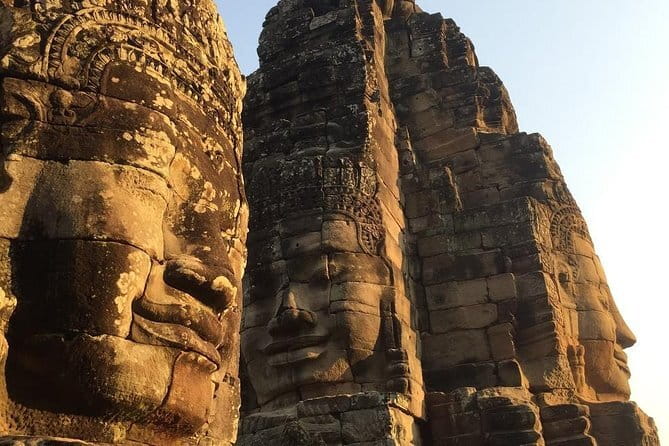
Angkor Thom receives about two hours. Jayavarman VII built this as the last major city of Angkor, centered on the Bayon.
This is not simply another temple stop. Angkor Thom was a city enclosed by walls and gates, and the visit helps you picture the political center of the Angkorian kingdom. The scale makes more sense after your guide explains how the city related to the surrounding region.
Two hours gives you time to focus on the Bayon and the city’s major features without treating the entire place as a quick photo stop. Ask questions about the shift from Hindu worship to Buddhist influence under Jayavarman VII. The tour’s guides are described as able to explain both Hindu and Buddhist contexts, which is useful here.
Ta Prohm, the atmospheric finale
Ta Prohm receives about an hour and is likely to be one of the most memorable stops. Its appeal comes from the way trees and roots have grown through the ruins, creating the famous image of nature pressing against stone.
The temple is more than a photo backdrop. It also shows why conservation at Angkor is complicated. Leaving some vegetation in place preserves the character people associate with the site, while protecting the structures requires careful work.
The guide can help you look beyond the best-known corners. Since the private itinerary can adapt to your interests, mention if you want time for photography or if you would rather hear more about Jayavarman VII and the temple’s purpose.
What the $102.57 price really covers
At $102.57 per person, the main value comes from private guiding and transport rather than an all-inclusive ticket. You receive an air-conditioned vehicle and a private experience for your group. Pickup is offered, while the stated ticket redemption point is Angkor Enterprise on Apsara Road in Siem Reap.
Temple admission is not included at any of the listed stops. GST is also excluded. That means you should calculate the total cost before deciding that this is the final price.
For a private two-day service, the price may be attractive if you want a guide who can explain the sites and adjust the pace. It is less compelling if you only want transportation and plan to walk through each temple independently.
The air-conditioning is not a minor extra. Day one includes seven stops, with a great deal of outdoor walking and repeated movement in and out of the vehicle. A cool car and reliable transport make the schedule more manageable.
Who will get the most from this tour
I would choose this experience if you want the major Angkor monuments but also care about smaller sites and historical explanation. It suits couples, families, and private groups who prefer asking questions without a large coach party around them.
It is also a good match for anyone interested in photography. Guides associated with the tour are described as helping with composition and phone photography, and the private format makes it easier to stop for a useful angle.
You should think twice if you dislike full sightseeing days, stairs, uneven surfaces, or detailed explanations. Several stops are short, while others could easily absorb more time. Tell your guide if you prefer a brisk overview or a slower, more academic visit.
The experience requires moderate physical fitness. Pickup is offered, and the meeting point is near public transportation, but exact pickup arrangements should be confirmed when you book.
Booking advice and cancellation terms
Confirmation is provided at booking. The experience is private, so only your own group takes part.
You can cancel for a full refund up to 24 hours before the start time. Cancellations or changes made inside 24 hours are not refunded or accepted. The tour also depends on good weather. If poor weather forces cancellation, you are offered another date or a full refund.
Because the tour is often booked about 28 days ahead, reserve early if your Siem Reap dates are fixed. That is especially sensible if you want a particular guide, although the available guide may vary.
Should you book these two Angkor days?
Book it if you want a private, guide-led introduction that combines Angkor Wat and Ta Prohm with Banteay Srei, Preah Khan, Neak Pean, Ta Som, Eastern Mebon, Pre Rup, Angkor Thom, and Phnom Bakheng.
The best reason to choose it is the guiding. Borey, Kim, Bunleat, and Kimhoeun are associated with strong English, historical detail, cultural explanation, flexibility, and photography help. The main caution is cost planning: admission and GST are extra, and the schedule is active.
For a first visit to Siem Reap, the two-day structure offers a useful balance. You see the icons, but you also leave the busiest monuments long enough to understand that Angkor is a whole civilization of sites, not just one famous temple.
FAQ
How long does the tour last?
The experience lasts approximately two days, with a separate set of temple visits scheduled for each day.
Is this a private tour?
Yes. Only your own group participates in the activity.
Is hotel pickup available?
Pickup is offered. The stated ticket redemption point is Angkor Enterprise on Apsara Road in Siem Reap.
Is transportation included?
Yes. An air-conditioned vehicle is included.
Are temple admission tickets included?
No. Admission tickets are not included for the stops listed on either day.
Is GST included in the price?
No. GST, or Goods and Services Tax, is listed separately from the tour price.
Which temples are visited on day one?
Day one includes Banteay Srei, Banteay Samre, Preah Khan, Neak Pean, Ta Som, Eastern Mebon, and Pre Rup.
Which temples are visited on day two?
Day two includes Angkor Wat, Phnom Bakheng, Angkor Thom, and Ta Prohm.
Can I cancel for a full refund?
Yes, if you cancel at least 24 hours before the experience start time. Cancellations within 24 hours are not refunded, and poor-weather cancellations offer either another date or a full refund.
Just added in Siem Reap
- Twilight Tastes of Siem Reap Include Dinner★ 5.0 · 13 reviews
- Ultimate Sunrise to Angkor Wat, Angkor Thom and Bayon Temple★ 5.0 · 3 reviews
- Trekking Tour at Phnom Kulen National Park from Siem Reap★ 5.0 · 3 reviews
- Full-Day Private Tour of Angkor Wat with Pick Up★ 5.0 · 12 reviews
- Private Day Trip to Angkor Temples with Expert Guide★ 5.0 · 4 reviews
- Siem Reap City Tour with War Museum and Killing Field★ 5.0 · 27 reviews
- Waterfall & River of 1000 Siva Linga- Kulen Mountain Private Tour★ 5.0 · 3 reviews
- Angkor Wat Experience Temple Pass and Siem Reap Food Tour★ 5.0 · 13 reviews
Angkor Temple Tours, compared.
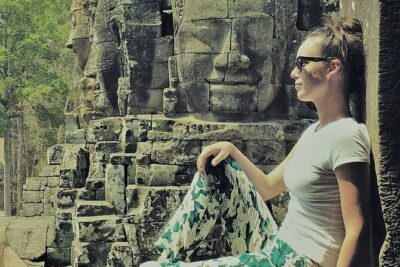
Siem Reap Tour: Angkor Wat Sunrise, Bayon, Ta Prohm, Banteay Srei
Read our review →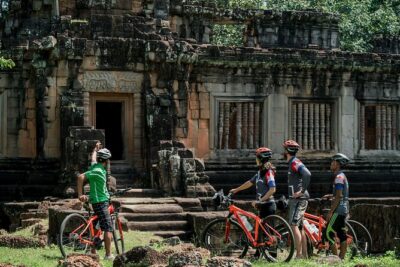
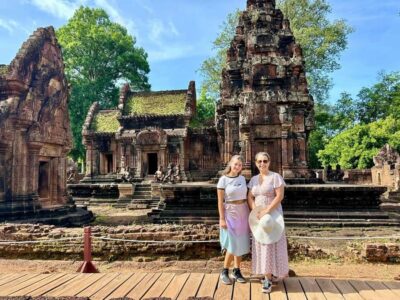
Angkor Wat one Day Private Tour for All Highlight Angkor Temples
Read our review →
1-Day private Angkor Temple Tour from Siem Reap
Read our review →

Private one-day tuktuk ‘small tour’ of the oldest Angkor temples
Read our review →Browse the lists this tour appears in