
Reviewed · BANTEAY SREI & BENG MEALEA TOURS
2-Day Angkor Wat, Banteay Srei & Floating Village Kampong Pluk
Angkor Wat is only the opening act here. Over two full days, you’ll see the famous temple at sunrise, walk beneath the tree roots of Ta Prohm, study Bayon’s many stone faces, cruise through Kampong Phluk, and reach the delicate pink sandstone of Banteay Srei. It is a big serving of Cambodia, with both grand monuments and ordinary life on Tonle Sap Lake.
I like the private format, since your guide can adjust the pace and your driver returns you to an air-conditioned vehicle between stops. I also like the mix of famous and quieter sites, especially Ta Nei and Preah Palilay. The main drawback is the packed schedule, plus the 5:00am start and extra costs for temple passes, the floating-village boat, and meals.
Key points to know before booking
- Sunrise and sunset in one trip: Start before dawn at Angkor Wat, then finish the first day at Phnom Bakheng.
- A private guide and vehicle: Only your group takes part, with hotel pickup, an English-speaking guide, and an air-conditioned vehicle.
- A broad temple selection: The route includes Angkor Wat, Ta Prohm, Bayon, Baphuon, Banteay Srei, Pre Rup, and several smaller sanctuaries.
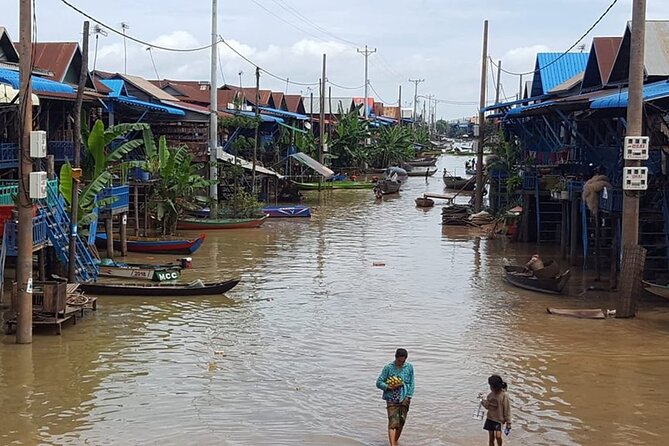
- A separate Tonle Sap experience: Kampong Phluk adds stilt houses, fishing life, and a private boat ride to the temple circuit.
- Guides with useful personal skills: Guides named Vanna, Chhay, Bun, and Lonn have been praised for historical explanations, friendly service, flexibility, and photography.
- Budget beyond the advertised price: Add $62 for the Angkor pass, $20 for the Kampong Phluk boat and village ticket, and about $5 per lunch.
Why this two-day route works
The smart feature of this tour is its range. Many Angkor visits become a parade of sandstone towers. This one gives you temples from different periods, wooded ruins, royal terraces, a mountain sunset, and a lake community.
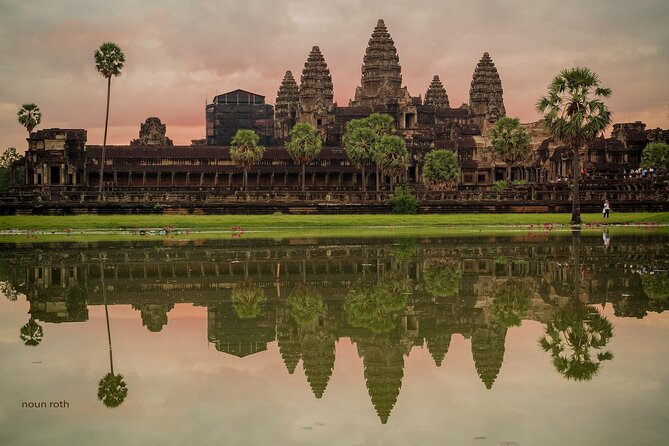
You also get two different kinds of time at Angkor Wat. The first day gives you a proper visit in daylight. The second begins in darkness, when the temple silhouette slowly appears behind the reflecting pools. That repeat visit is useful because the monument feels different at dawn than it does later in the day.
The tour is private, so you are not tied to the mood or pace of a large group. That matters at a site as tiring as Angkor. You can spend longer at Bayon, move more quickly through a smaller temple, or ask for help with photos. Guides such as Chhay and Bun have been praised for taking particularly good pictures, while Vanna and Lonn have been singled out for clear explanations of history, art, religion, and local culture.
Still, this is not a gentle holiday schedule. Day one runs from an 8:00am pickup through sunset. Day two begins at 5:00am and ends after several afternoon temples. Bring patience, water, and shoes that can handle uneven ground.
Other outlying temples from Siem Reap:
- Siem Reap: Kulen Mountain, Beng Mealea and Tonle Sap Tour
★ 5.0 · 1,483 reviews - Full-Day Banteay Srei & 4 Temples – Grand Tours Join-in Tour
★ 5.0 · 1,155 reviews - Siem Reap Tour: Angkor Wat Sunrise, Bayon, Ta Prohm, Banteay Srei
★ 5.0 · 931 reviews
Day one begins with Angkor Wat and Ta Prohm
Pickup is scheduled for 8:00am from your hotel or guest house. The first stop is Angkor Wat, and the visit is planned for about two hours. Your temple pass is not included, so you will need the required Angkor pass before entering. The listed price is $62 per person for the Angkor temples.
Two hours gives you time to see the major parts without turning the first morning into a full archaeological study. Your guide can explain the temple’s Hindu origins, its later Buddhist use, its galleries, towers, and carved scenes. You should pay attention to the scale as much as the details. Angkor Wat was built to impress from a distance, then reward you with close views of stone carving and carefully planned spaces.
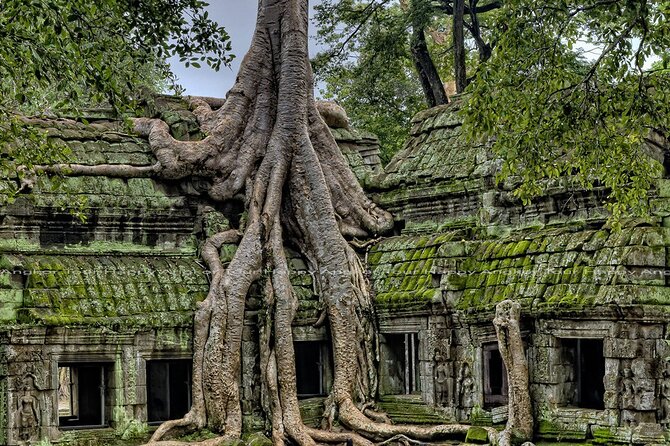
After Angkor Wat, the route moves to Ta Prohm for about two hours. This is the temple many people recognize from the film Tomb Raider, but the movie connection is only part of its appeal. Ta Prohm is memorable because enormous tree roots have grown across walls and galleries. Nature has not simply decorated the site. It has become part of the architecture you came to see.
Ta Prohm can feel crowded, and its uneven passages require care. That is where a private guide helps. You can focus on the best-known root-covered views while still hearing about the temple’s Buddhist character and later restoration work. Take your time with photographs, but do not treat the site as just a backdrop. The stones, roots, doorways, and narrow corridors make this one of Angkor’s most atmospheric stops.
Ta Nei and Angkor Thom bring a quieter rhythm
Ta Nei follows lunch and lasts about 45 minutes. Compared with Angkor Wat and Ta Prohm, it is small, wooded, and less restored. That rougher appearance is precisely the point. You can see a quieter side of the Angkor area, surrounded by large trees and away from the grand scale of the main monuments.
The visit then continues to the Victory Gate, an eastern entrance to Angkor Thom. The planned stop is only about 15 minutes, so think of it as a photo and orientation stop rather than a full visit. It introduces the fortified city before you continue to Bayon.
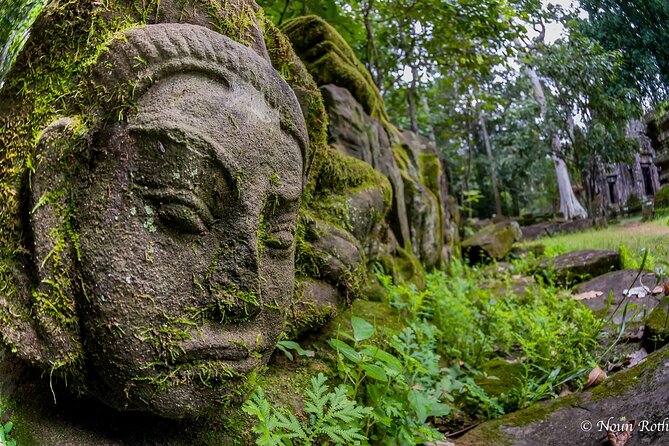
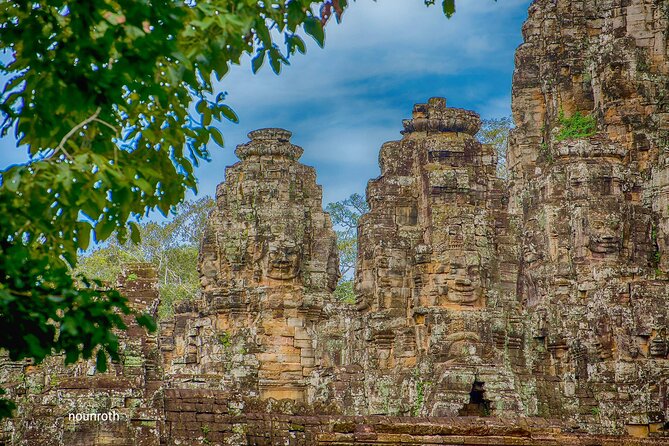
Bayon occupies the center of Angkor Thom and receives about 45 minutes. Its towers carry the famous serene faces associated with the bodhisattva Avalokitesvara. The supplied description counts 49 towers and 196 faces, although the condition and visibility of individual faces vary as you move through the temple.
Bayon is confusing in the best possible way. Towers overlap, faces appear through doorways, and the building can feel like a stone maze. Your guide’s explanation is valuable here because the temple’s layout is harder to read than Angkor Wat’s. Give yourself time to look up and around, not just straight ahead.
Royal terraces, a small sanctuary, and Phnom Bakheng
Baphuon is next, with about 45 minutes. This Hindu temple predates Angkor Wat and dates to the 11th century. A reclining Buddha was added behind it in the 16th century, giving the site more than one religious layer. The temple’s raised approach and steep structure also make it a different visual experience from Bayon.
Phimeanakas follows for about 20 minutes. This pyramid temple once formed part of the old royal area inside Angkor Thom. The visit is combined with the ancient royal enclosure wall, so it is less about a single dramatic monument and more about understanding how the royal center was organized.
The Terraces of the Elephants and the Leper King are short stops, around 15 minutes each. The Elephant Terrace was used by kings to watch returning armies and carries elephant carvings along its platform. The Terrace of the Leper King sits nearby on the north side. These are ideal places for your guide to connect stone carving with royal ceremony and public display.
Preah Palilay adds another brief detour. This small Buddhist sanctuary sits in a wooded area north of the royal enclosure. Ten minutes is not long, but the stop breaks up the larger monuments and gives you another look at the way trees and ruins meet around Angkor.
The final stop is Phnom Bakheng, where the plan allows about two hours for the climb and sunset wait. The hilltop view is the reward, but sunset access can involve waiting and the climb can feel tiring after a full day. You can skip the sunset if you prefer to finish earlier. If you stay, carry water and expect the last part of the day to be the least energetic.
Other trips out on the lake from Siem Reap:
- From Siem Reap: Kampong Phluk Floating Village Tour by Boat
★ 4.9 · 6,979 reviews - Sunset tour of Kampong Phluk stilts home village on the Tonle Sap
★ 5.0 · 4,865 reviews - Kompong Phluk Floating Village Half-Day Tour ( Morning / Sunset )
★ 5.0 · 1,494 reviews - Tonle Sap Lake & Kampong Phluk Village Half-Day Tour
★ 5.0 · 1,045 reviews
Sunrise at Angkor Wat requires an early start
Day two begins at 5:00am. You will return to Angkor Wat for sunrise, with about one hour and 45 minutes planned at the temple. This is not a casual morning. You need to be ready in the hotel lobby before dawn, and the early start comes after a long first day.
The payoff is the changing light over the temple. Sunrise also lets you see Angkor Wat before the heat of the day. The experience is popular, so do not expect solitude, but the dark-to-light transition gives the monument a different mood from your first visit.
After sunrise, the tour returns for breakfast before heading to Kampong Phluk. The schedule does not say that breakfast is included, so plan for that meal separately. Hotel pickup and drop-off, cool drinking water, and towels are included, which is welcome after two hot days.
Kampong Phluk shows another side of Siem Reap
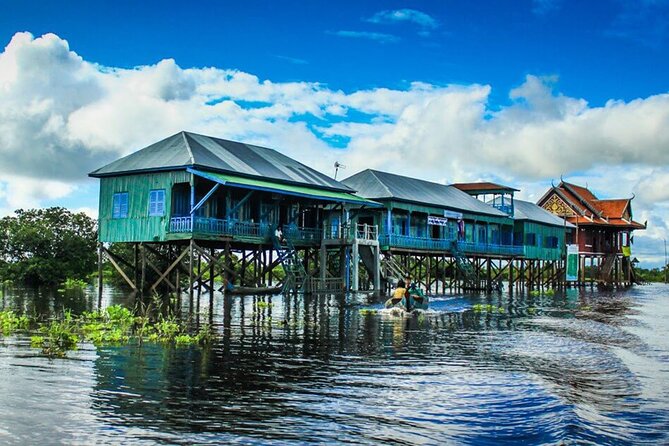
The visit to Kampong Phluk lasts about four hours and includes a private boat ride. The village sits on Tonle Sap Lake, and the boat takes you past stilt houses and fishing communities. This is an important change of subject after the temples. Instead of royal power and religious sculpture, you see homes, boats, and daily work connected to the lake.
The floating-village ticket and private boat cost an additional $20 per person. That fee is not a small detail, so include it when comparing the total price with other Siem Reap tours. The boat ride is the reason this part feels different from a standard Angkor circuit.
Four hours allows time for the boat portion and the visit, though the exact pace can depend on local conditions. The village is not a staged temple attraction. You are seeing a working community, so follow your guide’s advice about respectful photography and observation. The experience is strongest when you look beyond the floating-village label and notice how water shapes local life.
Banteay Srei rewards the long drive
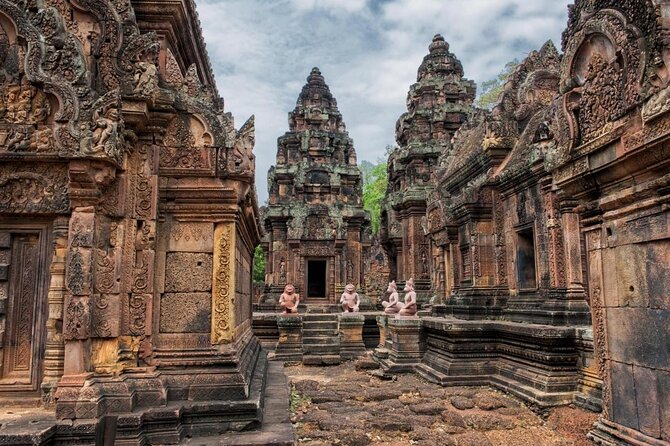
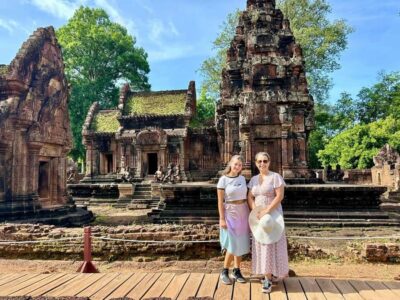
After lunch, the route heads to Banteay Srei, known as the Ladies Temple. The visit lasts about an hour. Its pink sandstone and fine carving make it one of the most detailed temples in the Angkor region, even though it is smaller than Angkor Wat.
Banteay Srei was built in the 10th century under the Hindu king Rajendravarman II and was dedicated to Hindu gods. Here, you should look closely at the door lintels, carved figures, and small-scale ornament. The stone’s warm color and delicate detail give the temple a jewel-like quality without requiring a huge footprint.
The drawback is distance. Banteay Srei takes more time to reach than the central Angkor temples, and you are visiting it late in a second long day. Still, I consider it worth the extra driving if you care about carving and want something more refined than massive.
Banteay Samre comes next for about 45 minutes. This 12th-century Hindu temple is often compared in form to Angkor Wat. Its more compact scale makes it easier to take in, and it helps you compare temple design across different sites.
Pre Rup and Banteay Kdei finish the temple circuit
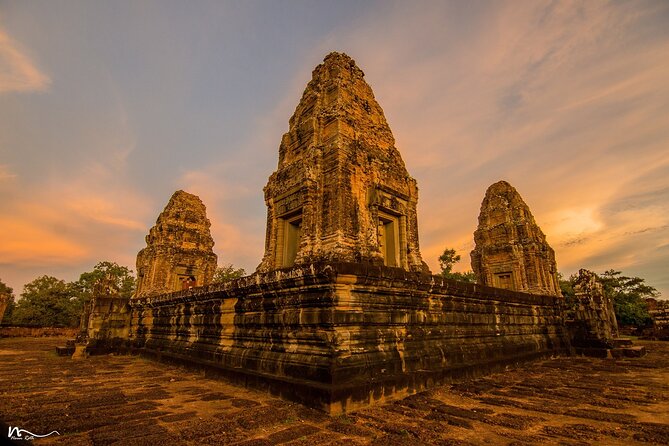
Pre Rup receives about 30 minutes. Built in the late 10th century, it was dedicated to Hindu gods and is linked with funerary beliefs. The name is commonly explained as turn the body, which connects the temple with cremation traditions described in the tour information.
This stop is useful because it shows how a temple could serve religious and royal purposes beyond simple worship. The upper levels also give Pre Rup a strong stepped profile, though you should expect another climb and more uneven stone.
The final temple is Banteay Kdei, with about 45 minutes. This Buddhist temple dates to the 12th century and shares stylistic features with Ta Prohm and Bayon. If you have already seen those sites, Banteay Kdei gives you a chance to notice the connection in a quieter setting.
By this point, the two-day plan has covered major temples, smaller ruins, royal monuments, and a lake village. It is a lot, but the sequence gives the trip a clear arc: grand Angkor Wat, wooded and enigmatic Ta Prohm, the faces of Bayon, the wider Angkor Thom complex, a dawn return, then smaller temples and Tonle Sap.
What the $166 price really means
The listed tour price is $166 per person. That covers hotel pickup and drop-off, an English-speaking licensed guide, an air-conditioned vehicle with driver, parking fees, road tolls, drinking water, and towels.
You must add $62 per person for the Angkor pass. The Kampong Phluk ticket and private boat add $20, and lunch is listed at about $5 per person depending on the menu. The practical total is therefore about $253 per person before breakfast and any other personal spending.
That is not a budget temple outing, but it is a reasonable price for a private two-day service with transport, a guide, sunrise, sunset, and the lake visit. The value depends on what you want. If you only need a vehicle and a few temple stops, it may feel expensive. If you want history explained, hotel transfers, photography help, and a route that would be difficult to organize alone, the cost is easier to justify.
The private format is especially useful for families. One family booking described the experience as smooth and easy to manage, with an itinerary that covered the major temples without feeling rushed. Another family-oriented assessment praised the private setup because the group could move together without waiting for strangers.
Who should book this tour
I would choose this tour if you have only two days in Siem Reap and want to cover the major Angkor sights without arranging separate transport. It suits families, couples, and small private groups that value an English-speaking guide and a vehicle waiting between sites.
It also suits you if photography matters. Guides including Chhay and Bun have been praised for taking excellent pictures, and a private setting gives you more control over photo stops. Guides such as Vanna and Lonn have also been praised for explaining history, religion, architecture, and culture in an engaging way.
I would hesitate if you dislike early mornings, long temple days, or repeated climbing. The 5:00am sunrise start, the sunset wait at Phnom Bakheng, and the number of stops can wear you down. You can skip the sunset, but the rest of the schedule remains full.
Free cancellation is available up to 24 hours before the start time. Changes or cancellations made inside that window are not accepted for a refund. Most people can take part, and only your group participates.
Should you book it?
Book this two-day tour if you want breadth with a private guide, especially if Angkor Wat sunrise, Ta Prohm, Banteay Srei, and Kampong Phluk are all on your list. The extra fees push the final cost well above $166, but the service includes the transport, guide, and planning that hold the trip together.
Skip it if you prefer a slow temple visit or want to choose each stop on the day. This is a full schedule. For the right kind of visitor, though, it delivers a strong first look at Siem Reap, from enormous monuments and tree-covered ruins to the homes and boats of Tonle Sap.
FAQ
How long does the tour last?
The experience lasts approximately two days. Day one begins with an 8:00am hotel pickup and can finish after sunset at Phnom Bakheng. Day two begins at 5:00am for sunrise at Angkor Wat and continues through the afternoon.
Is hotel pickup included?
Yes. Pickup and drop-off at your hotel or guest house are included.
Is this a private tour?
Yes. Only your group participates in the tour.
Is an English-speaking guide included?
Yes. The tour includes an English licensed guide. Guides named Vanna, Chhay, Bun, and Lonn have led bookings described in the supplied information.
Is the Angkor temple pass included?
No. The Angkor pass and temple admission cost $62 per person.
Is the Kampong Phluk boat ticket included?
No. The Tonle Sap Lake and floating-village ticket, including the private boat ride, costs $20 per person.
Are meals included?
No. Meals are not included. Lunch is listed at about $5 per person, depending on the menu.
Can the Phnom Bakheng sunset stop be skipped?
Yes. The sunset stop can be skipped if you do not want to wait for sunset or climb the hill.
More 2-Day Experiences in Siem Reap
- Siem Reap: Angkor Wat 2-Day Tour with Sunrise and Sunset
★ 4.9 · 4,429 reviews - Angkor 2-Day Sunset & Sunrise Small-Group Tour
★ 5.0 · 2,567 reviews - 2 Days Exclusive Temple Highlights with Sunset and Sunrise Tour
★ 5.0 · 1,157 reviews - Siem Reap: Angkor Sunrise 1- or 2-Day Guided Temples Tour
★ 4.9 · 1,132 reviews
Just added in Siem Reap
- Twilight Tastes of Siem Reap Include Dinner★ 5.0 · 13 reviews
- Ultimate Sunrise to Angkor Wat, Angkor Thom and Bayon Temple★ 5.0 · 3 reviews
- Trekking Tour at Phnom Kulen National Park from Siem Reap★ 5.0 · 3 reviews
- Full-Day Private Tour of Angkor Wat with Pick Up★ 5.0 · 12 reviews
- Private Day Trip to Angkor Temples with Expert Guide★ 5.0 · 4 reviews
- Siem Reap City Tour with War Museum and Killing Field★ 5.0 · 27 reviews
- Waterfall & River of 1000 Siva Linga- Kulen Mountain Private Tour★ 5.0 · 3 reviews
- Angkor Wat Experience Temple Pass and Siem Reap Food Tour★ 5.0 · 13 reviews
Banteay Srei & Beng Mealea Tours, compared.
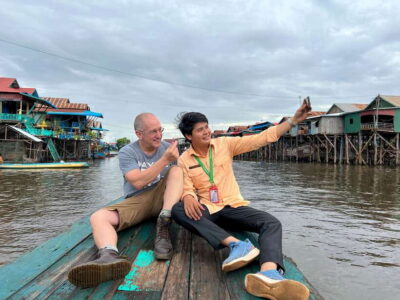
Kulen Mountain, Beng Mealea and Tonle Sap Tour
Read our review →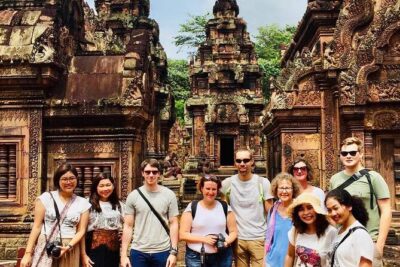
Full-Day Banteay Srei & 4 Temples – Grand Tours Join-in Tour
Read our review →
Siem Reap Tour: Angkor Wat Sunrise, Bayon, Ta Prohm, Banteay Srei
Read our review →
Koh Ker Temple Group & Beng Mealea Full-Day Join-in Tour
Read our review →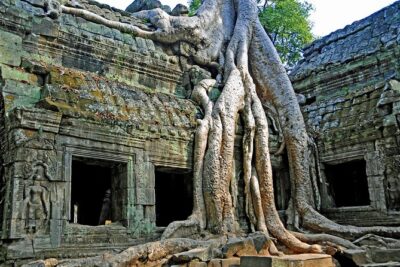
2-Day Angkor Wat With Small, Big Circuit and Banteay Srei Tour
Read our review →
3-Days Discovery Of Angkor: Waterfalls,Floating Village and Banteay Srei temple
Read our review →Browse the lists this tour appears in